> ## Documentation Index
> Fetch the complete documentation index at: https://docs.regasolutions.io/llms.txt
> Use this file to discover all available pages before exploring further.
# Watching several countries
> Open a second Vinted shop without picking the wrong site, read a price in pounds without mistaking it for a total in euros, and change rega's language knowing exactly what it moves.
Vinted is not one site: it is **26 national shops**, each with its own address, its own currency
and its own list of visible sellers. rega can watch all of them. This page explains how to open a
second one without getting it wrong, how to read a price that is not in euros, and how to change
rega's language — which is a setting **completely separate** from the country you watch.
**The one sentence to remember.** The **site being watched** (“which shop am I looking at”) and the
**origin** (“where does the seller come from”) are two different things, and rega **derives** the
first from the second. An origin that matches no shop drops the filter back to France — where the
United Kingdom does not exist. **Six of one customer's filters were in that state**, and nothing
said so: no error, no counter.
***
## The two axes people mix up
| | The **site being watched** | The **origin** |
| --------------- | --------------------------------------------------------------------------------------------------------------------------- | ----------------------------------------------------- |
| The question | Which Vinted shop am I looking at | Where the listing's seller is based |
| What it decides | The address read (`vinted.fr`, `vinted.co.uk`…), the currency accepted, and **which account the purchase will go out from** | Which listings are kept among those that come through |
| How you set it | You no longer set it: it is **derived** from the origin, then written on screen | The four **SELLER'S ORIGIN** chips in the filter form |
| Default | France | Euro area |
The site selector was **removed from the form**. There used to be two rows of country chips one
under the other — the site, then the origin — and the owner read that as a duplicate. Since then
only one row remains and the site is derived from it. That is simpler, but it moves where you have
to pay attention: you now have to **read** the line rega writes underneath.
### How rega decides which shop it looks at
```mermaid theme={null}
flowchart TD
A["You tick an origin
Euro area · Any origin · By market · By country"] --> D
B["…or you paste a Vinted link
into PASTE A VINTED LINK"] --> D
D{"Does your selection match
exactly what an account
from one country sees?"}
D -->|"yes"| M["That country becomes the site watched"]
D -->|"a single country ticked,
and Vinted has a shop there"| M
D -->|"anything else"| F["France — the default site"]
M --> L["The line “Watching Vinted …”
is written under the selector"]
F --> L
L --> H["① The Vinted shop actually read"]
L --> I["② The currency the filter accepts"]
L --> K["③ The account allowed to pay"]
```
**The trap, measured in production on 14 August.** A customer had ticked “United Kingdom” and
“United States” as the origin. Under the old rule those two countries matched no shop, so the site
stayed **France**: their filters read `vinted.fr` **and** threw away listings priced in pounds
before even looking at them. They could not structurally find anything British — and they filled
up with European listings instead.
The derivation has been fixed since, and rega now repairs an impossible pair on its own. But **the
rule of the game is unchanged: one filter = one market.**
***
## Opening a second country, step by step
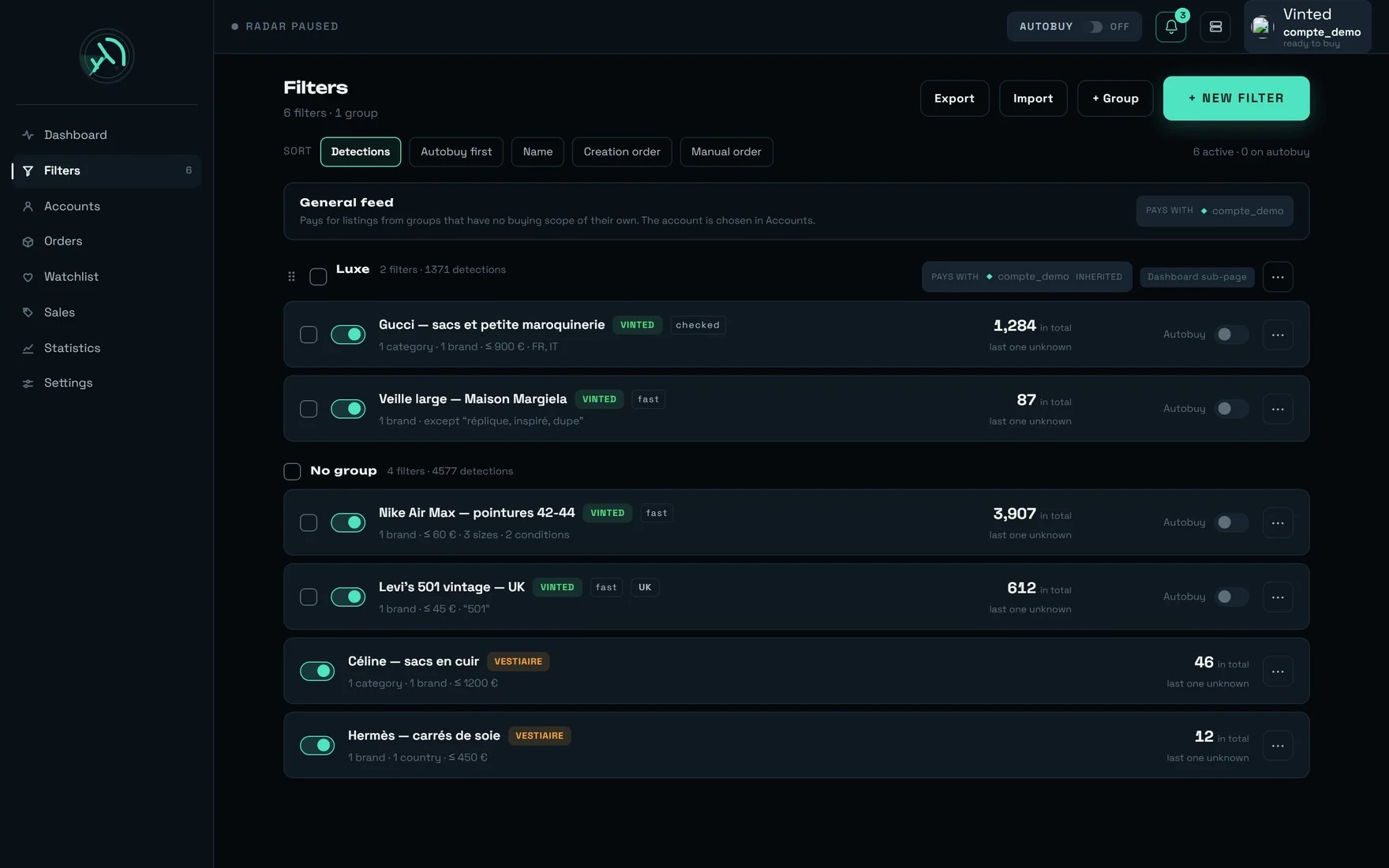 The button sits at the top of the Filters screen (badge **6** on the annotated capture further
down). It first asks which marketplace you are working on, then opens the form.
The panel that opens says:
“A market = what an account from that country sees. Choosing a market keeps the sellers it can
reach.”
Pick the country — **United Kingdom**, for instance. rega then writes, under the selector:
“A United Kingdom account (vinted.co.uk) sees 2 countries:” followed by the **United States**
and **United Kingdom** chips.
That is **the only thing on screen** telling you which shop will actually be read. If it says
“Watching Vinted France.” when you wanted the United Kingdom, your country selection matches no
shop — go back before you save.
With no account from that country, the form shows:
“No United Kingdom account is connected: this filter will spot listings, but no purchase can go
out. Connect a United Kingdom account from the Accounts page.”
This warning **blocks nothing**: preparing filters before accounts is a legitimate order of
work. But as long as no British account is connected, detection will work and the purchase will
**never** go out.
Back in the list, the filter carries a **Site: United Kingdom** marker. French filters carry
none — that is deliberate: a marker that is always there stops being a marker.
**The safest shortcut: paste a link.** The **PASTE A VINTED LINK (OPTIONAL)** field, right at the
top of the form, reads the country **from the address itself**. Pasting a `vinted.co.uk/catalog?…`
address creates a British filter without you ticking anything, and the line “Watching Vinted United
Kingdom.” appears on its own. It is the method that goes wrong least often.
### Which origin to tick
```mermaid theme={null}
flowchart TD
Q0{"Do you want to watch
The button sits at the top of the Filters screen (badge **6** on the annotated capture further
down). It first asks which marketplace you are working on, then opens the form.
The panel that opens says:
“A market = what an account from that country sees. Choosing a market keeps the sellers it can
reach.”
Pick the country — **United Kingdom**, for instance. rega then writes, under the selector:
“A United Kingdom account (vinted.co.uk) sees 2 countries:” followed by the **United States**
and **United Kingdom** chips.
That is **the only thing on screen** telling you which shop will actually be read. If it says
“Watching Vinted France.” when you wanted the United Kingdom, your country selection matches no
shop — go back before you save.
With no account from that country, the form shows:
“No United Kingdom account is connected: this filter will spot listings, but no purchase can go
out. Connect a United Kingdom account from the Accounts page.”
This warning **blocks nothing**: preparing filters before accounts is a legitimate order of
work. But as long as no British account is connected, detection will work and the purchase will
**never** go out.
Back in the list, the filter carries a **Site: United Kingdom** marker. French filters carry
none — that is deliberate: a marker that is always there stops being a marker.
**The safest shortcut: paste a link.** The **PASTE A VINTED LINK (OPTIONAL)** field, right at the
top of the form, reads the country **from the address itself**. Pasting a `vinted.co.uk/catalog?…`
address creates a British filter without you ticking anything, and the line “Watching Vinted United
Kingdom.” appears on its own. It is the method that goes wrong least often.
### Which origin to tick
```mermaid theme={null}
flowchart TD
Q0{"Do you want to watch
ANOTHER Vinted shop?"}
Q0 -->|no| Q1{"Do you want to exclude
countries wholesale?"}
Q1 -->|no| ZE["“Euro area” — free,
it is the default"]
Q1 -->|yes| PP["“By country” — about 0.7 s
of extra detection time"]
Q0 -->|yes| PM["“By market” → the country you want"]
PM --> V["Re-read “Watching Vinted …”"]
V --> CPT{"Is an account from
that country connected?"}
CPT -->|no| AV["Detection yes · purchase no"]
CPT -->|yes| OK["Detection AND purchase"]
```
The four chips, word for word, and what they cost:
| Chip | What it does | Cost |
| -------------- | ---------------------------------------------------------------------------------------------- | ------- |
| **Euro area** | “Euro area — the fastest.” — keeps listings whose seller prices in euros. This is the default. | Free |
| **Any origin** | “Any origin — the fastest.” — no restriction on the seller's country. | Free |
| **By market** | Keeps what an account from the chosen country sees. This is the chip that opens another shop. | \~0.7 s |
| **By country** | You tick countries one by one. | \~0.7 s |
**“By market” and “By country” cost exactly the same.** The form says so: “Country and region are
one and the same criterion here: the seller's origin, whether chosen by market or country by
country. The cost is the same either way.” Do not go looking for a third price.
**The good news that cancels the cost.** If your filter already carries a **category**, restricting
the origin costs nothing at all — the form writes it out: “This filter already carries a category:
restricting the origin adds no delay. Both criteria are settled together, their costs do not add
up.” On a filter with a category, **go down to the country without hesitating**.
***
## The 26 shops
| Zone | Countries |
| -------------------------------- | ------------------------------------------------------------------------------------------------------------ |
| Western and Southern Europe (10) | France · Austria · Belgium · Germany · Italy · Spain · Portugal · Netherlands · Luxembourg · Ireland |
| Central and Northern Europe (11) | Poland · Czechia · Slovakia · Croatia · Slovenia · Denmark · Sweden · Estonia · Latvia · Finland · Lithuania |
| South-Eastern Europe (3) | Greece · Hungary · Romania |
| English-speaking (2) | United Kingdom (`vinted.co.uk`) · United States (`vinted.com`) |
**The address cannot be guessed from the country.** The United Kingdom is on `vinted.co.uk`, the
United States on `vinted.com` — not on `vinted.gb` or `vinted.us`. And the list obeys no
geographical rule: the euro area, the European Union and Vinted's shops do not overlap. If a
country looks missing, it is because it has no Vinted shop.
If a country does not appear in the “By market” list, the panel shows:
“Markets unavailable — use “By country”.”
***
## A market does not only see its own country
This is the least intuitive point on the whole page, and the one that manufactures mistakes.
> **A British account sees exactly two countries: the United Kingdom and the United States.**
So “By market → United Kingdom” ticks **two** countries, not one. That is normal — it is what an
account over there really sees — and the form spells it out: “A United Kingdom account
(vinted.co.uk) sees 2 countries:”.
The measured reach of the three markets that come up most:
| Market | Number of seller countries visible |
| -------------- | ---------------------------------- |
| France | 10 |
| Poland | 13 |
| United Kingdom | 2 |
**What you must never do: mix two countries from two markets.** Ticking “United Kingdom” +
“Germany” produces a selection no shop covers. rega then falls back to France, and your filter
looks at `vinted.fr`, where the United Kingdom does not exist.
**Two countries from two markets = two filters.** There is no other method.
A “France + Germany” filter, on the other hand, **stays** on the French market, and that is
deliberate: Germany is inside what a French account sees, so the pair makes sense. rega only
auto-corrects **impossible** pairs — those whose set of possible listings is empty by construction.
Wherever your choice makes sense, it is respected.
***
## Currencies: two prices on the same card
**rega never converts anything.** That is a decision, not a gap: we do not have the day's rate, and
inventing it would mean displaying a figure nobody has measured.
A foreign listing therefore carries **two distinct amounts**, and mixing them up is expensive:
What the seller wrote, **in their currency**. On a British listing: `£10`.
What **you** will pay, fees included, in **your** currency. Rendered separately, right beside it.
**Do not compare those two figures as if they were in the same currency.** The first is the price
shown by the seller, the second is the amount that gets debited. The defect that led to this rule
is instructive: an item listed at **£10 was displayed as €11.84** — the seller's number, painted
with the buyer's symbol. Across the 217 cards in that measurement, **217 already carried the
seller's currency**; only the number was missing.
### The currency settles the country for free
This is the mechanism that makes multi-country watching viable. A currency used by **a single**
shop points at its country unambiguously — and that information arrives **with the listing**, with
nothing to ask for.
**Measured on 14 August across 90 listings from six shops:**
| Currency seen | Countries derived |
| ------------- | --------------------------------------------------------------------------------------------------------------- |
| `GBP` | United Kingdom — **28 times out of 28** |
| `USD` | United States — **4 times out of 4** |
| `EUR` | France, Italy, Spain, Germany, Netherlands, Belgium, Ireland, Austria — **eight countries, so never derivable** |
Eight currencies point at a single country this way: `PLN`, `CZK`, `DKK`, `SEK`, `HUF`, `RON`,
`GBP`, `USD`. The euro never does: **18 of the 26 shops** use it.
**What that is worth, in time.** When the currency is enough to settle the question, the card
appears in **\~0.15 s** instead of waiting for a check measured at **15 s**. That is why a British
filter is nearly as fast today as a French one, even though it carries a country constraint.
**The worldwide stream is not mostly in euros.** Across 395 real births:
`EUR` 212 · `GBP` 95 · `PLN` 41 · `USD` 16 · `HUF` 10 · `CZK` 7 · `RON` 6 · `SEK` 4 · `DKK` 4 —
that is **46% of the stream outside the euro area**. A customer who stays on “Euro area” therefore
ignores, by construction, close to half of everything born on Vinted.
***
## Comparing prices across countries
This is the question every shop asks when it opens a second market: “my €200 ceiling — what is it
worth on a British filter?”. The answer depends on **which** ceiling.
### The three ceilings, from widest to narrowest
| Ceiling | Where | Scope | Default |
| -------------------- | -------------------------------------- | --------------------------------------------------------- | ------------------------------------------------- |
| **Purchase ceiling** | Settings → **Buying** | **All** purchases, manual and automatic, on every machine | **Empty** — no ceiling |
| **Cap per item** | The **AUTOBUY** panel on the dashboard | Automatic purchases launched from this browser | **€120**, and remembered **in this browser only** |
| A **filter's** cap | The filter form | The automatic buying **of that filter** | Empty |
The **Purchase ceiling** describes itself: “Above this amount, the purchase is refused and you are
told. Empty = no ceiling.” Once set, it also refuses an item whose price cannot be read.
**A filter's cap really is in euros, including on a foreign filter.** Its `€ max` label is accurate:
it is compared against the price as reported in your currency, not against the price shown by the
seller. A British filter capped at €200 will therefore correctly refuse anything that would cost
you more than €200, whatever number is written in pounds on the listing.
**The filter's MIN PRICE / MAX PRICE bounds, however, are not always in euros.**
On a filter that carries a **category with no brand and no keyword at all**, the selection is done
by Vinted itself, **in the shop's currency**. On a British filter of that kind, a `MAX PRICE (€)`
set to `100` is therefore compared against **100 pounds**, even though the label shows the euro
symbol in both languages.
**What to do:** on a foreign “category only” filter, enter your bounds in the country's currency.
As soon as the filter carries **a brand or a keyword**, the question disappears: the bounds become
euros again.
**Amounts in several currencies do not add up, and rega refuses to pretend otherwise.** On tracking
that mixes sales in zlotys, pounds and euros, the screen does not manufacture a single total: it
shows **one sum per currency**, and the column's tooltip reminds you that two currencies never add
up. An honest cell rather than a false figure.
***
## What can refuse a foreign purchase
A foreign filter always detects. It is the **purchase** that can be refused, and rega names the
exact cause every time rather than serving one vague catch-all refusal.
| When | The exact sentence |
| --------------------------------------------------------------------- | ------------------------------------------------------------------------------------------------------------------------- |
| No account from that country is declared | « aucun compte rattaché au pays de cette annonce n'est déclaré. » |
| You named an account, and it is from another country | « le compte désigné n'est pas rattaché au pays de cette annonce — un achat ne peut partir que d'un compte du même pays. » |
| You named a group, and none of its accounts is from the right country | « aucun compte de ce groupe n'est rattaché au pays de cette annonce. » |
| At payment time, the last lock | « Achat interrompu : ce compte n'est pas rattaché au pays de cette annonce. » |
| At payment time, the account's country cannot be read | « Achat interrompu : impossible de vérifier que ce compte peut acheter sur ce site. » |
**These five sentences appear in French, even when rega is in English.** They are the only refusals
in the product that do not yet have an English version — which is exactly why we quote them here as
they will actually reach you. Every other purchase refusal is bilingual.
**The last two arrive before any debit.** If you see them, **nothing has been paid**. The last one
is special: it is the only place in rega that **refuses out of ignorance**. Not knowing which
country an account belongs to is not a licence to let it pay — missing a purchase costs one item,
paying from the wrong country can cost the account.
**A payment is never replayed after an interruption at payment time.** The outcome there is
unknown, and replaying would risk a double debit. You will be told, but rega will not retry on its
own.
***
## Changing rega's language
This setting is **entirely independent** of the countries you watch. Switching rega to English
changes no filter, no country, no shop. And watching Vinted UK does not put rega into English.
 | № | Control | What it does |
| ----- | ---------------------- | ----------------------------------------------------------------------------------- |
| **3** | **Administration** | REGA staff only — this button does not appear on your account. |
| **9** | The **Appearance** tab | This is the tab that holds the **Language** section, above the appearance settings. |
The **Language** section is the first one in the panel. Its description:
“This choice follows your account, not this device: your e-mails go out in this language.”
Each chip carries a small flag. The row spells out what is covered:
“The interface, the messages and the e-mails.”
A short message confirms, **in the language you switched to**: “Language — English” when you
move to English, “Langue — Français” when you go back to French. If the acknowledgement comes
out in the old language, the switch did not take.
### What the switch changes, and what it does not
The screen, **with no reload**. The refusal messages served by our servers. **Your e-mails and
your saved notifications.** Vinted's own labels (categories, conditions, sizes). Number
formatting — “4 213” becomes “4,213”. Country and market names, and the **order** of their list.
No watched country. No shop. No filter. No paying account. The language **never moves** what a
filter looks at — otherwise it would also move which account pays.
```mermaid theme={null}
sequenceDiagram
participant V as You
participant E as The rega screen
participant C as Your rega account
participant M as Your e-mails
Note over E,C: On every load, the screen adopts
| № | Control | What it does |
| ----- | ---------------------- | ----------------------------------------------------------------------------------- |
| **3** | **Administration** | REGA staff only — this button does not appear on your account. |
| **9** | The **Appearance** tab | This is the tab that holds the **Language** section, above the appearance settings. |
The **Language** section is the first one in the panel. Its description:
“This choice follows your account, not this device: your e-mails go out in this language.”
Each chip carries a small flag. The row spells out what is covered:
“The interface, the messages and the e-mails.”
A short message confirms, **in the language you switched to**: “Language — English” when you
move to English, “Langue — Français” when you go back to French. If the acknowledgement comes
out in the old language, the switch did not take.
### What the switch changes, and what it does not
The screen, **with no reload**. The refusal messages served by our servers. **Your e-mails and
your saved notifications.** Vinted's own labels (categories, conditions, sizes). Number
formatting — “4 213” becomes “4,213”. Country and market names, and the **order** of their list.
No watched country. No shop. No filter. No paying account. The language **never moves** what a
filter looks at — otherwise it would also move which account pays.
```mermaid theme={null}
sequenceDiagram
participant V as You
participant E as The rega screen
participant C as Your rega account
participant M as Your e-mails
Note over E,C: On every load, the screen adopts
the language stored on the ACCOUNT
C-->>E: the signed-in person's language
V->>E: Settings → Appearance → “English”
E-->>V: ① the screen switches immediately
E->>C: ② the choice is stored on the account
C->>M: the next e-mails go out in English
Note over E,C: If ② fails, it costs exactly ONE thing:
the next e-mail goes out in the old
language. The screen did switch.
```
**The language belongs to the person, not to the company.** Two people in the same customer space
can read rega in two different languages, each receiving their e-mails in their own. We translate
for a reader, not for an organisation.
**The language follows the account; the theme follows the device.** Switching the language from
your phone also changes your desktop and your e-mails. Switching the dark/light theme does not —
the appearance settings apply “to this device only”.
***
## Our advice
Never tick two countries belonging to two different shops in the same origin: the selection
matches no shop and rega falls back to France. To watch the United Kingdom **and** Germany,
make **two filters**. It is slightly more work up front, and it is the only configuration that
works.
Since the site selector was removed, that line is **the only** thing on screen that tells you
where you are really looking. Get into the habit of resting your eyes on it just before you
click Save, the way you check a recipient before sending a transfer.
rega does not accept a **declared** country: it **observes** an account's country on its first
successful connection. Until that has happened, a freshly added account is treated as French —
the “No United Kingdom account is connected” warning stays up, and a British purchase would be
refused. Add the account **and connect it**.
The “no account from that country” warning **warns without blocking**: preparing filters before
accounts is a legitimate order of work. The risk is one of timing: with no account from that
country, detection will work perfectly and the refusal will only arrive **at drop time**, when
the item is already gone. Close the loop before your first real hunt.
The **PASTE A VINTED LINK (OPTIONAL)** field reads the country from the address. Run your search
on `vinted.co.uk`, copy the results page address, paste it: the filter is born British, with the
search's categories and brands thrown in. It is the method that goes wrong least often. Note
that `time`, `page` and the sort order contained in the address are deliberately ignored —
copying them across has no effect.
“Euro area” is slightly wider than what can really be bought from France: it lets a few extra
listings through, it never makes you miss one. Switching to “By country” to get “France +
Belgium + Germany” costs you **\~0.7 s** of detection on every listing, for a sort you can do by
eye on the card. Keep “By country” for **wholesale exclusion**, not for cosmetic precision.
This is the only area of the product where the “(€)” label can mislead. It only concerns filters
carrying a category **with no brand and no keyword**. Add a brand or a keyword and the problem
disappears — with a speed gain thrown in.
It is the only capacity lever that is **free**, and opening a second country mechanically
increases the stream to sort. Measured across 675 real listings: with a floor at **€10**, only
**42%** of the stream remains; at **€20**, **23%**; at **€50**, **7%**.
⚠️ The floor applied is **the lowest across all your active filters**: a single filter without a
floor cancels the benefit for all the others.
The **Estimate** button always measures the **French** catalogue, whatever shop is being
watched. On a British filter, the figure it returns therefore has **no value for that filter**.
Judge a foreign filter on its detection counter after a few hours, not on its estimate.
A group's country is fixed **at creation** and cannot be edited afterwards — like the
marketplace. A group whose country was flipped would fill up with accounts from the other
country. So create **one group per country**; if you got it wrong, delete and recreate.
The sign-in screen has **no** language switch: it shows in French until you are identified, and
your choice only takes effect once you are signed in. For an English-speaking colleague, send
them their **invitation link** — that one opens in English by default — rather than the bare
sign-in address.
The screen switches **before** the choice is stored, and does not wait for confirmation: that is
what makes the switch instant. The price of that choice is that a failed save is invisible on
screen — it shows up on the **next e-mail**. A language round-trip from a fresh session is
enough to re-engrave the choice.
***
## What surprises people
A card's link always points at `vinted.fr`, including for a British item — Vinted's listing
numbering is worldwide, so the address “works” anyway. To see the listing as the seller
published it, with its price in pounds and its English labels, replace `vinted.fr` with
`vinted.co.uk` in the address bar.
**We have not measured** exactly what Vinted does with a British listing number served on `.fr`
— redirect, converted price or missing page. We would rather say so than assert it.
That is deliberate: the name of a language is always written **in that language**. Otherwise you
cannot recognise it when you are lost in the other one — which is precisely the moment you go
looking for that button.
It is never read aloud by a screen reader. A flag names a **country**, not a language: English
does not belong to the United Kingdom.
In French “Royaume-Uni” files under R; in English “United Kingdom” files under U. An
alphabetical list that is not alphabetical in the language you are reading is harder to read
through than an unsorted one, because it promises an order it does not have. France stays at the
top in both languages.
This is a known shortcoming, accepted for now: the sentences quoted above under “What can refuse
a foreign purchase” do not yet have an English version. An English-speaking customer will read
them in French. The rest of the purchase refusals are properly bilingual.
When a word has no English version, rega shows the French rather than a blank or a code. As a
result you only notice **by switching**, on a screen you had not opened. If you come across
French inside the English interface, that is a real defect — please report it.
rega is **lenient when reading** and **strict when writing**. A filter whose country has become
unreadable is read back as France rather than vanishing; but trying to save a country that does
not exist is refused outright: “That Vinted country is not available. Pick one from the list.” A
made-up value accepted on write would later be read back as a **choice** — and would decide
which account pays.
That is normal: country names and Vinted's labels are fetched again in the new language. If a
country name, a colour or a condition **stays** in the old language for more than a few seconds,
that is not the expected behaviour — it is a defect worth reporting.
***
## On a phone
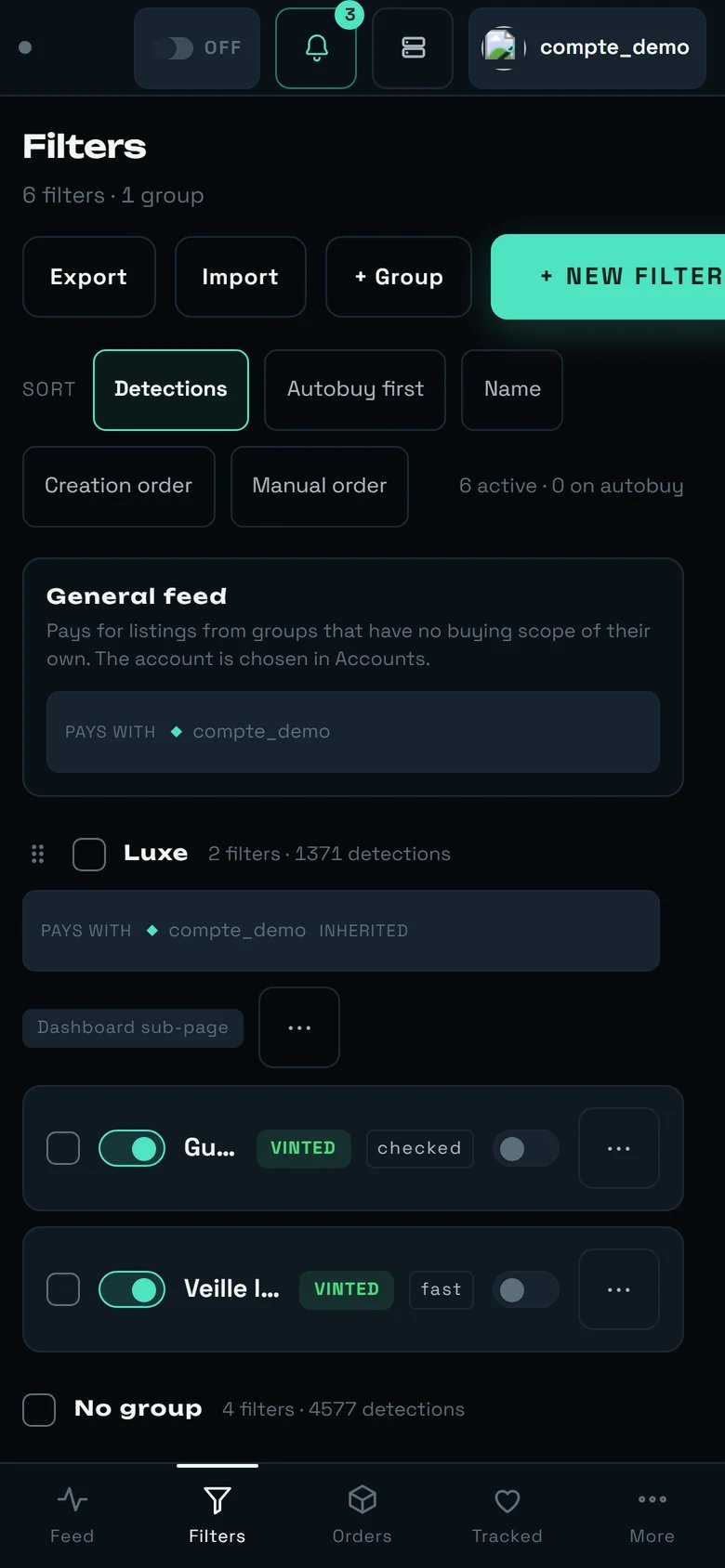 Nothing is lost on a small screen, but two things change:
* **The language switch lives in Settings, and that is precisely because of phones.** It used to sit
in the header, where it **disappeared below 430 px wide** — which locked anyone working on a
phone into the language of their last visit on a large screen. It now sits in **Settings →
Appearance**, reachable everywhere.
* **The filter form stacks**: the origin selector and the “Watching Vinted …” line end up one under
the other rather than side by side. The line stays right below the chips — scroll down to it
before saving; that is the gesture that avoids the most expensive mistake on this page.
***
## What rega cannot do yet
We would rather write it down than let you discover it.
rega does observe each account's country, and uses it to pick the payer. But no screen displays
it. If the “No United Kingdom account is connected” warning persists after you have added a
British account, the most likely cause is that it has not yet completed its first connection —
but you cannot check that yourself today.
The server knows how to carry it; no screen sends it yet.
Only **France (euro)** and **United Kingdom (pound)** have been verified against real traffic.
The other 24 are set from the country's official currency. That is very probably right, but we
will not write it down as a measurement until it is one — and we will check before opening a
third shop.
Accounts from another country deliver to your existing French addresses. The only prerequisite
for buying abroad is **an account from that country**, not an address over there.
The guard rail exists on the server but never reaches the screen. Nobody will stop you if a
foreign filter brings back a country's entire catalogue — it is up to you to bound it, first and
foremost with a **MIN PRICE** (advice 8).
***
## Going further
The detail of every control in the form: categories, brands, keywords, sizes, and what each
criterion costs.
Adding an account from another country, connecting it, and reading its state.
The purchase ceiling, the automatic pick-up point, and the Appearance tab where the language
lives.
Where the cards land, and where the seller's price is read next to the delivered total.
Nothing is lost on a small screen, but two things change:
* **The language switch lives in Settings, and that is precisely because of phones.** It used to sit
in the header, where it **disappeared below 430 px wide** — which locked anyone working on a
phone into the language of their last visit on a large screen. It now sits in **Settings →
Appearance**, reachable everywhere.
* **The filter form stacks**: the origin selector and the “Watching Vinted …” line end up one under
the other rather than side by side. The line stays right below the chips — scroll down to it
before saving; that is the gesture that avoids the most expensive mistake on this page.
***
## What rega cannot do yet
We would rather write it down than let you discover it.
rega does observe each account's country, and uses it to pick the payer. But no screen displays
it. If the “No United Kingdom account is connected” warning persists after you have added a
British account, the most likely cause is that it has not yet completed its first connection —
but you cannot check that yourself today.
The server knows how to carry it; no screen sends it yet.
Only **France (euro)** and **United Kingdom (pound)** have been verified against real traffic.
The other 24 are set from the country's official currency. That is very probably right, but we
will not write it down as a measurement until it is one — and we will check before opening a
third shop.
Accounts from another country deliver to your existing French addresses. The only prerequisite
for buying abroad is **an account from that country**, not an address over there.
The guard rail exists on the server but never reaches the screen. Nobody will stop you if a
foreign filter brings back a country's entire catalogue — it is up to you to bound it, first and
foremost with a **MIN PRICE** (advice 8).
***
## Going further
The detail of every control in the form: categories, brands, keywords, sizes, and what each
criterion costs.
Adding an account from another country, connecting it, and reading its state.
The purchase ceiling, the automatic pick-up point, and the Appearance tab where the language
lives.
Where the cards land, and where the seller's price is read next to the delivered total.