> ## Documentation Index
> Fetch the complete documentation index at: https://docs.regasolutions.io/llms.txt
> Use this file to discover all available pages before exploring further.
# The emails we send you
> The sixteen occasions on which reshipping writes to you: what sets each letter off, what it says word for word, what it asks of you — and the rule that decides everything we deliberately never write.
Reshipping writes to you on **sixteen occasions** over the life of a parcel, and not one more. Nine of those letters never ring the bell in the app, deliberately: they carry the facts you learn while you are **not** looking at a screen — at night, in another time zone, away from the tab. This page lists all sixteen, what each one says, where its button lands, and what it expects from you.
 ***
## Sixteen occasions, and not one more
The list is a closed one. A new event in the service writes to nobody until it has been added to it — that is the safe default for outgoing mail, and it is why this page can claim to be exhaustive.
**The admission test, in the words it was written with.** An event earns a letter only when **you must act**, or when **your money or your goods have moved while you were not looking at the screen**. Everything else stays where it happened: in your space, on the item, on the parcel.
And the reason for the test: a service that writes at every change of state ends up in the junk folder, and the one message that mattered is lost in there with the others.
The counterpart is why we write at all. A notification in the app only reaches somebody who is looking — and the clients of a reshipping service are, by construction, elsewhere. That is the whole argument for an email, and it is also the argument for keeping the list short.
## One parcel's life, and every letter it sets off
```mermaid theme={null}
flowchart TD
A["We open the service
***
## Sixteen occasions, and not one more
The list is a closed one. A new event in the service writes to nobody until it has been added to it — that is the safe default for outgoing mail, and it is why this page can claim to be exhaustive.
**The admission test, in the words it was written with.** An event earns a letter only when **you must act**, or when **your money or your goods have moved while you were not looking at the screen**. Everything else stays where it happened: in your space, on the item, on the parcel.
And the reason for the test: a service that writes at every change of state ends up in the junk folder, and the one message that mattered is lost in there with the others.
The counterpart is why we write at all. A notification in the app only reaches somebody who is looking — and the clients of a reshipping service are, by construction, elsewhere. That is the whole argument for an email, and it is also the argument for keeping the list short.
## One parcel's life, and every letter it sets off
```mermaid theme={null}
flowchart TD
A["We open the service
on your workspace"] --> B["“Your reshipping service is open”
two gestures asked"]
B --> C["A purchase reaches the warehouse"]
C --> D["“… has arrived at our warehouse”
nothing asked"]
D --> E["We inspect it and publish the photos"]
E --> F["“tell us if everything is fine”
letter AND bell — reply before the deadline"]
F --> G{"Do you reply?"}
G -->|"you report an issue"| H["“We have opened a dispute”
then “Dispute closed”"]
G -->|"you approve"| I["The item is in your warehouse"]
G -->|"you do not reply"| J["Approved for you —
letter AND bell"]
J --> I
H --> I
I --> K["Free storage runs out
“Your free storage ends in …”
letter AND bell"]
K --> L["You group items into a parcel
and ask for a quote"]
L --> M["“Your shipping quotes are ready”
letter AND bell — choose and pay"]
M --> N["“Payment received — your parcel is on its way”"]
N --> O["“Your parcel … has left”
with the tracking number"]
O --> P["Delivered — the bell rings,
no letter is sent"]
style O fill:#1f6f43,color:#fff
style P fill:#7a4b00,color:#fff
```
***
## Every letter we send, in one table
Four of these are set off by no gesture at all, but by a date passing: the clock, not a person. They do not leave at the instant that date falls, and we deliberately publish no figure for how fast a letter reaches you: nothing here measures it.
| What happens | Subject line | Set off by | What it asks of you |
| ---------------------------------------------------------------- | ---------------------------------------------------------- | ------------------- | ------------------------------------------------------------------------------------------ |
| Your service is opened — and only if it was closed before | `Your reshipping service is open` | Our team | Two gestures, once: tick the accounts, and copy our address onto them, phone included |
| Our delivery address changes | `Important: our delivery address has changed` | Our team | Update the address on your buying accounts now |
| An item physically arrives at the warehouse | `“{titre}” has arrived at our warehouse` | The warehouse | Nothing. It announces, and it announces the next one |
| We publish the inspection of an item | `Your item has arrived — tell us if everything is fine` | The warehouse | Reply before the deadline: approve, or report an issue |
| The reply window closes and we approve the item for you | `“{titre}” has entered the warehouse` | The clock | Nothing. The item is in your warehouse, and the letter says how long its free storage runs |
| We close a service request you made on an item | `We have answered your request` | Our team | Open your space — the answer is not in the letter |
| We file your report as a dispute with the marketplace | `We have opened a dispute for “{titre}”` | Our team | Nothing, and it says so |
| The dispute is settled, whichever way | `Dispute closed — “{titre}”` | Our team | Nothing. It carries the outcome, and the amount when there is one |
| A quote is issued for one of your parcels | `Your shipping quotes are ready` | Our team | Choose a carrier, and pay |
| Every live quote on a parcel has passed its validity date | `Your quote has expired` | The clock | Ask for a new one whenever you like |
| Your payment for a quote is recorded | `Payment received — your parcel is on its way` | Your payment, or us | Nothing. It is the receipt |
| We hand the parcel to the carrier | `Your parcel {reference} has left` | Our team | Nothing. It carries the tracking number |
| A parcel is cancelled and its contents returned to stock | `Your parcel {reference} has been cancelled` | You, or us | Nothing. Your items are back in the warehouse |
| An item crosses a reminder tier before free storage ends | `Your free storage ends in {jours} day(s)` | The clock | Group and ship before the free period runs out |
| An item passes the abandonment threshold and becomes a candidate | `Action needed: “{titre}” is about to leave the warehouse` | The clock | Put the item in a parcel and ask for a quote |
| An item is marked abandoned — a final state | `“{titre}” has left your warehouse` | Our team | Nothing. It states a fact |
**Seven of the sixteen ask you for a gesture.** One more asks only that you come and read. The other eight ask nothing at all — and one of them says so in as many words.
***
## What each letter says, family by family
**`Your reshipping service is open`** opens on “Your reshipping space is open. You can now have your purchases delivered to us: we receive them, we inspect them, and we reship them to you, grouped, wherever you want.” Then the two gestures, spelled out: “Two things to do once: tick the accounts whose purchases should come to us, and set our address — phone number included — as the delivery address on those accounts.” Its button reads “Open my space”.
It goes out **only when the service was closed before**. Switching it on again on a workspace that is already open writes to nobody: a switch that wrote on every click becomes harassment.
**`Important: our delivery address has changed`** is one of the two subject lines of the sixteen that carry a warning word — the other is the last reminder before abandonment — and it earns it: “The address to have your purchases delivered to has changed. Update it on your accounts now: a parcel sent to the old address will not reach us.” Then: “Copy it in full, phone number included — carriers use it for delivery notices.” Its button, “See the new address”, opens **How it works**, because that is the page carrying the address.
Only **six postal fields** set it off: recipient, address lines, city, postal code, country, phone. Renaming a warehouse or changing its internal instructions changes nothing you can see, so it writes to nobody. And it reaches every workspace whose service is **open** — a closed one is not told.
**`“{titre}” has arrived at our warehouse`** is the calm one: “We received “`{titre}`”. It is registered, weighed and stored.” Then, so that you are not surprised by the next letter: “Our inspection follows: you will get the photos and our report, and you will then have a window to tell us whether everything is fine.” Button: “See the item”, on that exact item.
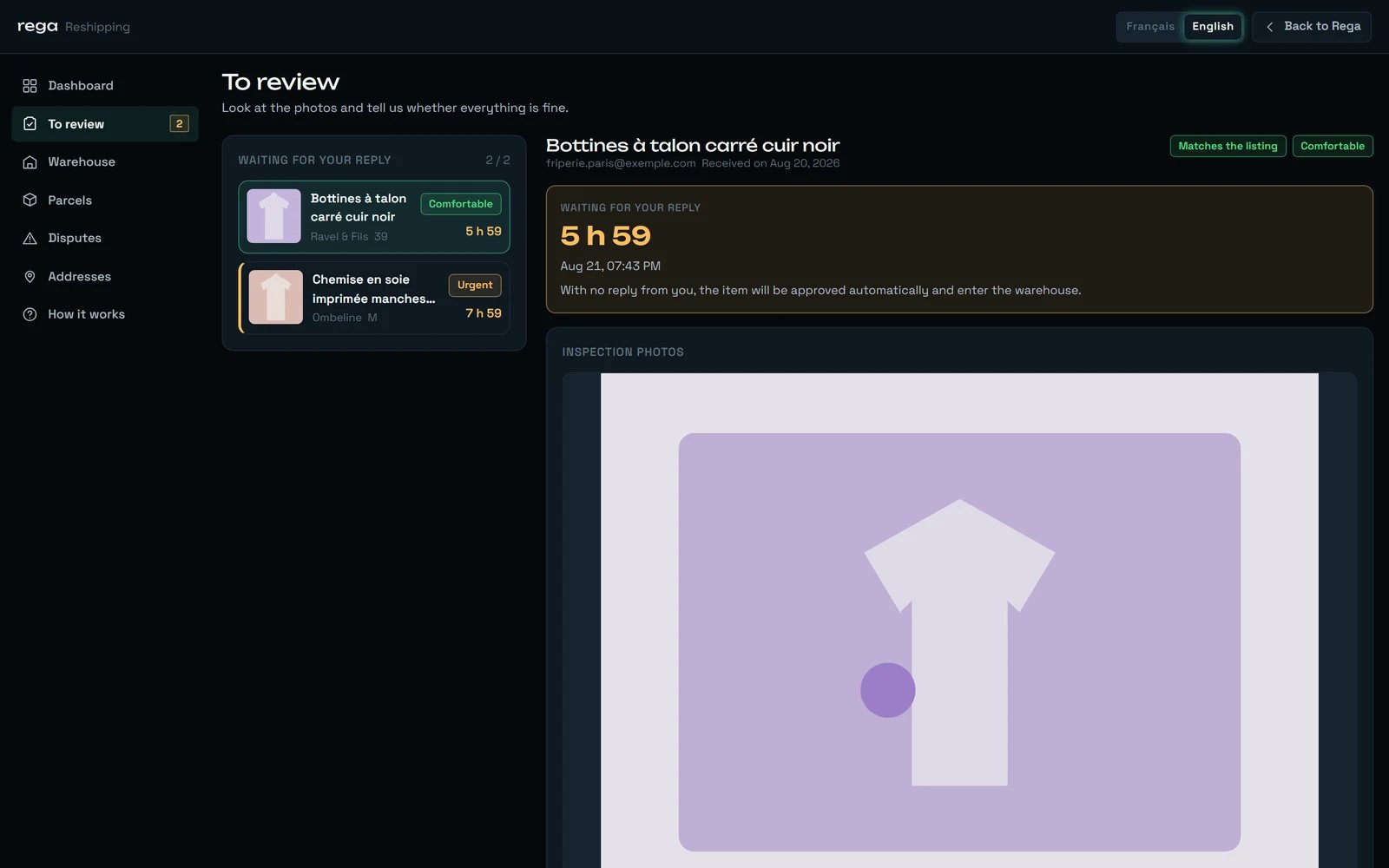
**`Your item has arrived — tell us if everything is fine`** is **the letter that commits you**, and the only one in the whole service written in two versions. Both open the same way: “We received “`{titre}`” and inspected it. The photos and our report are waiting for you.”
Then it splits. While a claim with the seller is still possible: “You have until `{echeance}` to reply. With no reply from you, the item will be approved automatically and enter the warehouse.” When the claim window has already closed: “The claim window with the seller has already closed for this item: you can still report an issue, but it cannot lead to a claim.” Button: “See the inspection”.
It is the only letter of the sixteen written in two versions, and the reason is the clock: it is the one message where the cost of not reading it in time is a claim you can no longer file.
**`“{titre}” has entered the warehouse`** is what comes next when you say nothing: “The reply window closed without hearing from you: “`{titre}`” was approved automatically and is waiting for you in the warehouse.” Then: “Your first `{jours}` days of storage are free. You can group it with other items whenever you like.” Button: “See my warehouse”, on that item.
It is set off by the clock alone, and it answers the only gesture of this service you do not make yourself.
**`We have answered your request`** says: “Your request about “`{titre}`” has been handled. Our answer is waiting in your space.” The answer itself is **not in the letter** — you open the item to read it. Its second line, “If anything is still unclear, just reply: it is faster than a second request.”, sits above a footer that asks you not to reply; see the last section of this page.
**`We have opened a dispute for “{titre}”`** reports a gesture we made on your behalf: “We have opened a dispute with the platform for “`{titre}`”, based on what you reported to us.” Then, unusually for a letter: “We are following the case and will write as soon as it is settled. **Nothing is asked of you until then.**” Its button opens the **list** of disputes — there is no page for a single dispute.
**`Dispute closed — “{titre}”`** opens on “The claim we filed for “`{titre}`” has just been closed.” Its second line is the outcome itself, and it is composed in the language of **each** reader, not in the language of whoever settled it:
* “You are refunded `{montant}`, and the item stays in your warehouse.”
* “You are refunded `{montant}`, and the item goes back to the seller.”
* “The platform rejected the claim. The item stays in your warehouse.”
* and, if the outcome cannot be named, simply “The claim is closed.”
It is **the only letter of the whole service that carries a sum of money**.
**`Your shipping quotes are ready`** reads: “Parcel `{reference}` is ready to go. We are offering you `{n}` carrier(s), from cheapest to fastest.” Then what the price covers: “The price covers shipping, packing and your storage fees. A quote stays valid for `{jours}` days.” Button: “See the quotes”.
The count of carriers is **recounted at the moment of sending**, which is why a second quote on the same parcel produces a second letter saying two. And the number of days is filled in from a setting — by default seven — so read the figure in your own letter rather than the one on this page.
**`Your quote has expired`** takes care to reassure before it asks: “The quote for parcel `{reference}` has passed its validity date and can no longer be paid. **Your items have not moved: they are still in the warehouse.**” Then the reason for the limit: “Ask for a new one whenever you like — carrier rates change, which is the reason for this limit.” Button: “Request a new quote”, on that parcel.
**`Payment received — your parcel is on its way`** is the receipt: “We have received your payment for parcel `{reference}`. It is moving to packing.” and “You will get the tracking number as soon as it is handed to the carrier.” It carries **neither the amount nor the breakdown** — those live on the quote.
**`Your parcel {reference} has left`** is the only letter carrying a tracking number, and it says nothing else: “Parcel `{reference}` was handed to `{transporteur}`.” then “Tracking number: `{numero}`”. Button: “Track my parcel”, on that parcel's tracking.
**`Your parcel {reference} has been cancelled`** leads with what you would worry about: “Parcel `{reference}` has been cancelled. **Nothing is lost:** the items it contained are back in your warehouse.” Then: “You can group them differently and request a new quote whenever you like.”
It does **not** say who cancelled — you or us. The same letter serves both cases, on purpose.
**`Your free storage ends in {jours} day(s)`** is the only letter that repeats without your doing anything: it goes out at each reminder tier, by default **fifteen days, seven days and one day** before the free period ends. Its body: “`{n}` item(s) in your warehouse leave free storage in `{jours}` day(s).” then “After that, fees accrue per day and per item, and are settled when you ship. Grouping your items now avoids them.” Button: “See my warehouse”.
**That count always says one.** There is one letter per item, not one per workspace — so thirty items crossing the same tier on the same day produce **thirty letters and thirty bells**, each of them saying “1 item(s)”.
**`Action needed: “{titre}” is about to leave the warehouse`** is the last call: ““`{titre}`” has been with us for a long time and is nearing the storage limit. Past that limit, it leaves the stock for good.” Then the way out, in one line: “To keep it, simply ship it: put it in a parcel and request a quote.” Button: “Ship this item”.
It carries **no date** — neither how long the item has been with us nor the day the limit falls.
**`“{titre}” has left your warehouse`** states the end: ““`{titre}`” passed the storage limit and has been removed from stock. **This is final.**” and “Storage fees accrued up to that date remain payable. Your other items are not affected.” It does not repeat the reason we recorded internally.
***
## The bell and the letter are not the same channel
They come from the same gesture, and they do not cover the same ground.
| Event | The bell in the app | An email |
| -------------------------------------- | ------------------------ | -------- |
| The inspection of an item is published | rings | yes |
| An item is approved without a reply | rings | yes |
| Your shipping quotes are ready | rings | yes |
| An item is about to leave free storage | rings | yes |
| Your parcel has left | rings, from its own side | yes |
| A dispute has been settled | rings, from its own side | yes |
| Your payment for a quote is recorded | rings, from its own side | yes |
| Your parcel has been delivered | rings | **no** |
| The other nine occasions | silent | yes |
**Three of them ring from their own side, and that is deliberate.** “Your parcel has left”, “Dispute closed” and “Payment received” each raise their own notification where the gesture happens. Ringing a second time from the letter would give you two notifications for one event.
In the main app, the bell has a **Reshipping** tab of its own, carrying **seven switches**, all on when you arrive — and those are the seven things that ring: inspection to approve, item approved, quote ready to choose, reshipping payment received, parcel shipped or delivered, dispute (opened, deadline, outcome), end of free storage and write-off. Everything else reaches you by letter only, and deliberately so: those are facts you need to learn when you are not in front of a screen.
A person with no address on record is simply skipped: the others are written to as normal. And in a workspace where nobody has an address on record at all, the notification still appears in the app — but no letter goes out.
***
## Who gets a copy, and in which language
Every letter goes to **every person in your workspace**. Three colleagues means three copies of the same message — we never let the person who made the gesture choose who hears about it, because the point of these letters is to reach whoever is awake.
The language is decided **person by person**, never by the workspace and never by the browser that happens to be open.
| Situation | The language of your letters |
| -------------------------------------- | -------------------------------------------------------- |
| You have chosen a language | That one, always. An explicit choice is never overridden |
| You have never chosen one | **English** — for reshipping and for reshipping only |
| Two people, one workspace, two choices | The same letter is composed twice, once per reader |
**Why English is the fallback here, and nowhere else in rega.** The rest of the product falls back to French. Reshipping does not, and the reason is written into it: this service exists to send things abroad, so its clients are international by construction. A French default would be the wrong guess more often than the right one.
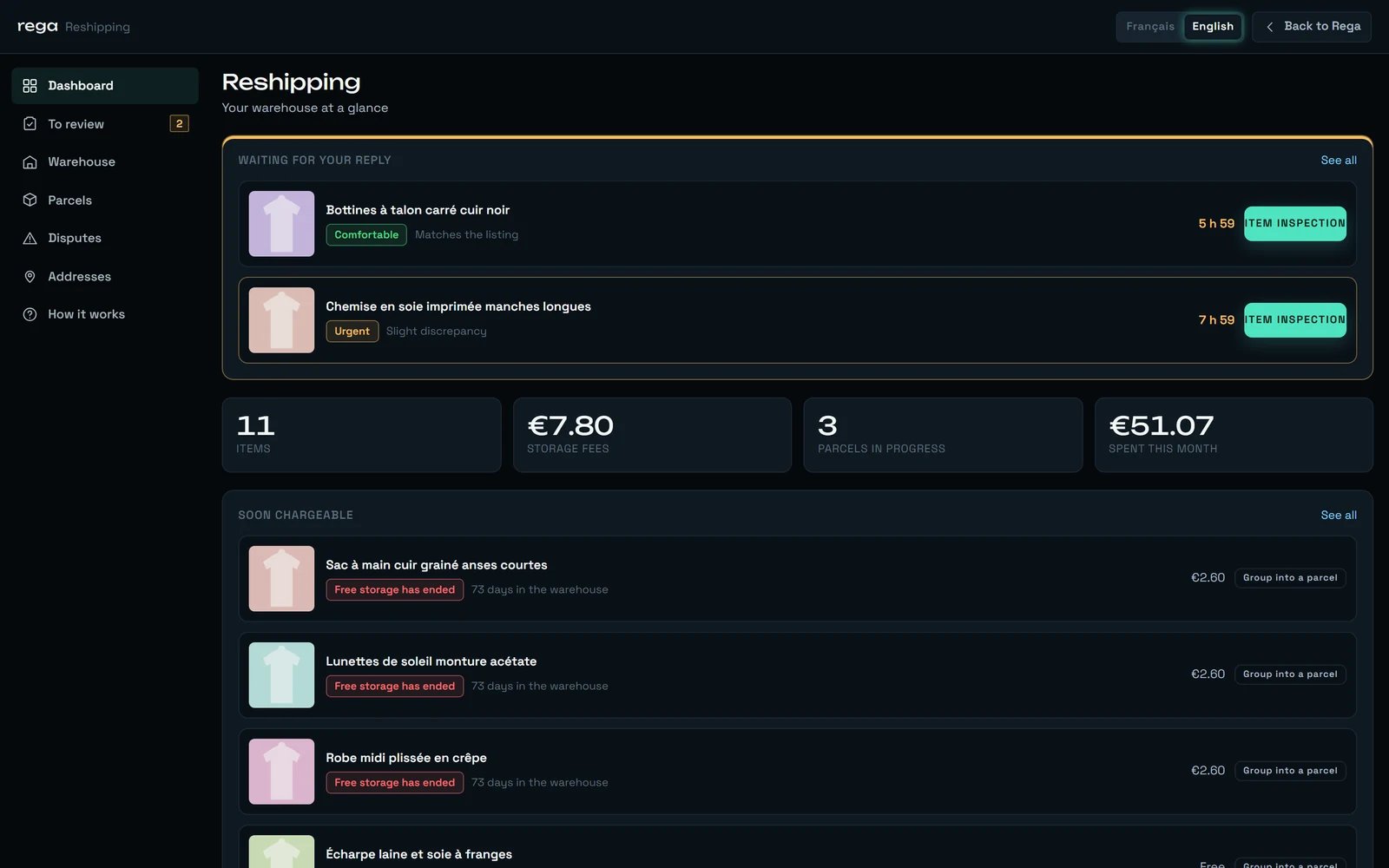
**Where you change it.** The reshipping service has no settings screen — which is exactly why the language buttons sit in its header, next to the rega name: “Français” and “English”. The switch takes effect on screen at once, and is then sent to us **so that your letters follow**.
The same choice also sits in the main app, in **Settings**, under “Language” — described there as “The interface, the messages and the e-mails.” The two write the same thing, so either one moves your letters. The language is the only setting in the product that touches them at all.
 ***
## Where each button takes you
Every letter carries **exactly one** button, and the same address repeated in plain text underneath it, under the line “If the button does not work, copy this address into your browser:” — for mail readers that strip links.
| The letter | Its button | Where it lands |
| ----------------------------------------------------- | --------------------- | ---------------------------------------------------- |
| Your reshipping service is open | “Open my space” | The service home |
| Our delivery address has changed | “See the new address” | **How it works** — the page that carries the address |
| An item has arrived | “See the item” | That item |
| Your item has arrived — tell us if everything is fine | “See the inspection” | The **list** of checks waiting, not that item |
| An item has entered the warehouse | “See my warehouse” | That item, in your warehouse |
| We have answered your request | “See the answer” | That item |
| We have opened a dispute | “See the dispute” | The **list** of disputes |
| Dispute closed | “See the details” | The **list** of disputes |
| Your shipping quotes are ready | “See the quotes” | The **list** of quotes, not that parcel |
| Your quote has expired | “Request a new quote” | That parcel |
| Payment received | “Track my parcel” | That parcel's tracking |
| Your parcel has left | “Track my parcel” | That parcel's tracking |
| Your parcel has been cancelled | “See my parcels” | The list of parcels |
| Your free storage ends soon | “See my warehouse” | Your warehouse |
| About to leave the warehouse | “Ship this item” | That item |
| Has left your warehouse | “See my warehouse” | Your warehouse |
***
## Where each button takes you
Every letter carries **exactly one** button, and the same address repeated in plain text underneath it, under the line “If the button does not work, copy this address into your browser:” — for mail readers that strip links.
| The letter | Its button | Where it lands |
| ----------------------------------------------------- | --------------------- | ---------------------------------------------------- |
| Your reshipping service is open | “Open my space” | The service home |
| Our delivery address has changed | “See the new address” | **How it works** — the page that carries the address |
| An item has arrived | “See the item” | That item |
| Your item has arrived — tell us if everything is fine | “See the inspection” | The **list** of checks waiting, not that item |
| An item has entered the warehouse | “See my warehouse” | That item, in your warehouse |
| We have answered your request | “See the answer” | That item |
| We have opened a dispute | “See the dispute” | The **list** of disputes |
| Dispute closed | “See the details” | The **list** of disputes |
| Your shipping quotes are ready | “See the quotes” | The **list** of quotes, not that parcel |
| Your quote has expired | “Request a new quote” | That parcel |
| Payment received | “Track my parcel” | That parcel's tracking |
| Your parcel has left | “Track my parcel” | That parcel's tracking |
| Your parcel has been cancelled | “See my parcels” | The list of parcels |
| Your free storage ends soon | “See my warehouse” | Your warehouse |
| About to leave the warehouse | “Ship this item” | That item |
| Has left your warehouse | “See my warehouse” | Your warehouse |
 A button never opens a broken link. Two letters — the inspection and the quotes — open the **section** rather than the exact line they are about, and you pick the right line once you are there. The rest land on a list for a different reason: there is no page for a single dispute, and the list of parcels and the warehouse open whole, even when the letter itself knows exactly which parcel or which item it is about.
***
## The letters that arrive more than once
| The situation | How many letters |
| -------------------------------------------------------- | ------------------------------------------------------------------------------------------------------------- |
| A second carrier is quoted on the same parcel | One more letter, each time a quote is issued. Several quotes per parcel is the normal case, not the exception |
| Thirty items cross the same storage tier on the same day | **Thirty letters and thirty bells** — one per item, never one per workspace |
| An item approaches the abandonment limit | One letter per item, for the same reason |
| An item crosses all three reminder tiers | Up to three letters, one per tier |
| Three colleagues share your workspace | Three copies of every letter above |
## The letters that never arrive twice
This is the other half of the same design, and it is worth as much.
A reminder for one item and one tier goes out once, and never a second time. And in the rare case where we cannot tell whether one has already gone out, **we do not remind at all**. The worst case is then a missed warning, never the same letter every day.
And if an item is found already six days from the end with no earlier reminder, **one** letter goes out — the most urgent tier due — never two to catch up.
The fees are running and visible in your warehouse from that point on. A reminder that proposes no gesture you have not already been offered is noise, so there is none. What comes later is not a second series of reminders but a single last call, once, when the item nears the point where it leaves the stock for good.
A double click, or a payment provider that tells us the same thing twice, cannot produce a second “Payment received”. The record is only written once, and the letter follows the record.
A second click, or a second tab, is refused before anything is written. No second letter goes out in either case.
Nothing. Clicking it again changes nothing and sends no second letter — a switch that wrote on every click would become harassment.
So there is one “about to leave the warehouse” letter per item, ever — never a daily countdown.
***
## What we never write, and why
Sixteen occasions is a short list on purpose. Here is what happens at the moments we deliberately stay quiet.
| The moment | What we do |
| ------------------------------------------------------------------------- | ----------------------------------------------------------------------- |
| Your parcel is **delivered** | The bell rings in the app. **No letter.** |
| Your parcel is packed and made ready | Nothing at all |
| We re-weigh an item, or move it, after it is already recorded as received | Nothing — only the arrival itself writes |
| Your service is switched **off** | Nothing. The gesture is recorded; it writes to nobody |
| The warehouse is renamed, or its internal instructions change | Nothing. Only the six postal fields set the address letter off |
| The address changes while your service is closed | Nothing — that letter only reaches workspaces whose service is open |
| A quote is issued for a **single item**, outside a parcel | Nothing. Only a parcel's quote writes |
| A quote is cancelled or withdrawn from the comparison, even the last one | Nothing |
| You pay the dispute-opening fee | Nothing. The fact is recorded, and that is all |
| A request is closed **without** a written answer | Nothing — “We have answered your request” would open onto an empty page |
| You report a problem on an item | Nothing. You have just made the gesture yourself |
| You approve an item | Nothing, for the same reason |
**The automatic approval is not one of these silences.** The inspection letter tells you plainly that without a reply the item will be approved and enter the warehouse — and when that actually happens, you are told: the bell rings (“Item approved”) and a letter goes out, `“{titre}” has entered the warehouse`.
The countdown on the sheet is still what binds you — but you do not learn about the approval after the fact.
***
## What you will not find inside a letter
* **No amount, anywhere — with one exception.** The refund obtained on a settled dispute is the only sum of money in the whole set. The receipt does not carry what you paid, nor the breakdown; the storage reminder never puts a figure on the fees; the abandonment letter does not either.
* **The answer to a service request is not in the letter.** It tells you an answer exists and takes you to it.
* **No date on the last reminder before abandonment.** It says the limit is near, not which day it falls.
* **No reason on the abandonment letter.** A reason is recorded internally; the letter does not repeat it.
* **No name on a cancelled parcel.** The letter does not say whether you or we cancelled it.
* **One button, never two.** With the same address repeated in plain text underneath.
* **The same footer on all sixteen**: “rega — automated message, please do not reply.”
Each letter goes out in two forms at once: a plain-text one and a formatted one, so that it stays readable whichever of the two your mail reader chooses to show. And the visual frame is the same as every other rega letter: one service, one identity.
***
## There is nothing to unsubscribe from
**There is no email preference, and no unsubscribe link, on any of these sixteen letters.** They are the short list precisely so that they do not need one: every single one of them is either something you must act on, or something that moved your money or your goods while you were not looking.
The **bell**, unlike the letters, does have a switch per notification type in the main app. The letters have exactly one setting — the language — and it lives in two places that write the same thing: the header of the reshipping service, and **Settings → Language** in the main app.
***
## How a letter travels
* **A letter that fails to go out never fails the gesture.** Your item is still received, your quote still issued, your parcel still gone.
* **Nothing here follows a delivery or an opening.** We do not know whether a letter reached you, and we would rather write that here than let you assume otherwise.
* **A message can be lost on the way out.** It is rare, and it is real.
The practical consequence of those three lines is one habit: **your space is the record, the letter is only the courier.** If you were expecting a letter and it never came, the fact itself is on screen all the same — the item, the quote, the parcel, the outcome. And whatever address these letters reach you from, add it to your contacts the first time one arrives.
***
## What this does not do yet
We would rather write it here than let you find out halfway through.
There is no per-letter switch and no unsubscribe link. The language is the only thing about these emails you can change.
“We have answered your request” ends with “If anything is still unclear, just reply”, above a footer reading “automated message, please do not reply.” Write to us the usual way instead — that one is known.
In the English letter it comes out as “You have until 21/08 à 14:30 (heure de Paris) to reply.” The time is correct; the wording around it is not translated. It is always Paris time, written into the letter that way, whatever your own time zone.
The one letter carrying an amount writes it the same way in both languages: “You are refunded 12,50 EUR, and the item stays in your warehouse.”
“See the inspection” opens the list of checks waiting, and “See the quotes” opens the list of quotes — not the exact item or parcel the letter is about. You pick the right line once you are there.
It rings the bell and nothing else. If you are not in the app that day, the tracking is where you find out.
An inspection deadline we do not hold is simply left blank, and the sentence goes out with the gap rather than not going out at all. Any other missing detail shows as itself instead, braces and all, and that can reach the subject line: `“{titre}” has arrived at our warehouse`. It is rare, and it is better recognised than puzzled over.
***
## Where to go next
The reply the inspection letter asks for, and the window you have to give it.
What “Your shipping quotes are ready” leads to: choosing a carrier, and paying once.
The free period the reminders count down, and the rate card that starts after it.
What happens between “Dispute opened” and “Dispute closed”, and what each outcome means.
The tracking number that arrives with the departure letter, and the link you can share.
The two gestures the welcome letter asks for, done once and never again.
A button never opens a broken link. Two letters — the inspection and the quotes — open the **section** rather than the exact line they are about, and you pick the right line once you are there. The rest land on a list for a different reason: there is no page for a single dispute, and the list of parcels and the warehouse open whole, even when the letter itself knows exactly which parcel or which item it is about.
***
## The letters that arrive more than once
| The situation | How many letters |
| -------------------------------------------------------- | ------------------------------------------------------------------------------------------------------------- |
| A second carrier is quoted on the same parcel | One more letter, each time a quote is issued. Several quotes per parcel is the normal case, not the exception |
| Thirty items cross the same storage tier on the same day | **Thirty letters and thirty bells** — one per item, never one per workspace |
| An item approaches the abandonment limit | One letter per item, for the same reason |
| An item crosses all three reminder tiers | Up to three letters, one per tier |
| Three colleagues share your workspace | Three copies of every letter above |
## The letters that never arrive twice
This is the other half of the same design, and it is worth as much.
A reminder for one item and one tier goes out once, and never a second time. And in the rare case where we cannot tell whether one has already gone out, **we do not remind at all**. The worst case is then a missed warning, never the same letter every day.
And if an item is found already six days from the end with no earlier reminder, **one** letter goes out — the most urgent tier due — never two to catch up.
The fees are running and visible in your warehouse from that point on. A reminder that proposes no gesture you have not already been offered is noise, so there is none. What comes later is not a second series of reminders but a single last call, once, when the item nears the point where it leaves the stock for good.
A double click, or a payment provider that tells us the same thing twice, cannot produce a second “Payment received”. The record is only written once, and the letter follows the record.
A second click, or a second tab, is refused before anything is written. No second letter goes out in either case.
Nothing. Clicking it again changes nothing and sends no second letter — a switch that wrote on every click would become harassment.
So there is one “about to leave the warehouse” letter per item, ever — never a daily countdown.
***
## What we never write, and why
Sixteen occasions is a short list on purpose. Here is what happens at the moments we deliberately stay quiet.
| The moment | What we do |
| ------------------------------------------------------------------------- | ----------------------------------------------------------------------- |
| Your parcel is **delivered** | The bell rings in the app. **No letter.** |
| Your parcel is packed and made ready | Nothing at all |
| We re-weigh an item, or move it, after it is already recorded as received | Nothing — only the arrival itself writes |
| Your service is switched **off** | Nothing. The gesture is recorded; it writes to nobody |
| The warehouse is renamed, or its internal instructions change | Nothing. Only the six postal fields set the address letter off |
| The address changes while your service is closed | Nothing — that letter only reaches workspaces whose service is open |
| A quote is issued for a **single item**, outside a parcel | Nothing. Only a parcel's quote writes |
| A quote is cancelled or withdrawn from the comparison, even the last one | Nothing |
| You pay the dispute-opening fee | Nothing. The fact is recorded, and that is all |
| A request is closed **without** a written answer | Nothing — “We have answered your request” would open onto an empty page |
| You report a problem on an item | Nothing. You have just made the gesture yourself |
| You approve an item | Nothing, for the same reason |
**The automatic approval is not one of these silences.** The inspection letter tells you plainly that without a reply the item will be approved and enter the warehouse — and when that actually happens, you are told: the bell rings (“Item approved”) and a letter goes out, `“{titre}” has entered the warehouse`.
The countdown on the sheet is still what binds you — but you do not learn about the approval after the fact.
***
## What you will not find inside a letter
* **No amount, anywhere — with one exception.** The refund obtained on a settled dispute is the only sum of money in the whole set. The receipt does not carry what you paid, nor the breakdown; the storage reminder never puts a figure on the fees; the abandonment letter does not either.
* **The answer to a service request is not in the letter.** It tells you an answer exists and takes you to it.
* **No date on the last reminder before abandonment.** It says the limit is near, not which day it falls.
* **No reason on the abandonment letter.** A reason is recorded internally; the letter does not repeat it.
* **No name on a cancelled parcel.** The letter does not say whether you or we cancelled it.
* **One button, never two.** With the same address repeated in plain text underneath.
* **The same footer on all sixteen**: “rega — automated message, please do not reply.”
Each letter goes out in two forms at once: a plain-text one and a formatted one, so that it stays readable whichever of the two your mail reader chooses to show. And the visual frame is the same as every other rega letter: one service, one identity.
***
## There is nothing to unsubscribe from
**There is no email preference, and no unsubscribe link, on any of these sixteen letters.** They are the short list precisely so that they do not need one: every single one of them is either something you must act on, or something that moved your money or your goods while you were not looking.
The **bell**, unlike the letters, does have a switch per notification type in the main app. The letters have exactly one setting — the language — and it lives in two places that write the same thing: the header of the reshipping service, and **Settings → Language** in the main app.
***
## How a letter travels
* **A letter that fails to go out never fails the gesture.** Your item is still received, your quote still issued, your parcel still gone.
* **Nothing here follows a delivery or an opening.** We do not know whether a letter reached you, and we would rather write that here than let you assume otherwise.
* **A message can be lost on the way out.** It is rare, and it is real.
The practical consequence of those three lines is one habit: **your space is the record, the letter is only the courier.** If you were expecting a letter and it never came, the fact itself is on screen all the same — the item, the quote, the parcel, the outcome. And whatever address these letters reach you from, add it to your contacts the first time one arrives.
***
## What this does not do yet
We would rather write it here than let you find out halfway through.
There is no per-letter switch and no unsubscribe link. The language is the only thing about these emails you can change.
“We have answered your request” ends with “If anything is still unclear, just reply”, above a footer reading “automated message, please do not reply.” Write to us the usual way instead — that one is known.
In the English letter it comes out as “You have until 21/08 à 14:30 (heure de Paris) to reply.” The time is correct; the wording around it is not translated. It is always Paris time, written into the letter that way, whatever your own time zone.
The one letter carrying an amount writes it the same way in both languages: “You are refunded 12,50 EUR, and the item stays in your warehouse.”
“See the inspection” opens the list of checks waiting, and “See the quotes” opens the list of quotes — not the exact item or parcel the letter is about. You pick the right line once you are there.
It rings the bell and nothing else. If you are not in the app that day, the tracking is where you find out.
An inspection deadline we do not hold is simply left blank, and the sentence goes out with the gap rather than not going out at all. Any other missing detail shows as itself instead, braces and all, and that can reach the subject line: `“{titre}” has arrived at our warehouse`. It is rare, and it is better recognised than puzzled over.
***
## Where to go next
The reply the inspection letter asks for, and the window you have to give it.
What “Your shipping quotes are ready” leads to: choosing a carrier, and paying once.
The free period the reminders count down, and the rate card that starts after it.
What happens between “Dispute opened” and “Dispute closed”, and what each outcome means.
The tracking number that arrives with the departure letter, and the link you can share.
The two gestures the welcome letter asks for, done once and never again.