> ## Documentation Index
> Fetch the complete documentation index at: https://docs.regasolutions.io/llms.txt
> Use this file to discover all available pages before exploring further.
# The marketplace, and how it differs
> Why hunting on Vestiaire Collective is not hunting on Vinted: a listing born by hand at an hour nobody can predict, a window swept without pause, one sweep shared by every client, and a marketplace that lives inside the screens you already use rather than on one of its own.
Vestiaire Collective is the second marketplace rega watches, and almost nothing in it works the way Vinted works. Listings are born here at about **24 a minute**, against roughly **150 a second** on Vinted — and not one of them is born at a moment anybody can predict, because a human being at the marketplace decides when it appears. That single fact rewrites the whole method, and this page is what it rewrites.
 ***
## Two marketplaces, two different jobs
Every figure below is measured. The language line was measured on both marketplaces **on the same day, 16 August**, each of them under identical conditions, held still for the whole reading — otherwise a comparison of that kind means nothing.
| | Vinted | Vestiaire Collective |
| ---------------------------------------------------- | ---------------------------------------------------------------------------------------------------------------------- | --------------------------------------------------------------------------------------------------------------------- |
| **How a listing goes live** | The seller posts it, and it is online | A member of staff checks it and retouches the photos, then validates or refuses it |
| **When it goes live** | At the second the seller presses send | At a moment only the marketplace's staff knows |
| **Birth rate** | \~150 a second | **24.2 a minute** during the day, **7.2 a minute** at night |
| **How we find it** | We catch the birth itself | We sweep a window of identifiers, without pause |
| **What decides the language** | The **address**: `.fr` answers “petit”, `.co.uk` answers “small”, and asking for English on the French site is ignored | A **setting** carried by the request. The identifiers behind the words never move |
| **Where your criteria are applied** | Some of them cost an extra read, and the filter form prices each one | **With us, on every detection.** The sweep itself carries none of them — only the form's counter asks the marketplace |
| **How a sale is known** | Rebuilt from an absence — two consecutive absences before we conclude | **Said outright**, with the exact hour of the sale, in one reading |
| **What a category, a country or a colour costs you** | Some criteria need an extra read of the listing | **Nothing at all** — they already came back with the sweep |
**Two facts explain everything else on this page.** The first: nothing exists publicly on Vestiaire before a human has validated it, so there is no starting gun to listen for. The second: because the marketplace applies none of your criteria, the same sweep can serve every client at once — which is why your filters cost the watch nothing, however many of them you write.
***
## Vestiaire has no screen of its own, and that is deliberate
There is no “Vestiaire” entry in the menu, and you never have to go looking for one. The marketplace is **mixed into the screens you already use**: a Vestiaire listing arrives in the same feed as a Vinted one, on the same card, with the same buttons, and it says which marketplace it comes from.
***
## Two marketplaces, two different jobs
Every figure below is measured. The language line was measured on both marketplaces **on the same day, 16 August**, each of them under identical conditions, held still for the whole reading — otherwise a comparison of that kind means nothing.
| | Vinted | Vestiaire Collective |
| ---------------------------------------------------- | ---------------------------------------------------------------------------------------------------------------------- | --------------------------------------------------------------------------------------------------------------------- |
| **How a listing goes live** | The seller posts it, and it is online | A member of staff checks it and retouches the photos, then validates or refuses it |
| **When it goes live** | At the second the seller presses send | At a moment only the marketplace's staff knows |
| **Birth rate** | \~150 a second | **24.2 a minute** during the day, **7.2 a minute** at night |
| **How we find it** | We catch the birth itself | We sweep a window of identifiers, without pause |
| **What decides the language** | The **address**: `.fr` answers “petit”, `.co.uk` answers “small”, and asking for English on the French site is ignored | A **setting** carried by the request. The identifiers behind the words never move |
| **Where your criteria are applied** | Some of them cost an extra read, and the filter form prices each one | **With us, on every detection.** The sweep itself carries none of them — only the form's counter asks the marketplace |
| **How a sale is known** | Rebuilt from an absence — two consecutive absences before we conclude | **Said outright**, with the exact hour of the sale, in one reading |
| **What a category, a country or a colour costs you** | Some criteria need an extra read of the listing | **Nothing at all** — they already came back with the sweep |
**Two facts explain everything else on this page.** The first: nothing exists publicly on Vestiaire before a human has validated it, so there is no starting gun to listen for. The second: because the marketplace applies none of your criteria, the same sweep can serve every client at once — which is why your filters cost the watch nothing, however many of them you write.
***
## Vestiaire has no screen of its own, and that is deliberate
There is no “Vestiaire” entry in the menu, and you never have to go looking for one. The marketplace is **mixed into the screens you already use**: a Vestiaire listing arrives in the same feed as a Vinted one, on the same card, with the same buttons, and it says which marketplace it comes from.
 | Screen | What it carries of Vestiaire |
| ---------------------------------- | ------------------------------------------------------------------------------------------------------------------------------------------------------------------------------------------------------------------------------------------------------------- |
| **Dashboard** | The detections themselves, in the common feed. A marketplace tag on every card, a “Both / Vinted / Vestiaire” chooser, the “BUY” button, “Make an offer on Vestiaire”, “Add to Vestiaire favourites”, and the banner that says a Vestiaire payment is waiting |
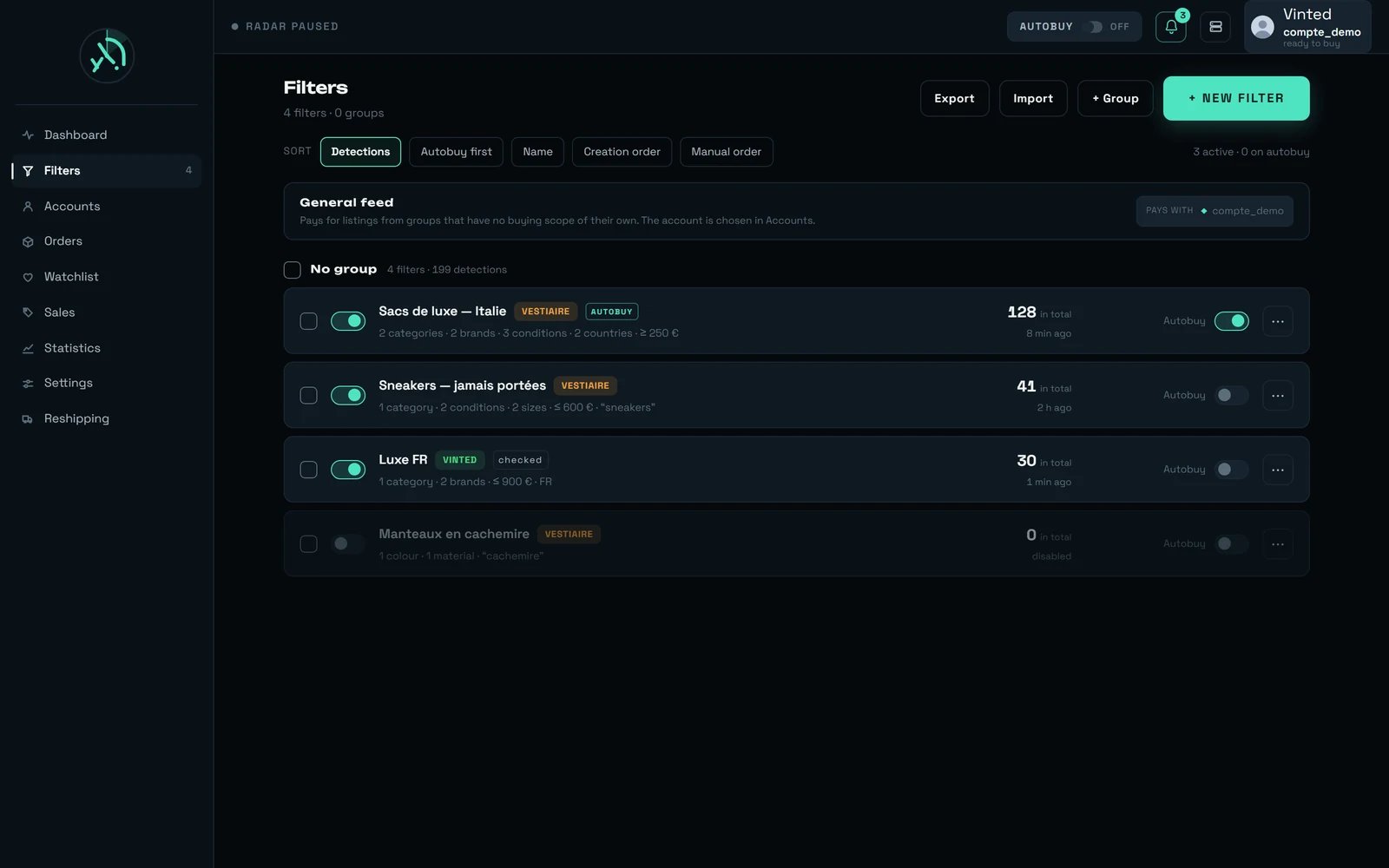
| **Filters** | Both marketplaces in a single list, a marketplace pill on every row, and the same “Autobuy” column on both |
| **Accounts** | A door of its own, “Vestiaire Collective”, where you connect an account and set its address, card and pick-up point |
| **Watchlist** | A “MARKETPLACE” chip group and a pill on every line |
| **Sales** | A “Marketplace” chip group, a tag on every card, and the three things only a Vestiaire sale can tell you |
| **Orders · Statistics · Settings** | Nothing at all. These three know Vinted only |
**The marketplace tag is written on both sides, always.** A Vinted card says “Vinted” and a Vestiaire card says “Vestiaire” — never one and not the other, because then the absence of a tag would itself be the information, and an absence is a poor thing to read at speed. The colour beside the word only confirms it.
The three chips above the stream — “Both”, “Vinted”, “Vestiaire” — change **what is painted, and nothing else**. The radar keeps detecting both marketplaces, automatic buying keeps handling both, and a counter appears beside them to say how many lines are hidden, so that a shortened list is never mistaken for a broken radar. Your choice is remembered by your browser.
***
## Every listing is validated by hand, and that is the whole story
A seller submits an item. It goes into verification and photo retouching at Vestiaire, and then a member of staff validates it or refuses it. Generally a few minutes to a few hours — and sometimes several days. That range is the marketplace's own, not a delay we time, and nothing on our side shortens it by a second.
| Screen | What it carries of Vestiaire |
| ---------------------------------- | ------------------------------------------------------------------------------------------------------------------------------------------------------------------------------------------------------------------------------------------------------------- |
| **Dashboard** | The detections themselves, in the common feed. A marketplace tag on every card, a “Both / Vinted / Vestiaire” chooser, the “BUY” button, “Make an offer on Vestiaire”, “Add to Vestiaire favourites”, and the banner that says a Vestiaire payment is waiting |
| **Filters** | Both marketplaces in a single list, a marketplace pill on every row, and the same “Autobuy” column on both |
| **Accounts** | A door of its own, “Vestiaire Collective”, where you connect an account and set its address, card and pick-up point |
| **Watchlist** | A “MARKETPLACE” chip group and a pill on every line |
| **Sales** | A “Marketplace” chip group, a tag on every card, and the three things only a Vestiaire sale can tell you |
| **Orders · Statistics · Settings** | Nothing at all. These three know Vinted only |
**The marketplace tag is written on both sides, always.** A Vinted card says “Vinted” and a Vestiaire card says “Vestiaire” — never one and not the other, because then the absence of a tag would itself be the information, and an absence is a poor thing to read at speed. The colour beside the word only confirms it.
The three chips above the stream — “Both”, “Vinted”, “Vestiaire” — change **what is painted, and nothing else**. The radar keeps detecting both marketplaces, automatic buying keeps handling both, and a counter appears beside them to say how many lines are hidden, so that a shortened list is never mistaken for a broken radar. Your choice is remembered by your browser.
***
## Every listing is validated by hand, and that is the whole story
A seller submits an item. It goes into verification and photo retouching at Vestiaire, and then a member of staff validates it or refuses it. Generally a few minutes to a few hours — and sometimes several days. That range is the marketplace's own, not a delay we time, and nothing on our side shortens it by a second.
 Three consequences follow, and all three are load-bearing.
The listing is at no address at all. Any search for a “fresher door” placed before the validation is looking for something that does not exist. There is no early view of Vestiaire to be bought, borrowed or negotiated.
Which means it is predictable by **nobody**: not the seller, not an insider, not a competitor. Everyone finds out at the same moment — and from that moment on, it is a race about seconds.
The number is assigned at **submission**; the validation lands later. On one real case we measured **66.7 minutes** between the two. A listing validated one second ago therefore carries an **old** number, scattered somewhere in the moderation backlog.
**There is no leading edge, and that is measured.** A radar that watched only the 300 numbers just above the frontier — the intuitive design, the one that would work on Vinted — made **18 discoveries out of 1,412**. Freshness cannot be read from the height of a number. It has to be swept for.
***
## What we do instead: a window, swept without pause
The window is read listing by listing. Reading hundreds at a time is possible and it is tempting, but we measured what it costs: it sees **54 listings out of 77**, and the **23** it misses are precisely the freshest — created **149 to 229 seconds** earlier. That way of reading lags **3 to 5 minutes**, and leaning on it would make us miss **30 % of fresh listings**. It serves completeness, never speed.
**The site's own “New in” page lags 5 to 10 minutes.** It is refreshed in batches of about ten minutes, and it is exactly what every other buyer is watching. That gap is where your seconds of advantage come from.
### The size of the window, and why it stops there
The radar sweeps from **2,000 numbers below** the frontier to **240 above** it — about 2,240 numbers, over and over. That figure is not a guess; it is where a measured curve flattens out.
| Window swept | Completeness measured |
| -------------------------- | --------------------- |
| 500 below the frontier | 75.1 % |
| 1,000 below | 93.2 % |
| **2,000 below, 240 above** | **99.3 %** |
| More than 2,000 below | **No gain at all** |
The **0.7 %** that stays out of reach is not a defect to be fixed later: those are old items **put back on sale**, sitting some 700,000 numbers below the frontier. No window, however wide, catches them by enumeration.
**The pass is the pace.** There is no wait between two sweeps — the next one starts as the previous one ends. That is why the delay you see is about **half a pass**, and why shortening the pass is the only thing that makes a listing arrive sooner. There is nothing else in the model.
A listing already filed is never filed twice. Once the sweep has read a number, it steps over it on every later pass without asking about it again — so a listing that stays inside the window costs the radar nothing, and you will never watch the same line climb back to the top of your feed every few seconds. A number that answered nothing, on the other hand, is tried again at every pass: it may be a listing still waiting on its human decision.
***
## The pace we measured
Each of these rows is a real run, with its own sample. None of them is derived from a setpoint.
| Reading | Usual delay | Nine times out of ten under | Refusals | Sample |
| ---------------------------------------- | ----------- | --------------------------- | -------- | -------------- |
| A first bench | 87 s | 389 s | 0 | — |
| Bench, once the sweep ran in parallel | 26 s | 40 s | 0 | 101 detections |
| In the product, first regime | 18 s | 25 s (worst 44 s) | 0 | 54 detections |
| **In the product, current regime** | **6 s** | **13 s** (worst 21 s) | **0** | 108 detections |
| **Current regime, radar actually armed** | **3.0 s** | **9.9 s** | **0** | 112 detections |
In the first regime, the full distribution over 101 detections: **34.7 %** seen in 15 seconds or less, **51.5 %** in 30 seconds or less, **97.0 %** in a minute or less, and **100 %** in two minutes or less.
**The model has one term in it, and only one: the usual delay is about half the length of a pass.** It was checked at both regimes — a pass that predicted 15.5 s measured 18 s; a shorter one that predicted 5.5 s measured 6 s. There is nothing else in it, because the marketplace adds nothing: the shortest delay we ever recorded is **about zero seconds**, over 54 detections. Vestiaire serves the listing at the very instant it validates it. There is no propagation floor to buy back.
**Do not judge the speed in the first minute.** On a cold start, the radar has the whole already-validated backlog to work through, and we measured a usual delay of **169 seconds during the first minute** against **3 seconds** once it settles. Nothing is wrong; it is catching up.
**What is honestly not measured.** The watch has held about **15 cumulative minutes** without a single refusal from the marketplace, on the bench and then in the product. A round-the-clock regime is an **extrapolation**, not a measurement — and no screen shows you those refusals today. That limit is written out at the foot of this page rather than left for you to discover.
***
## One sweep, for every client at once
This is the founding rule of rega, carried over to a second marketplace: **the watch is enumerated once, and shared.** Sweeping once per client would make the cost of the watch grow with the number of clients, which is the one thing this product cannot afford.
It is possible here for a precise reason: **the sweep carries none of your criteria**. What the radar asks for is a list of numbers and nothing else. Brands, categories, colours, materials, sizes, prices, countries, keywords — all of it is decided here, on our side, against what came back.
Ten filters or a hundred, the radar does exactly the same work. What changes is only how much of what it brings back is kept for you.
Everything it reads, it reads anonymously. Your Vestiaire accounts are for offering, favouriting and buying — never for watching. Nothing about the watch can put them at risk.
You do not have to click anything else: an active Vestiaire filter is the arming request. To stop detecting, deactivate the filter.
It is an inventory. Without that rule, arming would pour the couple of thousand listings already online into your screen as if they had just been born.
**Where the marketplace does apply your criteria: the preview, and nowhere else.** The “On Vestiaire right now” counter in the filter form is a real question asked of Vestiaire, and asking it does send your brands, categories, universes, conditions, colours, materials, sizes, countries and your two price bounds to the marketplace. Your **words** are the one thing that never goes: what to find and what to rule out is read here, on our side, and nowhere else. Detections are a different path entirely — which is worth knowing, because a fault in one shows up on the counter and not on your detections, or the reverse, and that makes the two easy to believe in agreement when they are not.
There is a free gift in that arrangement. When the form asks Vestiaire how many listings match, the marketplace answers **with the count for every value at once**, in the same reply, at no extra cost. It is why the Vestiaire filter form can show you what a criterion would gain you before you tick it — see [Writing a Vestiaire filter](/vestiaire/filters).
***
## Nothing to arm: an active filter is the arming request
There is no “arm the radar” button anywhere in rega, and you never needed one. **Having at least one active Vestiaire filter is the arming request.** It is the same grammar as Vinted, where nobody arms the radar either: you switch a filter on, or you switch it off.
Both marketplaces live in that one list, so this is where a Vestiaire filter is born too.
A window asks “Which marketplace?” and warns you underneath: “The two share neither their criteria nor their settings. This choice cannot be changed later.” Pick the “Vestiaire Collective” card. A filter never changes marketplace afterwards — if you got it wrong, make another one.
That is the arming. Nothing else to press, no other screen to visit.
Three consequences follow, and all three are load-bearing.
The listing is at no address at all. Any search for a “fresher door” placed before the validation is looking for something that does not exist. There is no early view of Vestiaire to be bought, borrowed or negotiated.
Which means it is predictable by **nobody**: not the seller, not an insider, not a competitor. Everyone finds out at the same moment — and from that moment on, it is a race about seconds.
The number is assigned at **submission**; the validation lands later. On one real case we measured **66.7 minutes** between the two. A listing validated one second ago therefore carries an **old** number, scattered somewhere in the moderation backlog.
**There is no leading edge, and that is measured.** A radar that watched only the 300 numbers just above the frontier — the intuitive design, the one that would work on Vinted — made **18 discoveries out of 1,412**. Freshness cannot be read from the height of a number. It has to be swept for.
***
## What we do instead: a window, swept without pause
The window is read listing by listing. Reading hundreds at a time is possible and it is tempting, but we measured what it costs: it sees **54 listings out of 77**, and the **23** it misses are precisely the freshest — created **149 to 229 seconds** earlier. That way of reading lags **3 to 5 minutes**, and leaning on it would make us miss **30 % of fresh listings**. It serves completeness, never speed.
**The site's own “New in” page lags 5 to 10 minutes.** It is refreshed in batches of about ten minutes, and it is exactly what every other buyer is watching. That gap is where your seconds of advantage come from.
### The size of the window, and why it stops there
The radar sweeps from **2,000 numbers below** the frontier to **240 above** it — about 2,240 numbers, over and over. That figure is not a guess; it is where a measured curve flattens out.
| Window swept | Completeness measured |
| -------------------------- | --------------------- |
| 500 below the frontier | 75.1 % |
| 1,000 below | 93.2 % |
| **2,000 below, 240 above** | **99.3 %** |
| More than 2,000 below | **No gain at all** |
The **0.7 %** that stays out of reach is not a defect to be fixed later: those are old items **put back on sale**, sitting some 700,000 numbers below the frontier. No window, however wide, catches them by enumeration.
**The pass is the pace.** There is no wait between two sweeps — the next one starts as the previous one ends. That is why the delay you see is about **half a pass**, and why shortening the pass is the only thing that makes a listing arrive sooner. There is nothing else in the model.
A listing already filed is never filed twice. Once the sweep has read a number, it steps over it on every later pass without asking about it again — so a listing that stays inside the window costs the radar nothing, and you will never watch the same line climb back to the top of your feed every few seconds. A number that answered nothing, on the other hand, is tried again at every pass: it may be a listing still waiting on its human decision.
***
## The pace we measured
Each of these rows is a real run, with its own sample. None of them is derived from a setpoint.
| Reading | Usual delay | Nine times out of ten under | Refusals | Sample |
| ---------------------------------------- | ----------- | --------------------------- | -------- | -------------- |
| A first bench | 87 s | 389 s | 0 | — |
| Bench, once the sweep ran in parallel | 26 s | 40 s | 0 | 101 detections |
| In the product, first regime | 18 s | 25 s (worst 44 s) | 0 | 54 detections |
| **In the product, current regime** | **6 s** | **13 s** (worst 21 s) | **0** | 108 detections |
| **Current regime, radar actually armed** | **3.0 s** | **9.9 s** | **0** | 112 detections |
In the first regime, the full distribution over 101 detections: **34.7 %** seen in 15 seconds or less, **51.5 %** in 30 seconds or less, **97.0 %** in a minute or less, and **100 %** in two minutes or less.
**The model has one term in it, and only one: the usual delay is about half the length of a pass.** It was checked at both regimes — a pass that predicted 15.5 s measured 18 s; a shorter one that predicted 5.5 s measured 6 s. There is nothing else in it, because the marketplace adds nothing: the shortest delay we ever recorded is **about zero seconds**, over 54 detections. Vestiaire serves the listing at the very instant it validates it. There is no propagation floor to buy back.
**Do not judge the speed in the first minute.** On a cold start, the radar has the whole already-validated backlog to work through, and we measured a usual delay of **169 seconds during the first minute** against **3 seconds** once it settles. Nothing is wrong; it is catching up.
**What is honestly not measured.** The watch has held about **15 cumulative minutes** without a single refusal from the marketplace, on the bench and then in the product. A round-the-clock regime is an **extrapolation**, not a measurement — and no screen shows you those refusals today. That limit is written out at the foot of this page rather than left for you to discover.
***
## One sweep, for every client at once
This is the founding rule of rega, carried over to a second marketplace: **the watch is enumerated once, and shared.** Sweeping once per client would make the cost of the watch grow with the number of clients, which is the one thing this product cannot afford.
It is possible here for a precise reason: **the sweep carries none of your criteria**. What the radar asks for is a list of numbers and nothing else. Brands, categories, colours, materials, sizes, prices, countries, keywords — all of it is decided here, on our side, against what came back.
Ten filters or a hundred, the radar does exactly the same work. What changes is only how much of what it brings back is kept for you.
Everything it reads, it reads anonymously. Your Vestiaire accounts are for offering, favouriting and buying — never for watching. Nothing about the watch can put them at risk.
You do not have to click anything else: an active Vestiaire filter is the arming request. To stop detecting, deactivate the filter.
It is an inventory. Without that rule, arming would pour the couple of thousand listings already online into your screen as if they had just been born.
**Where the marketplace does apply your criteria: the preview, and nowhere else.** The “On Vestiaire right now” counter in the filter form is a real question asked of Vestiaire, and asking it does send your brands, categories, universes, conditions, colours, materials, sizes, countries and your two price bounds to the marketplace. Your **words** are the one thing that never goes: what to find and what to rule out is read here, on our side, and nowhere else. Detections are a different path entirely — which is worth knowing, because a fault in one shows up on the counter and not on your detections, or the reverse, and that makes the two easy to believe in agreement when they are not.
There is a free gift in that arrangement. When the form asks Vestiaire how many listings match, the marketplace answers **with the count for every value at once**, in the same reply, at no extra cost. It is why the Vestiaire filter form can show you what a criterion would gain you before you tick it — see [Writing a Vestiaire filter](/vestiaire/filters).
***
## Nothing to arm: an active filter is the arming request
There is no “arm the radar” button anywhere in rega, and you never needed one. **Having at least one active Vestiaire filter is the arming request.** It is the same grammar as Vinted, where nobody arms the radar either: you switch a filter on, or you switch it off.
Both marketplaces live in that one list, so this is where a Vestiaire filter is born too.
A window asks “Which marketplace?” and warns you underneath: “The two share neither their criteria nor their settings. This choice cannot be changed later.” Pick the “Vestiaire Collective” card. A filter never changes marketplace afterwards — if you got it wrong, make another one.
That is the arming. Nothing else to press, no other screen to visit.
 The arming is remembered. It is replayed whenever the service starts, so you never have to set it up again after an interruption, and closing your browser has no effect on it whatsoever.
**One case is not immediate: switching a filter that already existed back on.** Creating a Vestiaire filter arms the watch on the spot, and deleting your last one stops it on the spot. But re-activating a filter you had switched off earlier only counts at the service's **next start-up**. If you have another active Vestiaire filter, this changes nothing for you — the watch is already running. If it was your only one, expect the wait, or create the filter afresh instead.
To stop detecting on Vestiaire, deactivate your Vestiaire filters, or delete them. There is no separate switch to hunt for, and no screen where a radar can be left running behind your back.
***
## Language is a setting here, an address at Vinted
Measured on 16 August, from production, on the same items, under identical conditions, asking first in French and then in English:
| What came back | In French | In English |
| -------------- | ------------------ | ---------------------------------- |
| Title | “Robe en soie” | “Silk dress” |
| Title | “Escarpins” | “Heels” |
| Description | translated | translated |
| Condition | “Jamais porté” | “Never worn” — **same identifier** |
| Colour | “Violet” | “Purple” — **same identifier** |
| Brand | “Alberta Ferretti” | “Alberta Ferretti” — unchanged |
The same day, from one single address, `www.vinted.fr` answered “petit” and `www.vinted.co.uk` answered “small” — and asking the French site for English was simply **ignored**. On Vinted, the address decides. On Vestiaire, a setting does.
**Why the radar still sweeps in French, once.** Because the sweep is shared by every client. Sweeping it in each client's language would multiply its cost by the number of languages, and that is the one thing the shared sweep exists to prevent. So the radar reads once, in French — and the screen translates afterwards, which it can do **because the identifiers do not move**. A condition, a colour, a material, a category: the word changes, the identifier behind it does not.
What is left after that is the **title** and the **description**, which are free text and cannot be translated from a table. Those are fetched on demand and kept for **an hour**. If your interface is in French, this costs nothing at all: there is nothing to fetch.
The lists in the filter form are not translated either: they are **asked for** in your language. Measured on 14 August, the marketplace returned a different label under an identical identifier for **14 of 14** top-level categories, **5 of 5** conditions, **3 of 3** universes, **20 of 24** colours, **49 of 56** materials and **86 of 99** second-level categories.
**The one thing this does not repair.** The condition label stored inside a detection card is the one from the radar's pass, so it is in French for everybody. What travels beside it is the **identifier**, and that is what your screen translates. If you ever see a French condition where you expected English, that is where it comes from, and nothing about the detection itself is wrong.
***
## From validation to purchase, end to end
```mermaid theme={null}
flowchart TD
A["A seller submits an item"] --> B["A member of staff checks it
The arming is remembered. It is replayed whenever the service starts, so you never have to set it up again after an interruption, and closing your browser has no effect on it whatsoever.
**One case is not immediate: switching a filter that already existed back on.** Creating a Vestiaire filter arms the watch on the spot, and deleting your last one stops it on the spot. But re-activating a filter you had switched off earlier only counts at the service's **next start-up**. If you have another active Vestiaire filter, this changes nothing for you — the watch is already running. If it was your only one, expect the wait, or create the filter afresh instead.
To stop detecting on Vestiaire, deactivate your Vestiaire filters, or delete them. There is no separate switch to hunt for, and no screen where a radar can be left running behind your back.
***
## Language is a setting here, an address at Vinted
Measured on 16 August, from production, on the same items, under identical conditions, asking first in French and then in English:
| What came back | In French | In English |
| -------------- | ------------------ | ---------------------------------- |
| Title | “Robe en soie” | “Silk dress” |
| Title | “Escarpins” | “Heels” |
| Description | translated | translated |
| Condition | “Jamais porté” | “Never worn” — **same identifier** |
| Colour | “Violet” | “Purple” — **same identifier** |
| Brand | “Alberta Ferretti” | “Alberta Ferretti” — unchanged |
The same day, from one single address, `www.vinted.fr` answered “petit” and `www.vinted.co.uk` answered “small” — and asking the French site for English was simply **ignored**. On Vinted, the address decides. On Vestiaire, a setting does.
**Why the radar still sweeps in French, once.** Because the sweep is shared by every client. Sweeping it in each client's language would multiply its cost by the number of languages, and that is the one thing the shared sweep exists to prevent. So the radar reads once, in French — and the screen translates afterwards, which it can do **because the identifiers do not move**. A condition, a colour, a material, a category: the word changes, the identifier behind it does not.
What is left after that is the **title** and the **description**, which are free text and cannot be translated from a table. Those are fetched on demand and kept for **an hour**. If your interface is in French, this costs nothing at all: there is nothing to fetch.
The lists in the filter form are not translated either: they are **asked for** in your language. Measured on 14 August, the marketplace returned a different label under an identical identifier for **14 of 14** top-level categories, **5 of 5** conditions, **3 of 3** universes, **20 of 24** colours, **49 of 56** materials and **86 of 99** second-level categories.
**The one thing this does not repair.** The condition label stored inside a detection card is the one from the radar's pass, so it is in French for everybody. What travels beside it is the **identifier**, and that is what your screen translates. If you ever see a French condition where you expected English, that is where it comes from, and nothing about the detection itself is wrong.
***
## From validation to purchase, end to end
```mermaid theme={null}
flowchart TD
A["A seller submits an item"] --> B["A member of staff checks it
and retouches the photos"]
B --> C{"Validated?"}
C -->|no| X["It never exists publicly.
There is nothing to detect."]
C -->|yes| D["The listing goes live, at an instant
only the marketplace chose"]
D --> E["Our sweep passes over its number
and reads it — usual delay 6 s"]
E --> F["Your active filters sort it,
here, on our side"]
F --> G["It lands in your feed beside your Vinted
finds, tagged “Vestiaire” — and alerts you
if you asked it to"]
G --> H["Favourite, offer, or prepare
the purchase from your account"]
H --> I["Your bank confirms.
That answer is what pays"]
D --> J["The site's “New in” page shows it
5 to 10 minutes later"]
J --> K["Every other buyer"]
style G fill:#1f6f43,color:#fff
style K fill:#7a4b00,color:#fff
```
Everything between the validation and your feed belongs to us and is measured in seconds. Everything after it belongs to you: no gesture on Vestiaire commits your money without a click, and the last one of all belongs to your bank.
***
## What changes once you decide to buy
The rest of the marketplace is as different as the watch is. Each of the four below has a page of its own; here is the shortest honest version of each, so that nothing surprises you on the way.
### The price on screen is not the price you pay
And the gap is neither constant nor proportional — it is not a percentage you can learn. Four real baskets, measured:
| Price shown | Basket total | Gap | What made it |
| ----------- | ------------ | ----------- | --------------------------- |
| €20.00 | €86.52 | **+€66.52** | shipped from outside the EU |
| €21.00 | €25.90 | **+€4.90** | pick-up point delivery |
| €34.00 | €102.12 | **+€68.12** | shipping and duties |
| €97.00 | €116.52 | **+€19.52** | — |
Taking the third one apart, since it is the one we measured line by line:
| Line | Amount |
| -------------------- | ----------- |
| The item | €34.00 |
| Delivery | €45.00 |
| Duties and taxes | €23.12 |
| **Charged in total** | **€102.12** |
**The buyer-service fee is inside the displayed price, not on top of it.** On that basket it was €8.16 — which means an item shown at €34 is paid €34 for the item, of which €8.16 goes to the marketplace and €25.84 to the seller. What is genuinely added above the shown price is **delivery** and **duties**. This is why every purchase in rega reads the **basket total** and never the price of the listing, and why a price criterion in a filter does not bound what you will pay. Delivery alone can more than double: we measured **€4.90** at a pick-up point against **€10.90** to a home address on the same order.
### The basket belongs to the account, not to the item
On Vinted, two purchases can run at once on one account. Here, the basket is **global to the account**: preparing a purchase empties whatever was in it, and one account can only carry one purchase at a time. It is also why the pick-up point map needs a basket with something in it before it can be drawn at all.
That is what the banner at the top of your dashboard is for. When a Vestiaire payment is still open it says so — “A Vestiaire payment is under way” — and it offers you the two gestures that unblock the account: resume the payment, or cancel it and empty the basket.
### Your bank is always the last word
We took the payment chain to the end and measured the bank's step: **four times out of four**, the card we used was sent to a full challenge — 18 seconds and three form submissions. That is a policy of the **card issuer**, not a limit of the marketplace, and another card may well be exempted. What it means for you is simple and it does not change: **rega prepares, you confirm with your bank, and it is your answer that moves the money.** Nothing is charged before it.
Automatic buying exists here, and it stops exactly there. On a filter you have armed for it — the “Autobuy” switch on the filter's row, or the same switch in its form, one filter at a time and never in bulk — rega reserves an account, fills the basket, sets the delivery and opens the payment, then tells you and hands back. You have **fifteen minutes** to answer. If you do nothing at all, the purchase is simply dropped, the account goes back into service, and nothing has been charged. Not one line of that path can charge a card.
### A sale is announced, not deduced
On Vinted a sold item vanishes, and we only conclude after two consecutive absences. Here, the page stays up and says “sold”, with the hour of the sale, so **one reading is enough**. A listing that was **withdrawn** answers something else again, and it is never counted as a sale — the two are told apart, which on Vinted they cannot be. And because both timestamps come from the marketplace itself, the time an item took to sell is genuinely **measured**: on the Sales screen a Vestiaire card reads “sold in …”, with none of the “at most” that a Vinted sale forces. Two real ones, to show the range: **398 seconds** for a Dolce & Gabbana coat, and **3,886,847 seconds** — 44 days, 23 hours and 40 minutes — for a Dior dress.
**The two marketplaces number in the same space.** A Vestiaire item carries a number around **70 million**, and Vinted handed out numbers in that range around 2016. So a listing number, on its own, does not say which marketplace it belongs to — everything in rega that follows an item carries its marketplace alongside its number. You will see it written on every detection card, on every filter row, on your watchlist and on your sales. It is not decoration.
***
## What surprises people
The radar runs **on our servers**. Closing the tab, closing the browser, shutting the machine down: none of it changes anything, and none of it is needed for a detection to be filed.
What starts it is not a button but a fact: **an active Vestiaire filter is the arming request**. There is no arming button anywhere in the product, and none is missing — a filter's own switch is the whole of it.
Settings → Notifications lists **kinds of event**, not marketplaces. A Vestiaire purchase raises exactly the same kinds as a Vinted one, so switching “purchase confirmed” off switches it off for Vestiaire too. No screen says so, which is why it is written here.
It is deliberate, and it protects you in the direction that matters: a Vestiaire alert can never slip past someone who has turned everything off.
The shortest delay we ever recorded is **about zero seconds** — and, once, a second **below** zero, which is clock drift and nothing more. Vestiaire serves the listing at the very instant it validates it: there is no propagation delay hiding between the two. When a pass happens to land on that number right then, the delay really is nil.
The marketplace itself slows down. We measured **24.2 births a minute** during the day — with a spread from 13.5 to 46.0 — and **7.2 a minute** between 22:30 and 00:30 UTC. That is roughly a third of the daytime rate. A filter that produced ten lines an hour in the afternoon and one overnight has not changed; the marketplace has.
Past that, Vestiaire stops counting. The filter form therefore writes `{n}+` rather than a bare “10,000”, because printing the round number would pass a limit off as a measurement. If you see the `+`, your filter is wide — much wider than the figure suggests.
A filter's name is yours to choose, and nothing stops the same name existing on both marketplaces. Where the product has to tell them apart it writes the marketplace beside the name: in the panel where you pick a filter to follow on the Sales screen, the option reads “Vestiaire · your filter name”.
One place still shows the name alone: the filter selector at the top of the Sales screen. If you keep twin names across the two marketplaces, that is the one spot where you cannot tell which of the two you are looking at.
When the watch starts, the two thousand or so listings already online are all, technically, new to it. Filing them as detections would be true and useless. So the first pass is an inventory: it fills the window, and it alerts nobody.
***
## Where to go next
Every criterion, what it does, what it rules out, and what happens when two of them contradict each other.
Connecting one, what we keep of it, and the connection that is valid for one thing and refused for another.
The floor, where it comes from, and why it rises to your own amount and never comes back down.
The two steps, the delivery choice, the full cost of an item, and what happens if you walk away halfway.
What a Vestiaire sale tells you that a Vinted sale cannot, and the watchlist across two marketplaces.
Where your detections land, both marketplaces together, and every gesture a card offers you.
If you are new to rega altogether, [the first ten minutes](/start/first-ten-minutes) is the page to read before this one. And [Money](/how-to/money) is the page that says, for the whole product, who authorises a spend and who bounds it.
***
## What this marketplace does not let us do yet
We would rather write it here than let you find out halfway through.
Not its passes, not its delay, not its refusals. The radar indicator in the header and the listings-a-minute counter above the feed count **Vinted only** — they say nothing about Vestiaire, in either direction. What tells you the watch is working is your detections arriving.
The **0.7 %** the window cannot cover are old items put back on sale, sitting hundreds of thousands of numbers below the frontier. Widening the window does not help — it was measured, and past 2,000 there is no gain.
The watch has held about 15 cumulative minutes with zero refusals. A day and a night without a refusal is an expectation, not a measurement — and, as above, no screen would show you the first one.
The clean-up runs on its own and nothing warns you first. Anything you want to keep — a favourite, a tab, a place on the watchlist — take it out the same day.
The marketplace publishes no list of models, and the field is missing from **79 %** of listings. A filter that already carries models keeps them and lets you remove them; you cannot add one.
rega's Orders screen follows Vinted only: a purchase made here never appears on it — not even when the notification that announces it points you there. Your Vestiaire orders live on Vestiaire, and that is where you follow them.
Once your bank has answered and the confirmation has gone, the marketplace says nothing more, and no page anywhere re-reads the state of a payment. rega will not claim a purchase went through when it cannot know.
An offer is always a click, and always yours. This is a decision, not a gap: an offer here is irreversible, and nothing should send one on your behalf.
You can set one from here; you take it off on Vestiaire. We would rather not offer a button that would fail silently, on a marketplace where a wrong gesture costs an account.
Measured: **zero** points on an empty basket, **twelve** on a full one. There is no way to draw that map without an item, so rega borrows one for the length of the reading and empties the basket afterwards.
Outside France, the map says it does not know where the address is rather than dropping a pin in the wrong place.
The Vestiaire filter form has no group selector: you file the filter into a group afterwards, from the row's ⋯ menu. Filter import and export still speak the Vinted format only.
The marketplace does send a duties figure — €23.12 on the basket above — but rega does not pull it out yet. It is inside the total you see, and only there.
One last thing that is a limit of the marketplace rather than of rega: the moderation delay itself. A listing can wait minutes or days on a human decision, and no watch, however fast, changes that. What we can promise is the part that is ours — the seconds between the validation and your screen — and that part is measured on this page, run by run.