Why an item gets lost, and everything you can do to lose fewer: the sequence of a purchase and its exit points, what costs seconds, what does not despite appearances, and the exact difference between buying by hand and letting REGA buy.
Two lines running the same way. One of them is ahead.
On Vinted a good deal is not won by eye: it is won by the second. This page does not describe
buttons — it explains where an item gets lost, and what you can change to lose fewer.
The rule that decides everything: the item goes to whoever is charged first, not to whoever opens
the order first. Opening an order reserves nothing — as long as nobody has paid, the item stays
available to everyone, including to the buyer who opened it.
The immediate consequence is a liberating one: you do not have to be fast. What has to be fast is
the chain — and it runs without you, on our servers. Your work happens beforehand: prepare the
accounts, arm the right filters, and do not waste the attempts Vinted grants you.
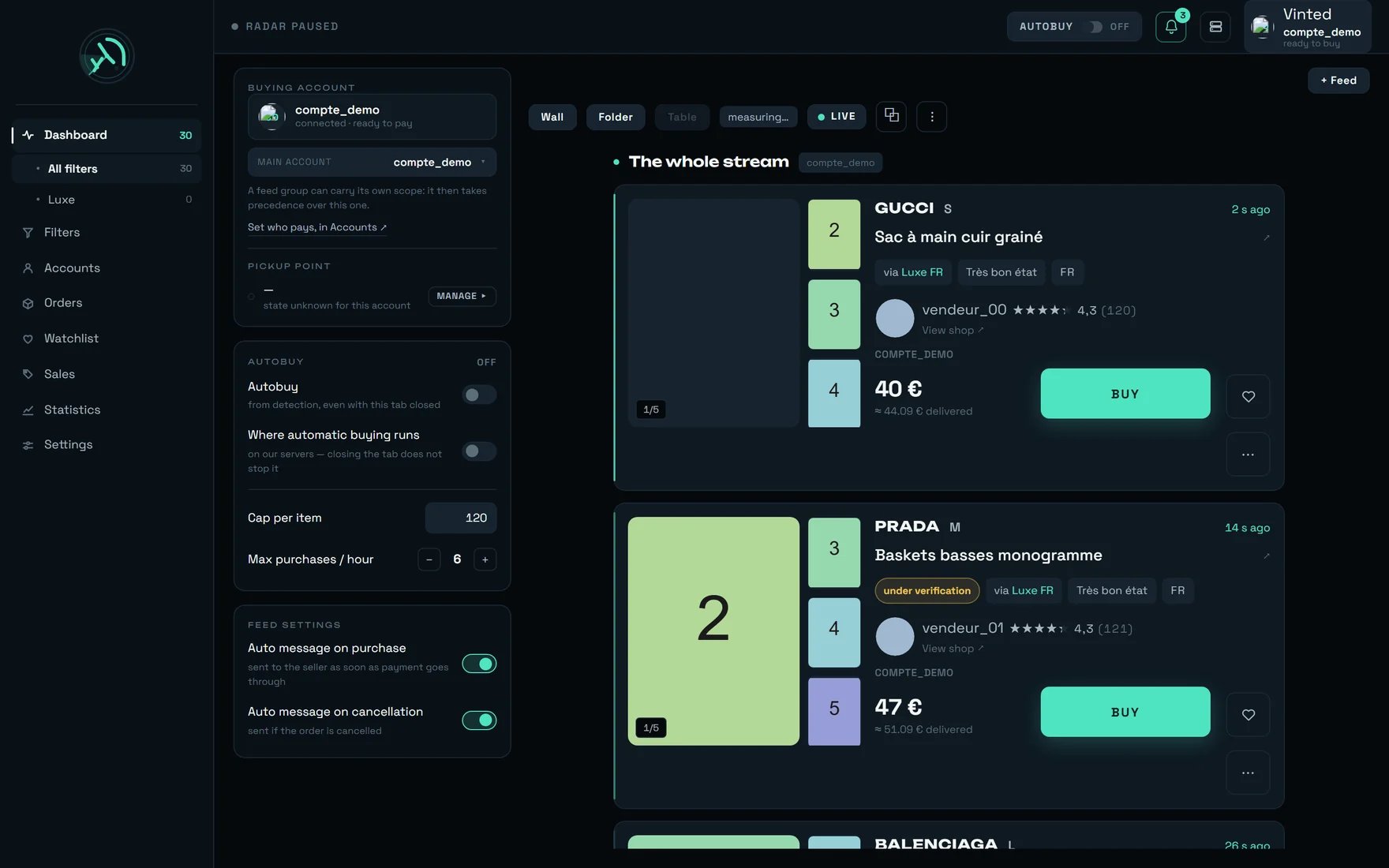
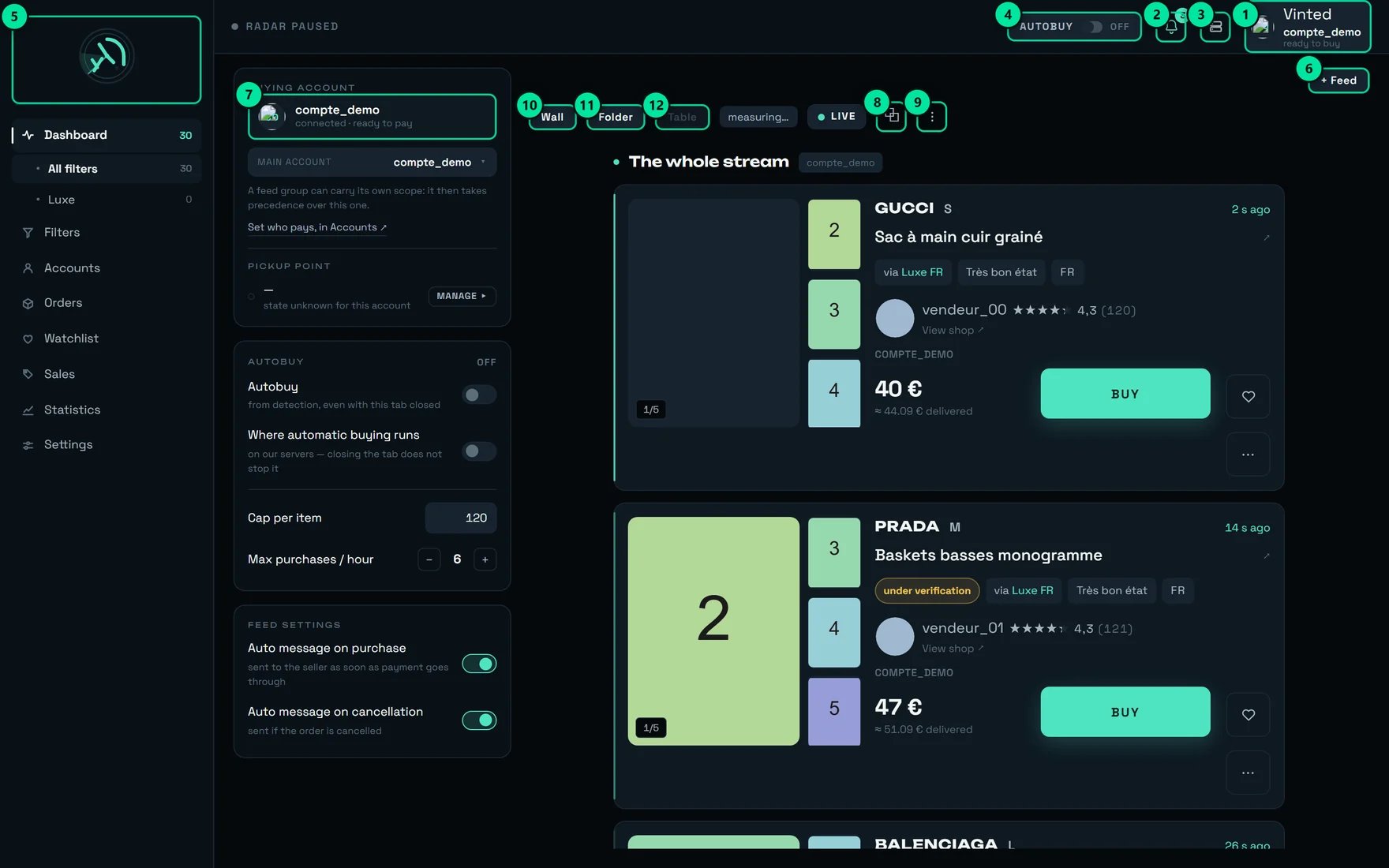
The dashboard: this is where listings land, and where races are won.
Four markers on this screen matter for a race, and only those.
The markers that decide a race.
№
The marker
Why it matters here
1
The account pill, top right
Tooltip: “compte_demo will pay for the next purchase — ready to buy.” This is the account that pays, and therefore the address the parcel goes to. A race won with the wrong account is a race half won.
2
The bell
“3 unread notifications” on our test account. This is where the bank confirmation request arrives — the only moment a race needs your hand.
3
Administration
REGA staff only — this button does not appear on your account.
4
The AUTOBUY pill, here on “OFF”
Tooltip: “Automatic buying disarmed”. Armed, it makes REGA run in your place, on our servers.
9
⋮
“Recent purchases and conversations”. The purchase row shown there is the only truth about what happened: the account actually committed, and the amount charged.
Automatic buying runs on our servers. Once the AUTOBUY pill is armed, it survives closing the
tab, closing the browser and shutting down the machine. The only gesture that stops it is
disarming it. The “Where automatic buying runs” switch in the left-hand panel states that fact
— its description says “on our servers — closing the tab does not stop it” — it is not a setting to
flip.
A purchase is not a click: it is a chain of steps, each of which can end in an exit. Knowing where
a race stopped is knowing whether there is anything to fix — or nothing at all.What the diagram says, and what to remember from it:
Three exits cost nothing
“GONE”, “Under verification”, and the refusal for a missing card or phone: in all three cases
not one euro left the account, and in the first two REGA did not even ask Vinted for anything.
Only one exit is ambiguous
An interruption at the moment of paying. The outcome there is unknown, so REGA never
replays: replaying would risk a double charge. That is the “TO CHECK — OUTCOME UNKNOWN” row.
A listing is not buyable the second it appears. Vinted makes it buyable a short moment later, and
until then every attempt is refused, including yours. REGA waits for that switch on your behalf —
there is nothing for you to time, and nothing you could do sooner.
Here is what actually weighs on a race — and what you can do about each item.
What weighs
What you can do about it
The payment itself
Nothing. That time belongs to Vinted, and it cannot be compressed.
Choosing a pick-up point the first time
Prepare the carrier once per account (see below). After that, the step disappears.
Setting the bank card
Save a card and make it the default on the Vinted account: the step becomes unnecessary.
Waiting for the item to become buyable
Nothing. Vinted decides when a listing becomes buyable, and nobody can shorten it.
End to end, a purchase takes about six to nine seconds. Of that total, the only two steps you can
make disappear — choosing a pick-up point the first time, and setting the card — weigh no more than a
small share of it: preparing a carrier gives back ~1.3 s, and a card saved as default removes its
step altogether. Everything else belongs to Vinted, and none of it can be won back.
The most profitable lever is not speed: it is not being refused. A purchase that fails because no
card is saved loses you the item; a slightly slower purchase that goes through loses you nothing.
Check card, address and phone on every buying account before you arm anything — that is where races
are actually won.
This is the most useful half of the page: do not spend your energy on any of these.
Closing the tab, the browser, or shutting the machine down
Stops nothing. Automatic buying runs on our servers. Only disarming the AUTOBUY pill stops
it.
Pausing the live stream, or scrolling the list
Freezing stops the screen from painting, never detection, never enrichment, never automatic
buying. A “N NEW” counter climbing while you read is not a fault, and nothing is lost.
A feed moved into a tab on the bar
It carries on detecting, counting and buying. An invisible feed is not a switched-off feed. Do
not close one to make room: pin what you want to keep on screen.
The layout, the number of photos, the detached window
Purely visual. The geometry of the screen does not change a purchase by a single millisecond — “the
interface cannot make a purchase faster, it can only avoid slowing it down”.
The progress bar that never reaches the end
It is capped at 96 %, and it runs against an average rather than against your purchase. It is
not proof of payment — the proof is the purchase row.
Preparing several carriers to go “even faster”
The gain is not additive. The seller chooses the carrier: preparing one more carrier widens
the share of your purchases that skip the pick-up point step, never the gain itself.
And conversely, three gestures that cost you while looking helpful:
Clicking again on a “GONE” item. Every needless attempt is paid for on the next item: three
clicks on something already sold are three chances fewer for the one that comes after. That is
exactly why the “RETRY” button does not appear on “GONE”.
Buying over an item already queued for verification. One BUY click is exactly what puts it
in that queue — that click is the right one. Clicking again while it waits costs an attempt for
nothing, and the mechanism designed to save you is disarmed by the waste that came before it.
Opening the purchase preparation over and over. Every preparation creates a real unpaid order
with a real seller, and it is paid for in exactly the same way. Keep it for “I am after this exact
item”.
Both paths are the same path. A BUY click and an automatic purchase go through the same
chain, the same account selection, the same lock, the same payment, the same bank confirmation.
Neither one is “the fast version”.The only difference that matters is when the start happens: automatic buying starts at detection,
your click starts when your eye reaches the card.
By hand (BUY click)
Automatic (AUTOBUY armed)
What triggers it
your click
the first armed filter that accepts the item
Start
after your reading time
at detection
Freshness required
none
120 s — an item detected more than two minutes ago is no longer bought
Price cap
the Settings one, if set
the Settings one and the filter’s “€ max”
Purchases in flight per account
2
2
If no account is free
the screen refuses: “A purchase is already under way on this account.”
the job stays queued and starts as soon as an account frees up
After a rate refusal
nothing
the account is set aside for a while, the others take over
After a purchase refusal from Vinted
nothing
all your automatic buying is disarmed (see below)
Condition that cannot be switched off
—
the filter must be confirmed: a draft never buys
Label on the row
—
AUTO badge, tooltip “Triggered by autobuy”
An item detected more than two minutes ago is almost always gone. That is why automatic buying
refuses to take it: this is not a cap, it is freshness. After an outage, nothing will be bought
“late”.
A single purchase refusal issued by Vinted disarms ALL your automatic buying. This is deliberate:
such a refusal concerns the account itself, not just that one item, and carrying straight on — on
that account or another — is how one refusal turns into several. The message received from Vinted is
kept as it came: read it before you re-arm.
A single streak crossing the dark from edge to edge: one chain, run once, whatever started it.
All three exist, they do not do the same thing, and none is active out of the box except the third.
No price ceiling is armed by default anywhere: that is an explicit decision by the tool’s owner —
visibility replaces the constraint.
The ceiling
Where it is set
What it acts on
Out of the box
“Purchase ceiling”
Settings → Buying
All purchases, manual and automatic, from any machine
empty — “Above this amount, the purchase is refused and you are told. Empty = no ceiling.”
A filter’s “€ max”
Filters screen, “Autobuy on this filter” block
Automatic buying for that one filter
empty — “No cap: this filter will buy whatever the price.”
“Cap per item”
AUTOBUY panel on the dashboard
Remembered in this browser only
€120
A ceiling, once set, also refuses an item whose price cannot be read. That is intended — better to
let a deal go than to be charged an amount nobody could read — but it is a cause of lost races that
nobody suspects. If you set a ceiling, know that you are accepting that refusal too.
Count on roughly €4 above the price on show, every time (measured: +€4.09). And all three caps
compare the ITEM price, never the total: a cap set at €100 therefore lets through a purchase charged
at around €104. Set your caps to the item price you accept, not to your total budget. While the exact
postage is unknown, the screen marks the total with a “≈”, using €3.50 of estimated shipping.
Most failures are not errors. They are lost races or items that had already
gone; only a minority are down to the tool. The screen files every failure under a verdict: “Race
lost, or the item had already gone”, “Postponed — the purchase will be retried”, “For us to fix”,
“Waiting for something from you”. React only to the last two.
When Vinted declines a payment, REGA files the real reason under one of these ten sentences. The
first six are lost races; the last four ask something of you.
The sentence you read
What it means
“Item sold or withdrawn.”
Race lost. Nothing to fix.
“Another member is currently buying this item.”
Race lost by a hair.
“A purchase is already under way for this item.”
You or the automation already started it — do not start a second one.
“Item reserved for another member.”
The seller reserved it. Nothing to fix.
“The payment did not go through.”
A decline with no usable reason from Vinted.
“Too many attempts in a row. Try again in a moment.”
Let it settle: this one passes.
“A phone number is required for delivery.”
Action needed — save a number on that Vinted account.
“The bank card could not be selected for this purchase. Check the card saved on this Vinted account.”
Action needed — no usable card.
“Payment declined. Check the saved payment method.”
Action needed, in principle. ⚠️ See the warning below.
“Payment declined by the bank.”
Action needed — this one is for your bank, not for us.
If you read “Payment declined. Check the saved payment method.” while your card is perfectly valid,
it is probably not your card. Vinted sometimes returns a generic decline that says nothing about
the cause. It has been seen on an account whose card was saved, set as default and not expired —
and that message all the same. Check once, then leave it alone.
Let the automation run the races, keep the click for what you want to judge
A human click always leaves after your reading time; the automation leaves at detection. For the
items you take every single time (a brand, a size, a price), arm the filter and stop clicking. Keep
the click for what needs judgement — condition, photos, seller.
Arming the AUTOBUY pill is not enough: arm each filter, then give it a moment
Without that double condition, an armed autobuy would buy everything the radar shows. An arming
done elsewhere is not taken into account the very same second: after arming a filter, let about
twenty seconds go by before concluding that “it is not buying”.
NEVER click again on a “GONE” item
Every refused attempt is paid for on the next item, on that same account. REGA itself makes a
single, immediate attempt: do not do by hand what it refrains from doing.
“Under verification”: click BUY once, then let the queue work
An item under verification is not lost, and it is not buyable either: Vinted has taken the listing
out of the catalogue and does not allow the transaction while it checks it — from 30 minutes to
2 hours. Click BUY anyway: the card switches to “Queued — the purchase starts as soon as
Vinted verifies the item.”, the purchase fires on its own at approval, and the queue gives up
after 96 hours. Do not buy over it in the meantime — every extra click only reduces your
chances on the next item.
Before arming anything, check card, address and phone on every buying account
These are the three refusals that cost you items without ever costing you a euro. A card must be
saved and set as default on the Vinted account; the address must exist; a phone number avoids a
flat refusal with the carriers that require one. In the United Kingdom the number is
mandatory, and the format matters: it must be the complete number in international form — the
country code, then the national number without its leading zero. One digit short and it is refused.
Prepare the carriers your recurring sellers use — not all of them
The “PREPARE THIS CARRIER” button (Accounts screen) makes a real purchase of a few euros,
once per account and per carrier. It is optional: without it the purchase still succeeds,
simply ~1.3 s slower on the items that carrier ships — out of the six to nine seconds a
purchase takes. Since the seller chooses the carrier, prepare first the ones you see coming back in
your streams — the gain does not add up, it widens.
Rank your pick-up points BEFORE an account's first paid purchase
Your ranking comes before any automatic strategy, but it is at the first paid purchase that it
fixes the point every later purchase will reuse without asking for anything. Setting it afterwards
costs you the point selection every time, until the next purchase through that carrier. A point
remembered this way then stays pre-filled on its own, with no upkeep at all.
Do not touch “Automatic pick-up point” — it is on out of the box
The setting says so itself: “rega chooses the collection point during the purchase. Turned off, the
purchase fails for want of a pick-up point — leave it on.” Turned off, nothing asks you
anything: the purchase stops on “No pick-up point could be selected for this order.”, and it
stops after the item has been reserved. Faced with a purchase that fails for no visible reason,
this is the first box to check.
Stay reachable for a quarter of an hour after a purchase
Bank confirmation is the only moment a race needs your hand, and it expires after 15
minutes. The notification goes out the instant the link exists, with “Bank confirmation required”
and “Your bank is asking for a confirmation — without it, the purchase will not complete.” An
adjustable reminder (from 60 s to 15 min) follows with “Bank confirmation still pending”. Leave
those notifications on, and accept them on your phone.
Several buying accounts beat one very clean one
An account can only carry 2 purchases in flight. An account that has just failed has already
used its turn in the rotation — the tooltip says so: “Account committed at click time: it is
reserved before the purchase completes. In rotation, a failed purchase has therefore already used
its turn.” And in automatic buying, an over-asked account is set aside for a time: with no second
account, that window is a hole in your coverage.
One account per country you hunt in
A purchase never leaves from an account attached to a country other than the listing’s, and
that lock is the only one in the chain that refuses rather than degrades. It is decided on the
currency of the total: the pound means the United Kingdom, the dollar the United States; the euro
means 18 countries, so it constrains nothing. If you open a
British filter, open the account that goes with it.
On “TO CHECK — OUTCOME UNKNOWN”, open Orders before clicking again
The missing “RETRY” button is not an oversight: the payment may still go through, and a second
click would be a second purchase on an order that may already be paid. The sentence says it
literally — “Check in Orders BEFORE retrying”.
Empty your verification queue before a weekend
It holds for 96 hours: four days during which a purchase can leave on its own, with no new
click. Orders screen → Being checked → remove what you no longer want. “Remove from the
queue” is not a cancellation: nothing was paid, so there is nothing to cancel.
If automatic buying disarms itself, read the message before re-arming
That is a purchase refusal issued by Vinted, and it concerns the account itself, not just that one
item. Re-arming straight away — on that account or another — is how one refusal turns into several.
The block lifts on its own, on the scale of a day: read the message — it is kept as it came, so
that you can judge — then re-arm the next day rather than trying to carry on elsewhere.
Only set a ceiling if you accept its refusals
No ceiling is armed out of the box, by explicit decision of the tool’s owner. If you set one, it
will also refuse an item whose price cannot be read — and it compares the item price, not
the amount charged. An item listed at £10 has shown on screen as €11.84: nothing is
converted, because nobody has the exact rate.
Do not scroll during a burst — but know that freezing does not stop buying
Scrolling by more than 40 px freezes the display without saying so, and that is a protection: a
card sliding in under your cursor is an unwanted purchase. To read in peace, pause deliberately
with PAUSED — detection and automatic buying carry on throughout.
An unpaid order holds nothing: the item stays on sale, and the first buyer to be charged takes it.
“Being first to open” is worth nothing — only the charge counts.
A dry run still creates an order with the seller
It simply does not pay it. But it is not free either: like any attempt, it is paid for on the next
item. Believing a dry run to be inert would be wrong.
A faster purchase does not necessarily win
The payment itself happens at Vinted, and that time is not ours. Two buyers who left at the same
instant do not arrive in the order they left. Speed improves your odds; it does not guarantee them.
The bank confirmation link appears before anyone knows it will be needed
Often the bank approves on its own and the purchase flips to paid without you clicking. Showing the
link straight away forces nothing: it only offers the confirmation earlier, in case it turns
out to be needed.
A bank confirmation not done within 15 minutes is not a fault
It is a payment nobody confirmed, hence an invalid purchase — and not one euro left the
account. Fifteen minutes is how long the order lives at Vinted, not a choice of ours.
A payment is never replayed after an interruption
The outcome there is unknown: replaying would risk a double charge. The purchase therefore
stops where it stopped, and the row asks you to check in Orders before any other gesture.
A failed purchase still used its turn in the rotation
The account is committed at reservation time, hence before the outcome. That is also why “RETRY”
leaves from the next account: an account that has just failed is the worst placed to start
again.
In “one specific account” mode, REGA will never go and find another
Not even when it is saturated. Silently switching to another account would change the delivery
address without telling you — that used to happen, and it no longer does. A saturated account
simply moves to the back of the order when there are other candidates, and the wait is shown when
it is on its own.
An empty account group does not fall back on anything
“No restriction” and “no account” are not the same thing. Confusing them would let any account pay
when you deliberately emptied the group. If your automatic purchases stop for no visible reason,
look at the feed’s account group first.
A purchase timer is never shown to you
A design decision: the internal time of a purchase is not useful information to a buyer, and showing
it would invite the very gestures that lose items. What you see is the result.
The price shown is the listing's, never a conversion
The total delivered stays in your account’s currency. Nothing is converted on screen: “we do not
have the rate, and inventing it would mean showing a figure nobody measured”.
Vinted always suggests a pick-up point — and its suggestion is not the best one
Vinted always puts a point forward, and it is often not the closest one — sometimes far from it.
Nothing in that suggestion makes it the best: the ranking that counts is yours, so set it.
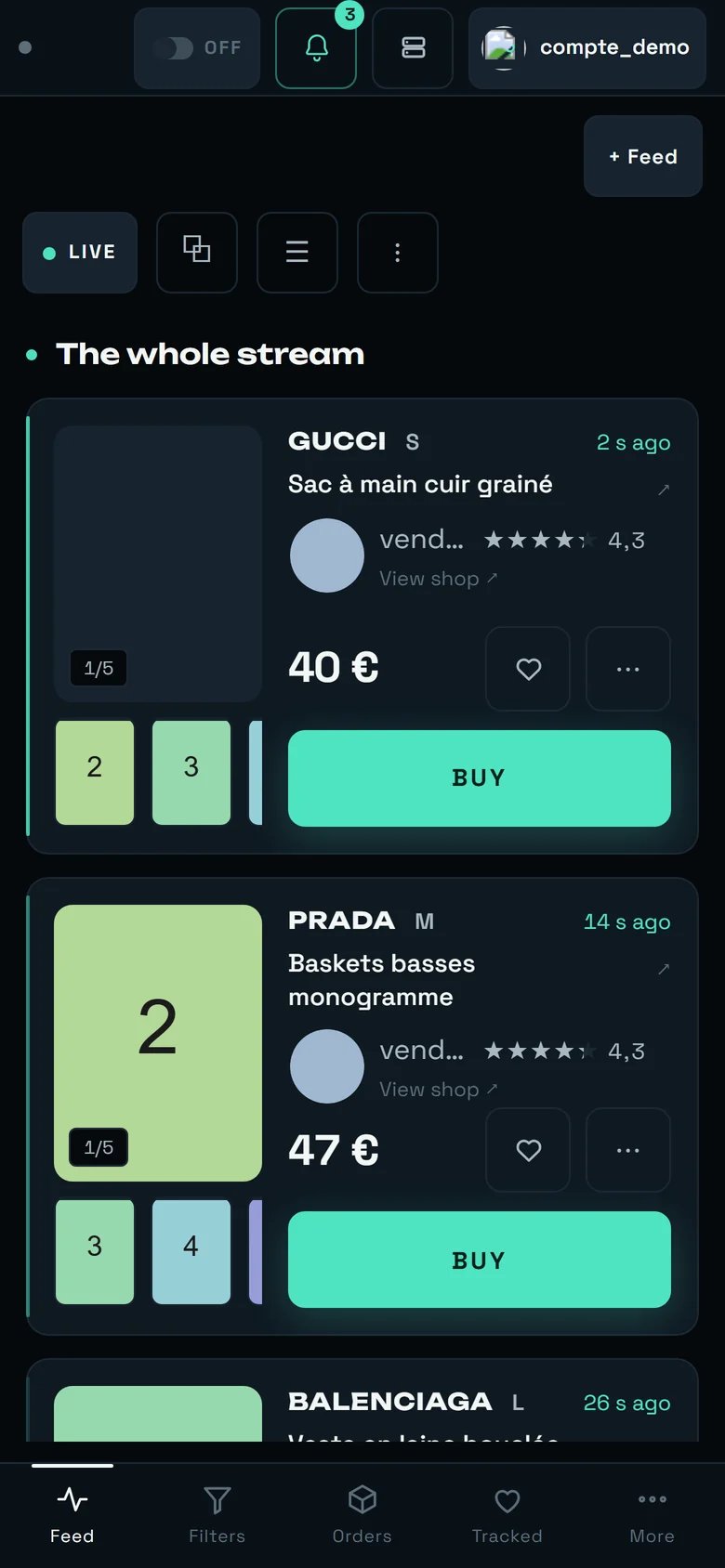
The dashboard on a phone: the gesture that matters here is the bank confirmation.
A phone is not where races are won — it is where you avoid losing one.
The useful gesture is the bank confirmation. Fifteen minutes, and a notification that leaves at
once. Accept notifications on the phone you actually carry.
BUY takes the full width, under the photos: it is the one geometry where you cannot hit the
wrong target.
A single feed, always: below 900 px REGA says so itself — “Only one feed on this screen — two
bands would fall below the readable card width.” An imposed layout, no selector; two feeds side by
side are a computer thing.
Automatic buying depends on no screen at all: it runs while your phone is in your pocket.
Said plainly, so that you do not build your day on it:
Nobody can guarantee that a purchase will never be hindered by a Vinted security check. The
question was asked in exactly those terms, and the answer is “No.” When it happens it costs a
few seconds — that is to say, the item.
The time the payment takes cannot be compressed. It happens at Vinted.
No price ceiling is active out of the box, anywhere. That is an explicit and repeatedly
reaffirmed decision by the tool’s owner.
The automatic message sent to the seller after a purchase is not guaranteed. Its content is
certain, its delivery is not — do not count on the seller having read it.