The sentence you read on screen, what actually happened behind it, and the one action that fixes it — for every purchase, payment, account and delivery refusal, on Vinted, on Vestiaire Collective and in reshipping.
A beam that goes all the way, then meets the thing that stops it.
REGA never serves you a sentence at random: every refusal is classified before it is displayed,
and the same situation always produces the same sentence. This page is the dictionary of those
sentences.Use it by the sentence, not by intuition. Find the exact wording on screen, look it up in the
tables below, do what the third column says. The sentences quoted here are the product’s own, to the
character.Three services, one dictionary. The first eleven families are Vinted’s; then come those of
Vestiaire Collective, then those of reshipping. One sentence never serves two services: if
you find it here, you are in the right place.
A refusal is almost never a fault. On the purchases we have followed, the largest share by far
were simply races lost, or items that had already gone. Only a minority came down to the tool,
some were purchases postponed and retried on their own, and a handful were waiting for something
from you.
On Vinted, three places, from the most immediate to the most complete.
The item card
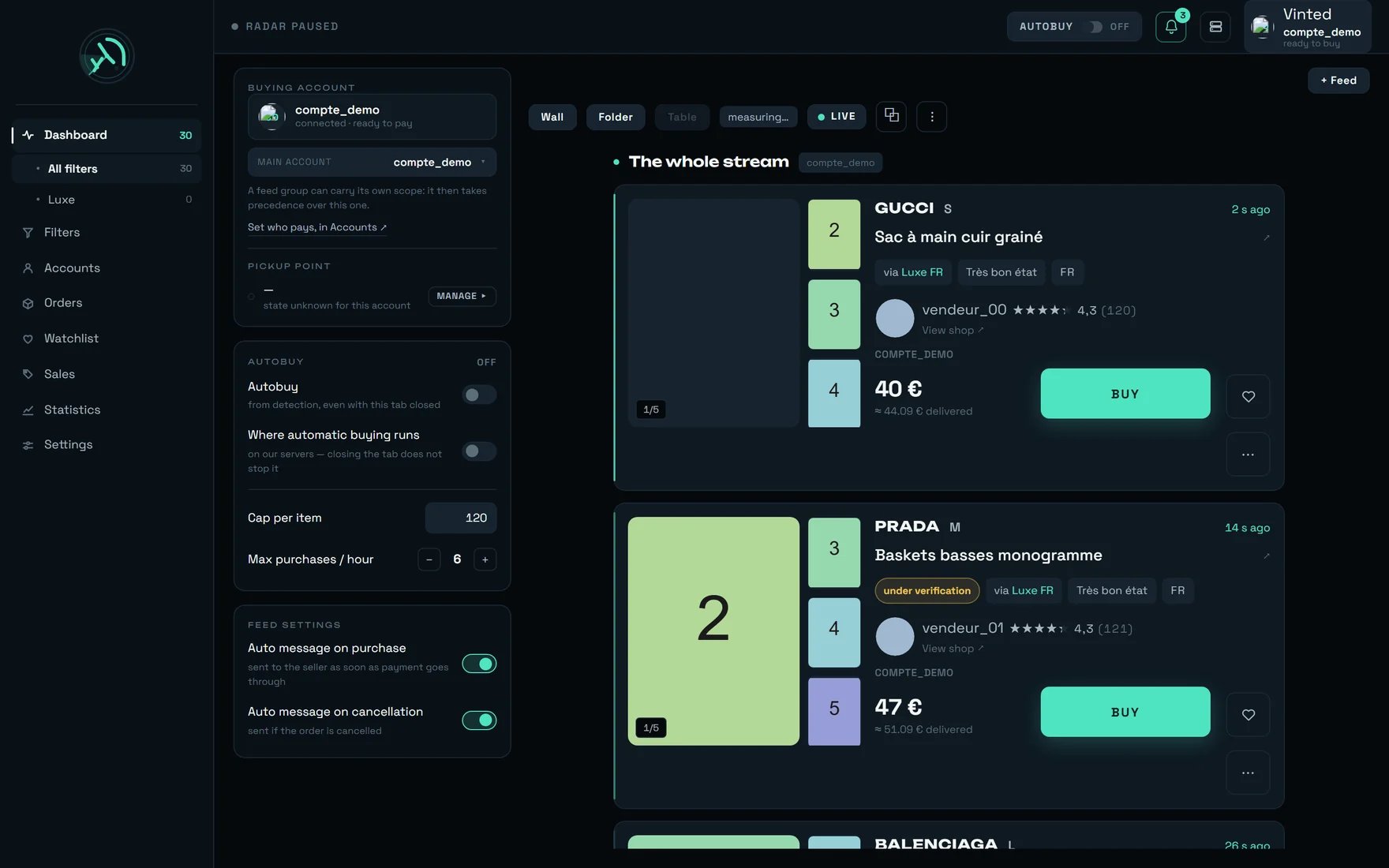
The BUY button becomes PURCHASE UNDER WAY…, then BOUGHT ✓, GONE, FAILED or
TO CHECK. On the item’s own sheet, where there is room, the same states are written out in
full: ✓ BOUGHT, GONE — BOUGHT BY SOMEONE ELSE, FAILED — SEE THE DETAIL, TO CHECK
— OUTCOME UNKNOWN. The layout never shifts.
RECENT PURCHASES
The right-hand panel of the dashboard: one row per purchase, with the account committed, the
total and the refusal sentence. It is not a history — it only covers this session.
The Orders screen
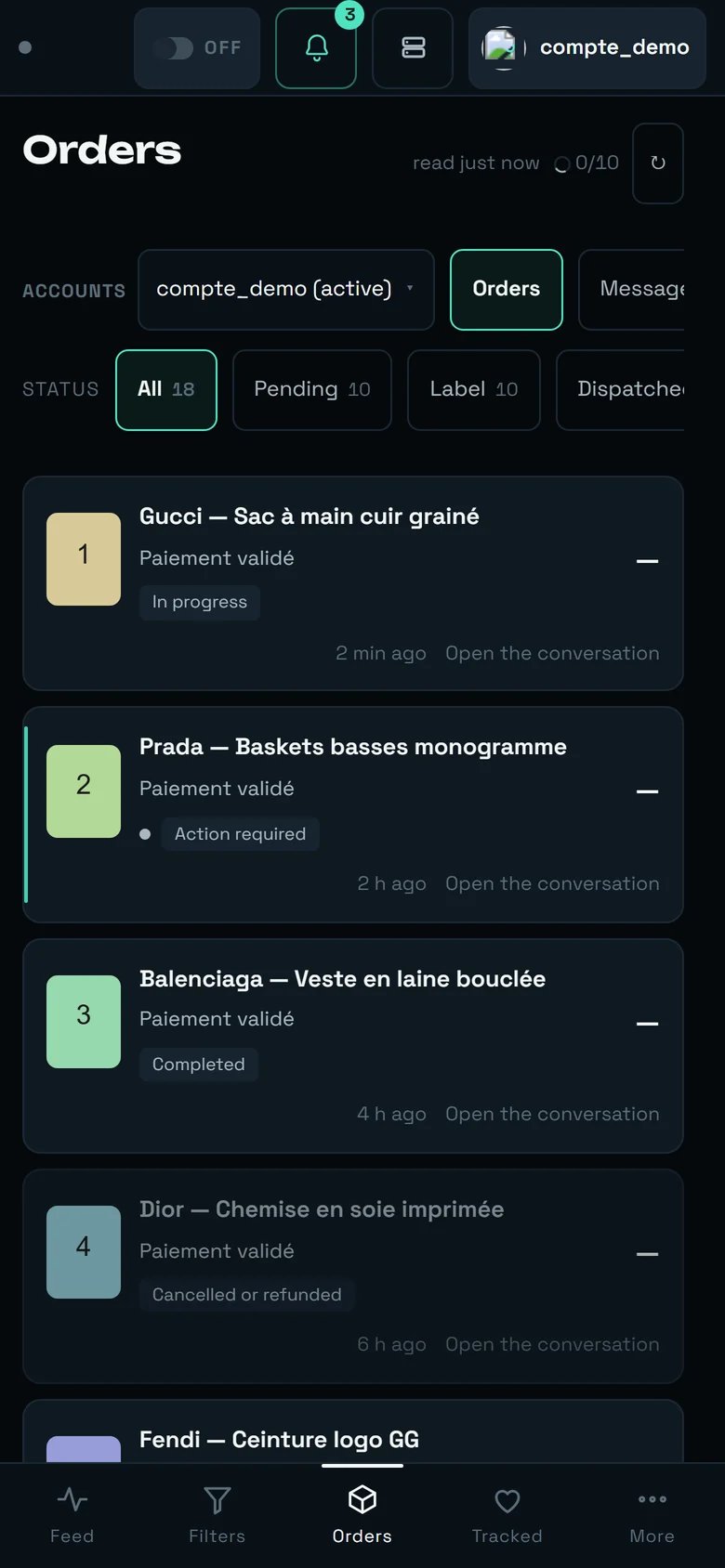
The full history of your Vinted purchases, plus the Being checked tab: the items waiting for
Vinted’s green light. This is where you go to check before retrying anything.
The other two services show their refusals elsewhere. A refusal from Vestiaire Collective appears
where the gesture was made — the item card, the panel of the Vestiaire screen, the offer window — and
a payment left open comes back as a banner on the dashboard. A reshipping refusal shows on the
reshipping screen, at the exact spot of the refused gesture. The Orders screen knows only Vinted:
there is no Vestiaire order and no parcel to look for there.
The dashboard: refusals appear on the card, then file into RECENT PURCHASES.
Orders screen — the markers that matter when diagnosing.
№
Control
What it tells you
1
The account indicator, top of screen
Who will pay for the next purchase. On our demo account: “compte_demo will pay for the next purchase — ready to buy.”
4
The AUTOBUY badge
Here on OFF — tooltip “Automatic buying disarmed”. No automatic purchase will go out.
6
The ↻ button
“Read again now” — reads your orders from Vinted again. Use it before concluding “I have received nothing”.
10
The Pick-up points tab
“Parcels waiting at a pick-up point, grouped by point”.
11
The Being checked tab
“Items being checked by Vinted — the purchase starts as soon as they are cleared”. The first place to open when a purchase seems never to have gone out.
The Administration button visible at the top of the screenshot: REGA staff only — this button
does not appear on your account.
On Vinted, a purchase always crosses the same stages, in the same order. Knowing where it stopped
is nearly always enough to know what to do.
The four exits on the left cost nothing. A refusal for address, pick-up point, phone or card
happens before any money moves: you lose the item, never a euro.
The Vestiaire Collective tunnel looks nothing like that one — it is prepared, then paid for in two
separate gestures. It is described in Buying on Vestiaire.
The most common family on a new workspace, and the quickest to fix.
What you read
What happened
What you do
“No account available to pay. Connect a Vinted account in Accounts.”
No Vinted buying account is attached to your workspace.
Accounts → Add an account. That account is the one that will pay, with its card and its address.
“no account to buy with — sort this out in Accounts”
The dashboard’s left panel finds nobody within the buying scope.
Check the scope: an emptied group refuses, it never falls back on another account.
{compte} is not connected — the purchase would be refused. Connect it from Accounts.
The named account exists but its connection has dropped.
Accounts → reconnect it. Nothing else to change.
“This account is no longer connected. Reconnect it from the Accounts page.”
Same cause, seen from a purchase already started.
Same. The purchase itself is lost.
“Account not connected.” · “No account set up.”
Short forms of the same state.
Same.
“No connected account within this scope.”
Every account in the chosen scope is offline.
Reconnect one, or widen the scope.
“A purchase is already under way on this account.”
At most two purchases can run at the same time on one account.
Wait, or let another account pay. This is not an error.
“No delivery address on this account — a purchase cannot go through without one. It is set in the Accounts tab.”
The Vinted account has no saved address.
Fill it in before the next drop, not during it.
An emptied account group falls back on nothing. REGA tells “no restriction” apart from “no
account”: confusing the two would let any account pay when you deliberately emptied the group. If
your automatic purchases stop for no visible reason, look there first.
Withdrawn, reserved, or paid for by someone else before you.
Nothing. REGA does not even offer “Retry” — see advice no. 1.
“This item is no longer available.”
Same situation, seen from the server.
Nothing.
“Item sold or withdrawn.”
Vinted refused the payment for that reason.
Nothing.
“Another member is currently buying this item.”
Another buyer had the order open.
Nothing. Opening an order does not reserve the item: it goes to whoever is charged first.
“Item reserved for another member.”
The seller reserved it.
Nothing.
deleted — “This listing no longer exists on Vinted: it was deleted or withdrawn. This is not a sale — a sold item keeps its page. The purchase will not go through.”
The listing has disappeared from Vinted.
Nothing. Do not count it as a sale.
“A purchase is already under way for this item.”
An order from this account was already open on this item.
Wait for its outcome rather than opening a second one.
This is not a failure. A new listing can stay under verification for 30 minutes to 2 hours.
REGA queues the item and buys on its own as soon as Vinted allows it.
What you read
What happened
What you do
“Vinted is still checking this listing. The purchase will start as soon as it is available.”
The item exists but is not transactable yet.
Nothing. Let the queue work.
“Queued — the purchase starts as soon as Vinted verifies the item.”
Same, seen from the card.
Nothing.
under verification — “Vinted is verifying this item: the transaction is not authorised yet. If it passes verification it becomes buyable again; if it fails it will be deleted.”
The marker carried by the card.
Nothing.
“Waiting — the purchase will start as soon as Vinted checks the item”
The row in Orders → Being checked.
Nothing, or Remove from the queue if you no longer want it.
“Removed or rejected at the check”
Vinted rejected the listing; it will not come back.
Nothing.
“Given up (not checked in time)”
The item was never cleared within the set delay (96 h by default).
Nothing. The delay is set in Orders, field Give up after.
“Remove from the queue” — “Stop waiting for this item’s verification: it leaves the queue and the purchase will not start. Nothing was paid, there is nothing to cancel.”
You take back control.
Click it if the item no longer interests you.
A queued purchase can go out up to 96 hours later, with no further click from you. Empty the
“Being checked” queue before a weekend or a time away.
“No pick-up point could be selected for this order.”
No usable point, or automatic selection was switched off.
Settings → BUYING: switch Automatic pick-up point back on.
“A phone number is required for delivery.”
The carrier requires a number; the Vinted account has none.
Save one on the account, once and for all. No charge was made.
“Number expected in international format, for example +33612345678.”
The number typed is in the wrong format.
Type it again with the country code.
“Saving a number needs an open purchase. Prepare a targeted item (or run a dry run), then come back: that is what avoids opening an order just for a setting.”
A number can only be set inside an open order.
Do exactly what the sentence says.
“Number saved. It will be confirmed on the next purchase, when Vinted sends it back to us.”
Success — Vinted will remember it.
Nothing. Later purchases pre-fill it.
“Pick-up point not recorded for this order — the platform does not give it back after the purchase.”
Vinted does not return the pick-up point afterwards.
Open the order on Vinted. This is not data lost on our side.
“Chosen {quand}. A point can close: check it before you travel.”
The point was recorded correctly.
Check its opening hours before going to collect.
“Automatic pick-up point” is on by default — leave it on. The setting’s own text says it plainly:
“rega chooses the collection point during the purchase. Turned off, the purchase fails for want of a
pick-up point — leave it on.” Nothing asks anybody anything: switched off, the purchase fails,
and it fails after the item has been reserved.
Ten possible refusals, all classified before display. None of them triggers an automatic second
attempt.
What you read
What happened
What you do
“Item sold or withdrawn.”
The race was lost.
Nothing.
“Another member is currently buying this item.”
Another buyer was faster.
Nothing.
“A purchase is already under way for this item.”
Duplicate on the same item.
Wait for the first one’s outcome.
“Item reserved for another member.”
Seller’s reservation.
Nothing.
“A phone number is required for delivery.”
See the Delivery section.
Save the number. No charge.
“The bank card could not be selected for this purchase. Check the card saved on this Vinted account.”
No usable card, or the card could not be set.
Save a default card on the Vinted account. No charge.
“Payment declined. Check the saved payment method.”
Vinted did point at the payment method.
Here it really is the card: check it on Vinted.
“Payment declined by the bank.”
Bank refusal.
Talk to your bank, or use another card.
“Too many attempts in a row. Try again in a moment.”
Too many payments in a row.
Wait a few minutes.
“The payment did not go through.”
A refusal with no detail given by Vinted.
Do not assume it is your card.
“The payment did not go through” does not point at your card. It is a refusal Vinted gives with
no detail at all: your card may be perfectly valid, saved and set as default. Do not go and change
it on that sentence alone. Only a genuine payment-method refusal carries the sentence “Check the
saved payment method.” — that one, and that one only, means the card.
“Your bank is asking you to confirm this payment.”
Your bank requires a confirmation.
Open it and confirm.
🔐 VALIDATE THE PAYMENT — “Your bank is asking for validation — open it and confirm the payment”
The link is exposed immediately, with no wait.
Click it.
Notification “Bank confirmation required” — “Your bank is asking for a confirmation — without it, the purchase will not complete.”
Sent at the very moment the button appears.
Same.
Notification “Bank confirmation still pending” — “Started {n} min ago. Without confirmation, the purchase will not complete.”
A reminder, if you turned it on.
Same.
You have 15 minutes. REGA watches for the confirmation the whole time, then
concludes: the purchase is not valid, and no euro left your account. Stay reachable for
about a quarter of an hour after a purchase, and keep purchase notifications on.
“Too many requests were sent to Vinted on this account. Wait a few minutes.”
Vinted limited this account.
Wait — a few minutes, exactly what the sentence says. In automatic buying that account stands aside on its own, and the others carry on buying meanwhile.
“Vinted asked for a security check on this account. It will resume automatically.”
A security check by Vinted.
Nothing. It resumes on its own.
“The connection to Vinted failed. A new attempt is under way.”
A passing network incident.
Nothing.
“The connection to Vinted did not go through. This is not your password: try again in a few minutes.”
A temporary refusal on Vinted’s side, not a credentials problem.
Try again later. Do not change your password.
“A confirmation code is expected for this account.”
Vinted is asking for its confirmation code.
Enter it in Accounts.
“Automatic buying is not available on this server.”
Automatic buying is not served here.
Write to us.
A single purchase refusal from Vinted disarms ALL your automatic buying, and that is deliberate:
carrying on with another account is exactly what makes them fall one after the other. The message
received is kept as it stands — read it before arming again.
Every failure is filed under one of four verdicts. It is the fastest reading on the whole screen:
the verdict tells you whether there is anything to do at all.
Verdict
What it means
How often you meet it
“Race lost, or the item had already gone”
You lost the race. Nothing to fix.
by far the most frequent
“Postponed — the purchase will be retried”
REGA will pick it up on its own.
uncommon
“For us to fix”
Our business.
uncommon
“Waiting for something from you”
A card, a number, a reconnection.
rare
“Cause not identified”
Not classifiable.
rare
And the twelve named causes behind those verdicts: “Another buyer paid first”, “A transaction of this
account was already open on this item”, “The item had already gone”, “Vinted was still checking the
listing”, “Too many requests sent to Vinted on this account”, “Security check by Vinted”, “The bank
confirmation was not done in time”, “This account must verify its phone number”, “The payment did
not go through — Vinted gave no detail”, “This account was no longer connected”, “Network problem”,
“The purchase was cancelled before payment”.
The Add an account window has two paths, and each refuses in its own words. On the Password
path, Vinted then sends a code by SMS, to be entered on the account’s page. On the Vinted token
path, you paste what your browser already holds — the token that starts with “ey”, or the whole
cookie export — and no sign-in is attempted. The sentences below are those of the window, of the
CONNECTION panel on the account’s page, and of the server behind them. The screen itself is
described in Accounts.
What you read
What happened
What you do
“Address and password are required.”
One of the two fields is empty.
Fill in both.
“This email address is not valid. Check it, then try again.”
The address is malformed. Nothing was saved.
Correct it.
“The password is empty. Enter it, then try again.”
No password typed.
Type it.
“Vinted rejected these credentials. Check the e-mail address and password of your Vinted account — the ones you use on Vinted, not your REGA ones.”
Vinted refused the pair. It is the Vinted password that is wrong, not your REGA one.
Correct the password in the window — the address is frozen there — then TRY AGAIN. Or Remove this account.
“Sign-in refused: {raison}”
Vinted refused and gave a reason REGA does not classify. {raison} is Vinted’s own sentence, copied out as it stands — in French, even on an English screen.
Read the reason: it is Vinted’s, not ours.
“Signing in to this account was refused. Check the password, then try again.”
A refusal without a usable reason.
Check the password, then start again.
“The connection did not go through. Check the password, then try again.”
The window’s fallback, when the server gave no sentence of its own.
Same.
“Signing in to Vinted did not go through. It is not your password: try again in a few minutes.”
A temporary refusal on Vinted’s side.
Wait a few minutes. Do not change your password.
“This account cannot be connected right now, and the reason is on our side — not your account, and not your password. Trying again will not help: our team is notified automatically, and you will be able to connect as soon as it is fixed.”
Our side.
Nothing. We are already told. Come back later.
“Your sign-in has expired. Enter your Vinted password again to reconnect this account.”
The connection ran out. REGA does not keep your Vinted password, so it cannot reconnect the account on its own.
On the account’s page, the RESUME THE CONNECTION block: type the Vinted password, RECONNECT, then enter the new SMS code.
“A confirmation code is expected for this account.”
Vinted sent its code, and nobody entered it within the delay — six minutes.
Start the connection again, and enter the code as soon as it arrives.
“Code missing — enter the one received by SMS”
You clicked SUBMIT with an empty field.
Type the code.
“Code refused”
Vinted did not accept the code.
Check the digits. If the panel reads “New code possible in {duree}”, wait for it, then RESTART — NEW CODE.
“No code expected — start the connection again” · “No two-step verification is pending. Start signing in again, then enter the code you are asked for.”
You submitted a code while no connection was waiting for one: the six minutes had passed, or the connection was never started.
Start the connection again first.
“The connection did not go through. You can restart it here.”
The panel’s fallback, when no reason came back.
Restart it from the panel.
“Connection failed”
The restart itself was refused.
Try again from the account’s page.
“This account was set up for you — write to us to remove it”
You are removing an account our team installed.
Write to us.
« Ce compte Vinted est déjà connecté sur un autre espace REGA. Déconnectez-le de cet espace avant de l’ajouter ici. » — This Vinted account is already connected on another REGA workspace. Disconnect it there before adding it here.
A Vinted account belongs to one REGA workspace. On the password path this sentence reaches the window in French only; the token path says the same thing in your language.
Disconnect it from the other workspace, then add it here.
« Ce compte n’a pas pu être rattaché à votre espace. Rien n’a été enregistré et il n’y a rien à faire de votre côté : notre équipe est prévenue, réessayez un peu plus tard. » — This account could not be attached to your workspace. Nothing was saved and there is nothing to do on your side: our team is notified, try again a little later.
Our side. In French only as well, on the password path.
Nothing. Try again a little later.
On the token path, the field and the server refuse like this:
What you read
What happened
What you do
“Paste the token to continue.” · “No token entered.”
The field is empty.
Paste it.
“This is not a Vinted token. In your browser, while signed in to Vinted, open the developer tools, go to the site’s cookies and copy the value that starts with “ey”.”
What you pasted is neither a token nor a cookie export.
Copy it again. The whole cookie table from the developer tools is accepted in the same field, and it is the better paste.
“This token carries no account identifier. It is probably truncated: copy it in full.”
The token was cut short.
Copy it in full.
“Vinted rejected this token. It has most likely expired — sign in to Vinted in your browser again, then copy the new one.”
The token is dead. A bare token lasts about two hours; the whole cookie export carries what renews it, and an expired token that comes with it is renewed on the spot.
Sign in to Vinted again and copy the new one — or paste the whole export.
“Vinted would not answer from our address just now. Your token is not at fault. Try again in a few minutes.”
Vinted refused to answer us.
Wait a few minutes.
“Vinted did not answer. Try again in a few minutes — nothing has been saved.”
No answer came back.
Try again.
“This Vinted account is already connected on another REGA workspace. Disconnect it there before adding it here.”
One account, one workspace.
Disconnect it there first.
“We cannot connect another account right now. Your token is not at fault — write to us and we will make room.”
We have no room for one more account today.
Write to us.
“The account could not be saved. Nothing was kept — try again, and write to us if it persists.”
The save failed.
Try again.
“This token was not accepted.”
The window’s fallback.
Copy it again.
“No password” in the list is not a fault. REGA never keeps the Vinted password of an account you
connect: it crosses once, opens the connection, and is forgotten — which is why an expired
connection asks for it again. A disconnected account therefore reads “No password” rather than
“Disconnected”: read it as “to reconnect with your password”, from the RESUME THE CONNECTION
block on its page.
A refused password does not undo the addition. Under the refusal, the window adds: “ The account
has been saved: correct the password below and start again, or remove it.” The account is already
in your list, with its address frozen. Either correct the password and TRY AGAIN, or Remove this
account — Later leaves it in the list, unusable until you come back to it. And “{compte} — the
connection is taking longer than expected, the rest is on its page” is not a refusal either: after
90 seconds the window closes and the account’s page carries on where it left off.
A United Kingdom account connects in the same window. Nothing to change on the password path.
The United Kingdom chip only exists on the token path, and it only sets which of the two sites is
tried first — see Several countries.
An offer goes out from one of your Vinted accounts, always in euros, and never below −40 % of
the listed price. It opens a conversation with the seller — that conversation is where the answer
comes back. Three windows send one: the ⋯ menu or the detail window of a feed card, the REGA item
card, and a watchlist line; the watchlist also sends them in batches. What they refuse:
The offer window from the feed: the floor at −40 %, the amount opening at −10 %, and the account the offer will go out from.
What you read
What happened
What you do
“Seller unknown — open the item to make an offer” · “Seller unknown — unavailable here” · “Seller unknown — open the item to make an offer.”
The card does not know the seller yet, and an offer needs one.
Open the item card: the offer is offered there once seller and price are known.
“This item’s price is not known yet — reopen it in a moment.”
The price has not been read yet.
Reopen the item in a moment.
“No account can make an offer — sort this out in Accounts.” · “No account can make an offer — set this in Accounts.”
No connected account within the buying scope.
Accounts.
“This item’s price has not been checked yet — the offer floor cannot be worked out.”
On the watchlist, the item’s price has not been checked, so −40 % of it cannot be computed.
Check now on the line, then try again.
“Seller unknown for now: it arrives at the next enriched check, and the offer needs it.” · “Offer available once the seller has been read”
On the watchlist, no seller yet. The second sentence stands where the Make an offer button would be.
Wait for the next check.
“Offer too low — minimum {plancher} €.” · “Offer too low.” · “Minimum offer: €{plancher} (-40% of the listed price of €{prix}).”
Below the floor. The server checks it before anything reaches Vinted, and the window raises your amount to the floor it was told.
Send again at or above the floor.
“Listed price missing — reopen the item then try again.” · “The item’s listed price is needed to check the offer floor (-40%).”
The floor cannot be computed without the listed price.
Reopen the item, then try again.
“Too many offers in a row — wait a moment before trying again.” · “Too many offers sent in a row. Try again in a moment.”
Vinted limited this account. Offers and purchases draw on the same quota — a refusal counts too.
Wait about twenty minutes, or send from another account.
“Item not open to offers yet — try again in a few seconds.” · “This item cannot be bought yet: Vinted is still checking it.”
The listing is still being checked by Vinted — family 3.
Wait.
“The item is no longer for sale (sold or withdrawn) — an offer is not possible.”
Gone. From the watchlist, the most frequent refusal by far.
Nothing.
“Vinted did not open a conversation for this item, so the offer could not be sent.”
Vinted did not open the exchange the offer travels in.
Try again in a moment.
“The offer amount must be a positive number.”
Zero, or not a number.
Type an amount.
“Item or seller not recognised.”
The item or its seller could not be identified.
Reopen the item from the feed.
“Offer refused.” · “refused without a reason”
Fallbacks, when no reason came back.
Try once more.
“{n} not sent — Vinted rate-limited this account (offers share the same quota as purchases). Try again in about twenty minutes, or spread them over another account.”
The batch stopped at the first quota refusal; the number is what was left.
Wait, or another account.
“{n} beyond the cap of {max}, not sent”
A batch sends at most 20 offers.
Select the rest later.
“batch stopped”
You clicked Stop.
Nothing.
The button that will not send the same amount twice is not a fault. In the feed window, after
a send — accepted or refused — Send the offer stays off without any sentence until you change
the amount. The same amount would cost a turn on the quota your purchases use, and buy you nothing.
An offer that went out is not a refusal, and the screen that lists it does not know the answer.
Orders → Offers shows what you proposed, never whether the seller accepted: that answer comes back
in the conversation, in Vinted’s words — Open the conversation on the offer’s line. See
Orders and Watchlist.
Vestiaire does not refuse the way Vinted does, and one thing explains it: the basket belongs to the
whole account, not to the item. An account therefore runs one purchase at a time, and a payment
left open holds that account until you resume it or cancel it. Many of this marketplace’s refusals
follow from that single fact.
Two lines of light crossing on a matte wall: a refusal is an intersection, not a dead end.
Your Vestiaire accounts
Connecting an account, the five health points, and what an account carries.
Buying on Vestiaire
Preparing, paying, answering your bank — and what the item really costs.
Making an offer
The floor, the bounds, and the rise that never comes back down.
Most of the refusals below are settled in the window itself, on the field at fault. Two of them are
not yours to fix: they call for a word to us, and nothing you retype will change them — see
Your Vestiaire accounts.
What you read
What happened
What you do
“Enter the address of the Vestiaire account.”
The address field is empty.
Type it.
“Give this account’s password, or paste an existing session.”
Neither a password nor a sign-in code.
Give one of the two. With a password the account reconnects on its own; a code alone lasts 30 days, then the account stops.
“Vestiaire does not know this address. Check it — it is the address of the Vestiaire account, not necessarily the same as your Vinted one.”
The marketplace does not know that address.
Check the address, not the password.
“The password is refused for this address. Check it, then try again.”
The address is right, the password is not.
Correct the password.
“Vestiaire refused these credentials. We could not tell whether it is the address or the password: check both.”
The marketplace did not say which of the two was at fault.
Check both.
“The session you pasted does not let this account buy — {detail}. Paste a fresh session, or give the password.”
The sign-in code you pasted was checked for buying, and refused.
Paste a fresh code, or give the password.
“Vestiaire did not answer — {detail}. Nothing has been saved; try again in a moment.”
The marketplace stayed silent.
Try again. Nothing was written.
“No access is available for this account.”
Nothing is missing from what you typed.
Write to us. Nothing to correct on your side.
“This account is not ready to be connected yet: its set-up is not finished on our side.”
The account exists, and nothing you typed is at fault.
Write to us, or create the account again.
A refused connection writes nothing. A failed attempt costs you nothing: the account is not
saved, no half-connected account is left behind, and the window stays open on the field at fault.
Correct it there and send again — there is nothing to clean up first.
“Session” and “sign-in code” are the same object. The field asks for “…or a Vestiaire sign-in
code”, while the refusals talk about a session — “Give this account’s password, or paste an
existing session.” Same object, same gesture.
These are the words of the Connection health point on the account sheet, the answers of its
Check button, and the notifications sent when a renewal fails.
What you read
What happened
What you do
“Access not allocated” — “This account has no access yet: create it again, or ask support to set one up.”
Its set-up is not finished on our side.
Create it again, or write to us.
“Account deactivated” — “Reactivate this account so it can buy.”
The account was set aside.
Switch it back on.
“Disconnected” — “Connect this account with its password.”
There is no usable sign-in code.
Connect it with its password.
“Connection expired” — “Reconnect this account: its connection expired on {jour}.”
The 30 days ran out, and the point names the day it happened.
Reconnect it.
“Connection refused” — “Reconnect this account: the marketplace refused its connection at payment time.”
The marketplace turned the session away when it came to paying.
Reconnect it.
“Check not possible” — “The marketplace did not answer. Try again in a moment.”
No answer came back.
Wait a moment, then check again — once. Repeating the gesture straight away is the surest way to have the account locked.
The Check button tried the account for buying, and it was refused.
Reconnect the account, then try again.
“the session is refused when it comes to buying — it may still work elsewhere: it needs reconnecting”
The same thing, said by the server.
Reconnect the account.
“The last sign-in did not go through. Reconnect this account.”
A renewal failed.
Reconnect it.
“Connection refused. {detail}” · fallback “Check the password, then try again.”
The manual reconnection was refused.
Check the password.
“This account is not connected — connect it first”
The help on the Check button, inactive while no session exists.
Connect the account.
“credentials refused — password changed, or account closed. The account is disabled: fix it to switch it back on.”
The notification received when a renewal meets a credentials refusal. A credentials refusal is never replayed.
Fix the password, then switch the account back on.
“session expiring soon and the renewal is failing ({detail}).”
The renewal keeps failing while the deadline approaches.
Reconnect by hand, before the deadline.
“No account: the radar detects, but nothing can be bought or negotiated.”
No Vestiaire account is attached.
Add one in the Accounts tab.
“Connect a Vestiaire account to buy, make an offer or add to favourites.”
The same thing, seen from an item’s panel.
Same.
A session can be whole for browsing and refused for buying. A connection that has not expired
does not prove that the account can pay: the two are not the same thing. That is the whole point
of the Check button — press it on an account you are counting on before the item you want
appears, not during the race. It is also why the Connection health point of a freshly connected
account reads “Not checked” until somebody has actually checked it.
“Connected — to be renewed soon” calls for no gesture at all. The account will buy this evening
exactly as it bought this morning. It is a forecast, not a fault.
“A purchase is already under way on this account. Wait for it to finish: on Vestiaire, two purchases started at the same time from one account cancel each other out.”
The lock is per account, not per item.
Wait. Do not start again.
“A payment is already waiting on this account, and both share the same basket. Resume it, or cancel it to free the account.”
A payment was left open, sometimes for hours.
The banner offers Resume and Cancel payment.
“This payment was already closed — the account is free.”
You clicked Cancel payment twice.
Nothing.
“This payment could not be cancelled.”
The cancellation did not go through.
Try again.
“Payment cancelled and basket emptied — the account can buy again. rega never requested the money for this one. The item is no longer reserved for you.”
The cancellation worked. This is not a refusal.
Nothing — but the item is back in the race.
“Payment cancelled, but the Vestiaire basket could not be emptied. The next purchase will clear it; until then, the pickup-point map will refuse to open.”
The line is closed, the basket is not.
Nothing urgent: the next purchase clears it.
“This validation is no longer waiting: it was completed, cancelled, or its time ran out. Nothing was charged.”
The quarter of an hour of an automatic preparation has run out.
Start the purchase again from the item.
“This purchase could not be opened. The item may have been sold in the meantime — nothing was charged.”
The preparation no longer holds.
Nothing. The race is lost.
“No usable card is saved in rega for this account: the payment was not opened.”
Neither a full card nor a security code on its own.
Save one of the two.
“No card is set for this account: the payment could not be opened.”
No card is held as this account’s card.
Choose one.
“The card saved in rega does not match any usable card on this Vestiaire account. Nothing was paid.”
The card was changed or removed at the marketplace.
Save it again.
“Vestiaire did not accept the saved card for this order. Nothing was paid.”
The marketplace turned that card down, on that order.
Try another card.
“Vestiaire replied in a way we cannot read. Nothing was paid.”
An answer outside what we know how to read.
Try again in a moment.
Every refusal in that table lands before the payment is opened. You lose the item, never a euro.
This is the same rule as on Vinted, and it holds for the same reason: money only moves at the very
last call.
“Your bank is asking you to confirm this payment. Nothing is charged until you answer, and this step can be resumed.”
The normal path, and not an incident: on Vestiaire the bank asks for a confirmation every time.
Open ANSWER MY BANK and answer inside the frame.
“Your bank declined the payment. Nothing was charged. Try another card.”
Your bank refused.
Another card, or talk to your bank.
“Your bank did not approve this confirmation. Nothing was charged.”
The confirmation was not approved.
Start the purchase again.
“Your bank’s security check did not go through. Nothing was paid.”
The check failed on the bank’s side.
Start again.
“Your bank’s security check could not be opened. Nothing was paid.”
The check never opened.
Start again.
“This bank confirmation can no longer be opened. Nothing was charged: start the purchase again.”
The challenge expired on your bank’s side.
Start again. It is never replayed — a replay is exactly how a double charge happens.
“Your bank’s answer could not be read. Nothing was charged: you can start the purchase again.”
The answer came back unreadable.
Start again.
“You left without answering your bank. Nothing was charged.”
You closed the confirmation page.
Nothing is lost: the payment stays open and the banner offers to resume it.
“The payment has been requested. Your bank has the last word; you will find the order in your Vestiaire account.”
As far as we can see, it went through.
Nothing here. The order lives at Vestiaire from now on.
One sentence in the Vestiaire tunnel does not state that no money moved, and it is deliberate:
“The confirmation was sent but Vestiaire did not answer. Check your order on Vestiaire before
starting another purchase: we cannot tell whether the payment went through.” Every other one says
“nothing was charged” because it is true; this one does not, because we do not know. Its neighbour,
“This payment has already been requested from the bank: rega can no longer cancel it. Check your
Vestiaire orders before buying this item again.”, calls for the same reflex: go and read your
orders at Vestiaire before doing anything else. A payment is never replayed on an unknown outcome
— the risk there is a double charge.
At Vestiaire the pick-up point map is tied to your basket: it will not open while that basket
already holds something of yours, nor while the account is preparing a purchase. Most of the
refusals below come from that — and each of them names the basket, so you always know why.
What you read
What happened
What you do
“The pickup-point map needs an item in the basket — Vestiaire shows none without an order. Start the Vestiaire radar, or open the map from an item in the feed: REGA borrows it just long enough to read, then empties the basket.”
There was no item of yours to borrow.
Open the map from an item in your feed.
“Your Vestiaire basket already holds an item. Empty it to display pickup points: the map needs the basket, and we will not discard your choice.”
You filled that basket yourself.
Empty it at Vestiaire, or finish the purchase in progress.
“This account is already preparing a purchase. Finish it before opening the pickup-point map — both share the same basket.”
A preparation is holding the account.
Finish it or cancel it.
“Your Vestiaire basket could not be read. Nothing was changed.”
The read failed.
Try again.
“Pickup points could not be displayed. Your basket was not changed.”
The preview failed.
Try again; nothing was engaged.
“Add a delivery address to see the pick-up points.”
The account has no address.
Add one.
“Choose the delivery address first: a pick-up point only makes sense for the address that produced it.”
Two possible addresses, none retained.
Set the address, then open the map.
“No delivery address could be set for this account. The purchase was stopped before any payment.”
No usable address at the moment of buying.
Set the address. Nothing was engaged.
“The pick-up point saved for this account ({nom}) is not offered by Vestiaire for this order. The purchase was stopped before any payment: without that choice, the parcel would have gone to a shop nobody picked. Choose a pick-up point from those Vestiaire offers, or switch to home delivery.”
Each order has its own list of points.
Choose from this order’s list, or switch to home delivery.
Two neighbouring sentences are not refusals, they are successes. “The saved pick-up point was not
possible for this order: delivery switches to the account’s HOME address, for {port}. REGA
preferred that to losing the item — nothing has been paid yet.” and its twin the other way round
announce a fallback and its price: we preferred that to losing the item, and nothing has been
paid yet. Read the amount: postage can more than double from one mode to the other — €4.90 to a
pick-up point against €10.90 to a home address, measured. Buying on Vestiaire
breaks the total down.
An empty map is not always a refusal. Plenty of Vestiaire items simply do not travel to a
pick-up point, and the marketplace says so by showing nothing at all rather than an error. That is
why “no point near here” and “this order does not accept pick-up points” are two distinct states:
the first invites you to widen the search, the second tells you to switch to home delivery. Read
which of the two you have before you look for a better address.
Very often the floor moved between the window opening and the send. The bounds are re-read straight away.
Read the new minimum on screen, then try again above it.
“Vestiaire gives neither a minimum nor a maximum for this item, and nothing lets us derive them. Nothing has been sent: a guessed offer would burn one of your attempts.”
All three sources of the bounds stayed silent.
No gesture unblocks this; the amount field stays closed on purpose.
“You have no offers left on this item — the number is capped per item.”
Your attempts on that item are used up.
Nothing. The cap is set by the marketplace.
“No Vestiaire account can make an offer” · “sort this out in Accounts”
No usable account.
Connect or reconnect an account.
“This item could not be added to favourites.”
The heart did not go through.
Try again from the named account.
Two sentences in that window refuse nothing. “Vestiaire did not state its minimum; {min} is
derived from the observed rule (−30 %). An offer just below it may be refused.” only tells you where
the bound comes from. And “Offer of {montant} sent from {compte}. It could not be recorded here:
it did go out, but it will not show up in your offers.” begins with the only thing that matters:
the offer went out. What failed is our own record — and there is no screen today that lists your
Vestiaire offers. Vinted offers, for their part, are kept under Orders → Offers: see family 11.
The floor rises to your amount, and it never comes back down. The screen writes it above the
button, before the gesture: “The minimum rises permanently to your amount: after an offer at −10 %,
you can no longer go down to −30 %. Aim right the first time.” This is not a refusal, it is what
makes the next refusals unavoidable — measured twice, including a floor that went from €1,225 to
€1,488 after a single offer.
The send button refusing to light up is not a bug. It stays inactive while an offer is being
sent, while the bounds are still being read, and when there is no account, no amount, no known floor,
no attempt left, an offer already accepted — or the same amount you sent last time. That last one
is the guardrail that matters: the marketplace would accept the identical amount and consume an
attempt for nothing. Everything about the floor is on Making an offer.
“Give this filter a name so you can find it again.”
You cleared the name of an existing filter.
Name it.
“The radar has no way of querying Vestiaire at the moment. It therefore cannot detect anything — this is not an absence of matches.”
The radar cannot reach Vestiaire.
Write to us. Do not change your filters: they are not at fault.
“The radar could not get ready to query Vestiaire. Disarm it then arm it again; tell us if it happens again.”
Getting ready failed.
Do exactly what the sentence says.
“No listing matches these criteria. Most often, two category levels contradict each other.”
The form’s preview returns zero.
Loosen one of the two category levels.
“The count could not be refreshed. The lists shown are still those of the last reading.”
The preview could not be refreshed.
Try again; the filter itself is untouched.
“No active filter: nothing will be kept. Create one in the Filters tab.”
The radar is running for nothing.
Create or reactivate a filter.
“The radar is disarmed. Nothing will be detected while it is off.”
The detection list is empty because nothing is running.
Arm the radar.
“The radar is running, but no active filter can keep a listing.”
The radar is sweeping, and every filter is either a draft or switched off.
Tick “Active filter” on the one you want, or write a new one.
“The radar is running, nothing matches yet. Allow about thirty seconds for the initial sweep.”
Start-up.
Wait.
“Vestiaire asked us to slow down, or did not answer. A rising figure means listings are getting past us.”
The help on the refusals from Vestiaire counter.
Nothing on your side; tell us if the figure rises.
To stop detection, untick the filter. Disarming the radar by hand is immediate, but an active
filter counts as a request to arm: the disarming survives neither a restart nor the creation of an
active filter. See Writing a Vestiaire filter.
Reshipping is a service of its own, with its own front door. Nothing below appears until the service
has been opened on your workspace. It also goes further than the rest of the product: a refusal
here is always written in your language, and reads identically on a phone and on a laptop.
What reshipping does for you
The problem it settles, and the only two fixed fees.
Your first parcel
The address, the phone number, the accounts to tick.
When something is wrong
Reporting, opening a dispute, and the window for recourse.
“Reshipping is not open on your workspace yet. Write to us to get access.”
The service is not open for you. It is also the default answer when we cannot read the state of the service: the doubt closes the door.
Write to us.
“Reshipping is not open on your workspace.”
The same thing, without the invitation, met on an inside screen.
Same.
“The service is temporarily closed. Try again later.”
The same state again, served by the warehouse screens.
Try later.
“The service could not be reached. Try again in a moment.”
The door did not answer.
Try again.
“This workspace could not be found.”
Your workspace no longer exists on the service’s side.
Sign out and sign back in.
The entry link itself fails without a sentence of its own, and that is worth knowing before it
happens. The pass it carries is single-use and short-lived, and asking for a new one
burns the previous one — the last link you clicked is always the only live one. When the pass does
not go through, you are simply sent back: to the reshipping home page, or to your Settings screen.
Nothing there names the link. If you read “Sign in to access reshipping.”, that is the first line of
this table, and the answer is the same as here — click the entry link again from rega.
Some screens belong to the REGA team. Reaching one gives an access refusal. It does not mean your
access to reshipping was withdrawn: click the entry link again and you will find your parcels.
The account you ticked is not yours — or the inventory of accounts could not be read, and the doubt closes.
Check the account in rega.
“This marketplace is not supported by reshipping.”
The account belongs to a marketplace the service does not read yet.
Nothing: trying again will not help.
“A detail is missing from this address.”
A field required by the destination country is empty. The refusal names the first one missing, and the screen highlights the others.
Fill in the field it names.
“This country is not in our list.”
The country code typed is in no reference list.
Choose a country from the list.
“We do not serve this country yet.”
The country exists, and we closed it — a suspended carrier, a restriction.
Choose another destination, or write to us.
“This address could not be found.”
It was deleted, or none was designated.
Choose another.
“This address is used by a live parcel: it was archived rather than deleted.”
An address a parcel points at is never erased — otherwise the history would no longer say where that parcel went.
Choose another, or create one.
An address is checked again at the quote, not only when you type it. Between the two, a country
can be closed. That is why “We do not serve this country yet.” can appear on an address you have
been using for weeks.
“This parcel is paid: its contents can no longer change. To modify it, cancel it and start a new one.”
Everything freezes at payment: items, options, address, instructions, insurance.
Cancel the parcel and start another.
“This option does not exist.”
The packing option was displayed, but the list has changed since your page was opened.
Reload the page, then tick again.
“State the value to insure.”
Insurance is switched on and the declared value is zero.
Type the value.
“This amount is not valid.”
A value that is negative, not a number, or out of bounds. The upper bound is a technical one — it is not a spending cap, and REGA sets none.
Correct the amount.
“This parcel has not been shipped yet.”
You asked for a shareable tracking link too early.
Wait for the departure.
“This item could not be found.”
The piece does not exist in your warehouse.
Reload the list.
“This item already belongs to another parcel.”
It is already in a parcel being prepared.
Take it out of the other one.
“A dispute is under way on this item: it cannot ship right now.”
A live claim requires the goods to stay with us.
Wait for the outcome.
“This item is no longer available for this action.”
Its state allows neither entering nor leaving a parcel. Only a piece in stock can be packed — so this also answers for a piece not yet arrived, one that has only just arrived, and one still waiting for your reply to the inspection.
Shipped, delivered, returned or given up: nothing. Waiting on the inspection: answer it, and the piece goes into stock. Not arrived yet: wait for it.
A refused item does not cancel your gesture. Tick five pieces of which one is refused: the parcel
is created with the other four, and the refused ones come back named, each with its own reason.
The piece is not on a shelf. Either it has shipped, been delivered, returned or given up — nobody can photograph it or handle it any more — or it has not arrived yet: the order exists, the parcel does not. The button stays active in both cases.
If it has gone: nothing. If it has not arrived yet: wait for it, and the request becomes possible on its own.
“This service does not exist.”
The service was displayed, but the list of services has changed since your page was opened.
Reload the page.
“This request is already under way on this item.”
The same request is already open. The double click is the normal case: two people on the same team often look at the same piece.
Nothing: it is already asked for.
“This request could not be found.”
The request does not exist.
Reload the list.
“This request has already been handled.”
You are cancelling it after we carried it out, or declined it.
Nothing.
“This request is already paid.”
It refuses the cancelling of a request that carries a settlement. No payment path exists for requests today — no service appears on a parcel’s quote — so nothing can reach that state.
Nothing: you will not meet this sentence. If you do read it, write to us.
“This note is too long.”
The personal note is over 2,000 characters. We refuse rather than truncate: a silent cut would lose your text without saying so.
Shorten it.
“Too many labels on this item.”
More than 12 labels once duplicates are merged — “Winter” and “winter” count as one.
Take some off.
The price of a request is fixed the moment you ask — and nothing charges it today. Our rate card
can change tomorrow; what you read when you clicked is the price that will stand. But no service
appears on a parcel’s quote, and no payment path exists yet: the day one does, it is those recorded
prices that will be called. See Your warehouse.
We pulled it — a price correction, a carrier gone unavailable. It stays on record, dated, but it is no longer choosable.
Choose another quote.
“This quote has expired. Request a new one.”
The validity — seven days — has passed. It is worked out at the instant you click.
Ask for a new quote.
“This parcel is not waiting for a quote.”
The parcel is not at the choosing stage: already paid, cancelled or shipped — but also still a draft, or waiting for a quote that has not come back.
Reload the parcel. If no quote was issued on it, ask for one.
“This item cannot be quoted on its own.”
The piece is no longer in stock, or it is already inside a parcel.
Take it out of its parcel, or quote the whole parcel.
“Choose a carrier first.”
You paid without retaining a quote.
Retain one in the comparison.
“This quote is already paid.”
The quote already carries a settlement date.
Nothing: it is settled.
“The amount to pay is not valid.”
The total came out at zero or below — a mistake on our side, refused here rather than in front of the payment page.
Write to us.
“Payment is not available at the moment.”
Our payment provider cannot be reached.
Try again later.
“The payment link could not be created. Try again.”
The provider refused to open the session.
Try again.
“Before paying, fill in your billing identity: it names you on the customs documents, and without it the carrier refuses the shipment. You can enter it under “My addresses”, at the top of the page.”
Your sender details are empty. They name you on the invoice and on the customs documents.
On the Addresses page, fill in Your sender details — that is what the sentence calls “My addresses” — then pay again.
The order of these refusals is chosen for you, not for the machine. “This quote is already paid.”
is checked before “This quote has expired.”: somebody who paid yesterday, on a quote that has lapsed
since, must read “it is settled”, not “you are too late”. See
Consolidation and quotes.
One payment link lives at a time. Reopening the payment hands you back the same address: two
live links are two charges the day somebody opens two tabs. And the amount sent is the one frozen
in the quote — never recalculated, even if our rate cards have changed since.
A reshipping invoice is born in one of two ways. Already paid, when you settle a parcel’s quote:
the transport as a disbursement, then the services, and the document carries the payment reference.
Awaiting payment, when a service you asked for on an item has been carried out: one document per
service, and the bell says “Invoice {numero} issued” — no e-mail goes with it. On the Invoices
screen, Pay now settles every outstanding document in one charge, on your saved card,
without leaving the page. How a quote is paid is on
Consolidation and quotes.
Invoices and payments: the last twelve months, then the list — here every document is already paid.
What you read
What happened
What you do
“No card is registered. Add one to pay in a single click.”
Pay now charges a saved card, and there is none.
Cards → Add a card, then pay again.
“The bank declined the payment. Nothing was charged.”
Your bank refused the saved card. The bank’s own wording may stand in for this sentence.
Another card — Cards → Use this one — or your bank.
“The outcome of this payment is not known yet. Nothing is replayed: we are checking and will come back to you.”
The charge went out and no answer came back. Nothing is retried: a replay is how a double charge happens.
Nothing. The button does not offer the payment again.
“Your bank requires a validation. Nothing was charged — confirm it to complete the payment.”
Not a refusal: your bank wants a confirmation.
Answer it in the frame that opens on the page. The screen then asks us to conclude, and we read the outcome from the provider — never from the screen.
“These invoices are not in the same currency. Settle them separately — a total that mixes currencies means nothing.”
The outstanding documents mix currencies. The screen only offers Pay now when they share one, so you will rarely read this.
Write to us.
“There is nothing to settle here.”
Everything was paid in the meantime — another tab, or the automatic debit.
Reload the page.
“This invoice is already settled. Nothing was charged.”
A second click, or a document already charged.
Nothing.
“This invoice is not in your workspace.” · “This invoice cannot be found.”
The document does not exist here.
Reload the list.
“No invoice matches this filter.”
Not a refusal: Paid or Outstanding is simply empty.
Choose All.
The direct debit of a transport difference shows nothing at the moment it happens. When a
parcel’s real transport cost exceeds what you paid, and the mandate is signed, the difference is
charged on your preferred card once a notice period has run from the document’s issue. What you see:
the “Invoice {numero} issued” notification when it is issued, then the document turning to
“Paid on {date}” — no notification at the debit itself. Without a mandate, the parcel waits for
you to settle the difference by hand. The card and the mandate are family 25.
There is no PDF to download, and no invoice by e-mail.View the invoice opens the document
on the page; Print opens your print dialog, and the screen says the rest: “Your accounting
document. “Print” opens the print dialog: choose “Save as PDF” to keep a file.”
A saved card lets you pay a quote without redirection, settle invoices with Pay now, and be
charged the transport difference under the mandate. Saving it authorises nothing by itself: only
the signed mandate allows a charge while you are not in front of the screen. And REGA sees the brand,
the last four digits and the expiry date — never the number, which is typed at our payment provider.
What you read
What happened
What you do
“Fill in the number, the expiry date and the security code.”
The provider’s field is incomplete.
Complete it.
“The secure form could not load. No card was saved.” — “An ad blocker or a security extension is often the cause. Disable it on this page, then try again.”
The provider’s form was blocked in your browser.
Disable the blocker on this page, then try again.
“It is this page’s security policy that refused the form, not your browser. Please report it to us: the fix is on our side.”
Our side.
Write to us.
“The card could not be saved. No card was saved.”
The provider refused the card.
Correct it in the same field: nothing needs retyping from scratch.
“Card saved, but it could not be set as preferred. Set it from the list.”
The card is saved; the preference was not written.
Use this one on its line.
“Your workspace is not linked to the payment provider yet. Try again in a moment; if this persists, write to us.”
Our side.
Try again; write to us if it persists.
“The payment provider did not respond. Your cards were not changed.”
The provider stayed silent.
Try again.
“This card is not in your workspace.”
The card does not exist here.
Reload the page.
“This is your last card, and your direct debit mandate is active. Revoke the mandate, or register another card before removing this one.”
A live mandate with no card would fail at the exact moment a parcel is ready to leave.
One of the two, then remove.
“Saving a card is not available on this space at the moment. The mandate can still be signed.”
Not a fault: your workspace is not linked to the provider yet.
Sign the mandate if you wish; come back for the card.
“Tick the acceptance box before signing.” · “Type your name to sign.” · “Sign the mandate to register it.”
The signature is incomplete.
Tick the box, type your name, then Sign the mandate.
“The mandate text was not sent. Reload the page and try again.”
The text you read did not travel with your signature.
Reload the page, then sign again.
“The debit limits, the percentage and the notice period, are not known to this screen. The mandate is therefore not offered for signature: we do not ask anyone to sign a text with holes in it. Try again later.”
The two figures that fill the mandate’s text were not received.
Try again later.
Three states on that screen are not refusals.Expired and Expiring soon on a card:
“An expired card makes the debit fail at the exact moment a parcel is ready to leave. Save another
one.” Needs signing again on the mandate: “The mandate text has changed since you signed: direct
debit stays suspended until the new wording is accepted.” And the banner “No mandate signed: the
transport top-up cannot be charged, and a parcel whose real cost exceeds the estimate will wait for
a manual payment.” — the service works without the mandate; each invoice is then paid by hand.
“This parcel is paid: its declaration can no longer change.”
The declaration is written up to the quote included; once paid it is frozen — it must keep describing what was billed.
Cancel the parcel, or write to us.
“This declaration mode does not exist.”
An unknown mode was sent.
Reload the page.
“Add at least one line.”
You are writing the declaration yourself, with no line at all.
Type at least one.
“Too many lines in this declaration.”
More than 500 lines.
Take some out.
“{n} customs declaration line(s) have no description. Paying freezes it: an empty form gets the parcel held at customs, and nobody can correct it afterwards.”
At the moment of paying, lines are still without a description.
Fill in the descriptions, then pay again.
That last one lets you through if it is the check itself that fails. If the declaration cannot be
re-read at all, the payment is not blocked. Refusing on a reading failure would turn a passing
incident into “I can no longer pay for my parcel”.
“At least one line is incomplete.” does not describe what happened. Nothing is incomplete: you
supplied customs lines while the chosen mode writes them itself from your listings. The gesture that
unblocks it is to switch to the declaration you write yourself, then type your lines. See
Customs and insurance.
The inspection was already approved — by you, by another tab, or by your silence once the delay ran out.
Reload the sheet.
“Tick at least one reason.”
You are reporting a problem without ticking a reason.
Tick at least one.
“Opening a dispute costs that amount. Pay it so we can start the procedure with the platform.” — where that amount is the figure set for your workspace, written into the sentence itself. Read it off the screen rather than from here.
You are reporting a problem, a claim is still possible, and the fee has not been paid.
Pay the fee, then come back and send the report.
“The opening fee has already been paid for this item.”
A second click on Pay the fee. It is also what you read when no opening fee is set for your workspace — the sentence is the same, and you go through without paying anything.
Nothing: go back and report.
“The claim window has closed: there is no dispute left to open, and nothing to pay. You can still report the problem to us.”
You clicked Pay the fee when recourse is already closed. We do not bill for a procedure we cannot carry out.
Report anyway: it is free, and it is recorded.
“This photo could not be found.”
The photo does not exist in this workspace.
Reload the gallery.
“No photo was sent.”
You are downloading the archive of an item that has none.
Wait for the inspection to be published.
“The image was not found.”
The photo existed, its file has gone.
Write to us.
Approving an inspection is irreversible, and silence counts as approval. Approving closes the
recourse: the marketplace will treat the transaction as accepted. And an item left without an answer
beyond its delay is approved on its own. That is why “This item is no longer waiting for a reply.”
can appear on a piece you never touched. You are told when silence approves an item: the bell
rings (“Item approved”) and a letter goes out — but the countdown on the sheet is still what binds
you.
When a claim is impossible, the screen says which of four reasons applies — and the first of them
is not a refusal at all:
“The parcel has not been collected yet: the clock has not started.”
“The platform deadline falls outside our opening hours: we will not be able to file a claim for this item.”
“The claim window has closed. You can still report an issue, but with no recourse against the seller.”
“The inspection came after the claim window had closed.”
Reporting is not opening a dispute, and a report never moves your goods: the item stays with us,
still at the inspection stage. The whole clock, and why ours closes before the marketplace’s, is on
When something is wrong.
The document belongs to the parcel, but we do not publish it — a carrier label, a note on a claim, a draft invoice.
Write to us if you need it.
“The document was not found.”
The record exists, the file has gone.
Write to us.
“This tracking could not be found.”
On the public tracking page: the link is malformed, unknown, or revoked — the three give the same sentence on purpose.
Ask whoever shared it for the link again.
Revoking a share really revokes it. Share again and you get a brand-new link; the old one is dead
for good. And asking to share a parcel already shared gives you the same link back — otherwise
every visit to that window would kill the address you had just pasted into a message. See
Parcels and tracking.
We would rather write these down here than let you decode them in the middle of a parcel.
What you read
What it actually means
What you do
“At least one line is incomplete.”
Nothing is incomplete. You typed customs lines while the declaration was set to write itself from your listings.
Switch to the declaration you write yourself, then type your lines.
“This item changed in the meantime. Reload the page to see its current state.”
It says item, and it is also served on a parcel — asking for a quote, cancelling, paying. Read it as “your parcel or your item moved while this page was open”. It is almost always a second tab or a double click.
Reload the page.
“This service does not exist.”
Not a service we never had: a list that changed since your page was opened.
Reload the page, then ask again.
“This option does not exist.”
The same thing on the packing options of a parcel.
Reload the page, then tick again.
“No billing details on file. Add them in your settings and they will appear on your next documents.”
It says settings: the form lives on the Addresses page, section Your sender details.
Fill them in there. They appear on the next documents, never on the ones already issued.
Consolidation and quotes
Every line a quote can carry, the seven days you have to pay it, and the eighth.
Your warehouse
The states a piece goes through, the requests you can make on it, and their prices.
A new workspace is empty everywhere, and each screen says so in its own words:
Filters — “No filter — the radar is looking for nothing.”
Stream — “Waiting for the stream — check that the radar is running.” then “No recent detection on this source — the radar is sweeping.”
RECENT PURCHASES — “No purchase in this session — the full history is in Orders.”
Orders — “Reading orders…” then “No order on this scope.”
Being checked — “No item being checked.”
Watchlist — “No watched item — the heart on a feed card adds the item here.”
Sales — “No sale yet on this filter.”
Stats — “No event in this period. The blocks below show their structure with absent values — these are not zeros.”
Note that last one: REGA tells “—” (no measurement) apart from “0” (a measurement of zero).
They are not the same information.
The Table view that does not appear
The table aligns its columns across the full width. The screen says so: “The table aligns seven
columns: it is offered only from a 1280 px window upwards.”And it often needs a good deal more: measured, at a 1920 px window the display area only offers
1004 px while the table requires 1138 — panels and margins take the rest. Fold away or close
whatever eats the width, or detach the stream into its own window with ⧉.Two neighbouring refusals, also correct: “The table compares rows aligned across the full width: one
feed at a time. Switch to wall or folder to open several.” and “On a phone there is only one layout.”
A filter aimed at the wrong country
The seller’s country decides which site is watched. The filter dialog writes it under your
choices: “Watching Vinted {pays}.”If no account from that country is connected, an alert appears — and it warns without blocking:
“No {pays} account is connected: this filter will spot listings, but no purchase can go out.
Connect a {pays} account from the Accounts page.”A filter that detects a lot and never buys is nearly always that one. Read the “Watching Vinted”
line after every change of origin.
The badge says ARMED and the switch below says OFF
The badge paints your intention. The “Where automatic buying runs” line states a fact, it is
not something you set: “on our servers — closing the tab does not stop it”.Automatic buying runs on our servers. It survives closing the tab, closing the browser, and shutting
down your machine. The only action that stops it is disarming the badge.
The badge says ARMED but nothing is bought
Several conditions, all normal, prevent an automatic purchase:
The filter is a draft. An unconfirmed filter never buys, whatever you tick.
The card carries “category unverified”. The screen says it: “The {quoi} of this item could not be verified in time. The card is shown so nothing is missed — it may therefore not match the filter, and automatic buying holds off.”
The item was detected more than 2 minutes ago. This is not a ceiling, it is freshness: an item detected several minutes ago is nearly always gone.
Arming a filter does not buy what is already on screen — otherwise arming it would instantly buy everything already displayed.
The price exceeds the filter’s cap, or a cap is set and the price is unreadable.
The test that settles it: arm, trigger a detection, and check that a purchase row appears. The
ARMED badge on its own proves nothing.
A pick-up point missing from an order
“Pick-up point not recorded for this order — the platform does not give it back after the purchase.”Vinted does not return the pick-up point once the order is placed: REGA records it at payment time,
or never. So an order placed before you started using REGA will not have one. Open it on Vinted.
The progress bar stuck at 96%
It is capped and never reaches its end before confirmation. A real purchase takes about 6 to 9
seconds. A full bar would prove nothing, and a slow purchase is not a lost purchase: the
payment itself is time spent at Vinted.
The price displayed is not the total charged
On Vinted, three numbers circulate, and they do not say the same thing:
the card’s price — the item alone, in the listing’s currency;
the “≈ incl. tax” — an estimate: “Estimated total price: item + delivery (about €3-4). The exact postage depends on the carrier chosen at purchase.”;
the total charged — “Amount actually debited (item + delivery + buyer protection).”
Before confirmation the purchase row says “item price — total not confirmed yet”; afterwards it says
“total debited”. Measured: buyer protection takes 10.00 to 11.20; one real postage measured at €2.89.
Reckon on about €4 above the displayed price, every time — measured, +€4.09. A cap set at
€100 therefore lets through a purchase charged at around €104.And a foreign currency is never converted: we do not have the rate, so we do not invent it.Those ~€4 are Vinted’s, and Vinted’s alone. On Vestiaire Collective the gap is far wider and it
is not constant: an item displayed at €34.00 was billed €102.12 at the basket, postage and
customs duties included. That is why every purchase there reads the basket total, never the
listing price — see Buying on Vestiaire.
The 'Spending' tile does not match your bank statement
It is written in its own tooltip: “Sum of the ITEM PRICES of every order, whatever its state.
Postage and buyer protection are not included.”So it understates the statement, and it also counts cancelled orders. For a true total, add up
the “total debited” column of the purchase rows.
A bank confirmation that resolves on its own
The confirmation link appears before REGA knows whether you need it. Your bank often approves on
its own, and the purchase turns paid without you clicking. Showing the button forces nothing: it
merely offers the confirmation earlier.
This is the advice that costs most to ignore. Every pointless attempt is paid for on the next
one: retrying three times on an item that has already gone slows down the very account you want to
buy the next item with. That is why the “Retry” button does not appear on GONE.
2
Faced with 'TO CHECK — OUTCOME UNKNOWN', open Orders first
“Outcome unknown: tracking stops here. Check in Orders BEFORE retrying — a payment may still go
through.” The row is never red, and “Retry” is never offered: it would be a second purchase on a
transaction that may already have been paid. A payment is never replayed after an interruption at
payment time — the outcome there is unknown, and replaying would risk a double charge.
3
Prepare each buying account ONCE: default card, phone number, address
Those three live on the Vinted account, not in REGA, and they are set once and for all. Vinted no
longer pre-selects the card by itself, and purchases are lost for want of a usable one — so save a
default card, do not merely register one. In the United Kingdom the phone number is compulsory
and its format is strict. A badly prepared account fails cleanly — no charge, but no item either.
4
Set your caps in the FILTER dialog, nowhere else
Three caps coexist, from the widest to the narrowest:
“Purchase ceiling” (Settings → BUYING) — applies to every purchase, manual and automatic alike. Empty by default. Once set, it also refuses an item whose price is unreadable.
“Cap per item” (AUTOBUY panel on the dashboard) — €120 by default, and remembered in this browser only. Change machine or open a private window and it is back to 120.
A filter’s cap (“€ max” in its dialog) — bounds only that filter’s automatic buying.
An armed filter with no “€ max” will buy at any price, and the screen tells you only once: “No cap:
this filter will buy whatever the price.” In the list, all that remains is a discreet “no cap”.
5
Set your caps on the item price, not on your budget
Count on roughly €4 above the price on show, every time (measured: +€4.09). And all three caps
compare the item price, never the total: a cap set at €100 therefore lets through a purchase
charged at around €104. Set your caps to the item price you accept, not to your total budget.
6
Rank your pick-up points BEFORE an account's first purchase
Your ranking always comes ahead of the automatic strategy, but it is at the first paid
purchase that it fixes the point every later purchase will reuse — about 1.3 seconds saved
each time. Setting it afterwards costs that time on every purchase until
the next one through that carrier.
7
'PREPARE THIS CARRIER' is optional, and its gain does not add up
That button on the Accounts screen triggers a real purchase of a few euros, once per account and
per carrier. Without it the purchase still goes through — simply ~1.3 s slower. And since it is
the seller who chooses the carrier, preparing several widens the share of purchases that gain
that time; it never increases the gain itself.
8
Stay reachable for a quarter of an hour after a purchase
The bank confirmation expires at 15 minutes, and the purchase then becomes not valid — no charge,
but the item is lost. Keep purchase notifications on and accept the alerts on your phone: the
confirmation link goes out at the very moment the button appears.
9
If you must cancel, do it within the hour — and not three times the same day
Cancelling becomes impossible as soon as the parcel leaves. And REGA warns you from
2 cancellations in 24 h: it is a neutral caution — we warn, we never forbid. The reason is
sent in plain words to the seller.
10
After an automatic disarm, read the message before arming again
A purchase refusal from Vinted disarms all your automatic buying. The message received is kept as
it stands: read it. Arming again without reading it means risking your accounts falling one after
the other.
Opening an order does not reserve the item. One buyer can open an order without paying while another pays and takes it. The item goes to whoever is charged first — so never treat an open order as a place held for you.
A failed purchase has already used its turn in the rotation. The account is committed on click, so before the outcome: “Account committed on click: it is reserved before the purchase completes. In rotation, a failed purchase has therefore already used its turn.”
“Retry” starts again on the next account, not the same one — an account that has just failed is the worst placed. If your scope names one specific account, that same one goes again.
The account shown before the purchase is only a forecast. The one that counts is the one on the purchase row, and it is the one that says where the parcel will be sent.
The pick-up point follows your delivery address, not the site you use. A French session delivering to Florence asks for Italian points — that is correct.
In “one specific account” mode, REGA will never reach for another account, however busy: it makes you wait for that account’s pace rather than delivering to the wrong address.
“deleted” is not “sold”. A sold item keeps its page; a deleted listing disappears.
A dry run is not inert: it does create an order with a real seller, it simply does not pay it.
On Vinted, two purchases can run at once on one account, not one. With several buying accounts, the simultaneous spending window is two per account. On Vestiaire, only one: the basket belongs to the account, not to the item.
The hourly cap counts only your purchases, never another client’s.
The Orders screen on a phone: same tabs, a single column.
Nothing changes at heart: same sentences, same tabs, same actions. Two practical differences:
a single layout — “On a phone there is only one layout.” The Wall, Folder and Table views are not offered;
it is the 3-D Secure screen. Those 15 minutes of confirmation almost always play out on a phone: accept REGA’s notifications, that is the only way to be told the instant the link appears.
Some sentences come from Vinted, not from REGA. When the platform refuses without a usable
reason, the screen copies its answer out as it stands rather than inventing an explanation. Those
sentences are not in the tables above — and they can appear in French on an English screen. That is
not a display fault: it is the original answer, untranslated.Nobody can guarantee that a purchase will never be interrupted by a security check from Vinted.
The question was put to us directly; the honest answer is no. What we do guarantee is that the
interruption is classified, named, and that it never causes a second charge.Some reshipping sentences do not describe what happened, and we would rather write that down
than let you go looking. “At least one line is incomplete.” reports no incomplete line; “This item
changed in the meantime.” is also served on a parcel; “This service does not exist.” and “This
option does not exist.” both name a list that changed since your page was opened; “No billing details
on file. Add them in your settings…” points at Settings while the form lives on the Addresses page.
In all four cases the right gesture is the one written beside the sentence in the tables above — not
the one the sentence suggests.
On the reshipping side, refusals are always in your language, on every device — with one narrow
exception. The exception is small and worth naming: while a member of our team is working
inside your workspace — setting it up, or handling a request you made — a handful of
refusals still come out in French. It means nothing more than that, and it never changes what was
refused.
And the rule that never moves: a payment is never replayed after an interruption at payment
time — on Vinted and on Vestiaire Collective alike. The outcome there is unknown, and replaying would
risk a double charge. When REGA offers you no button, it is not an oversight — it is the protection.