Sixty free days, then a per-day, per-item rate card capped at €50.00 an item: when the clock actually starts, what each stage costs, the reminders you get, what happens to a piece nobody ever ships, and one bill worked out to the cent.
We hold your purchases for 60 days at no charge, counted item by item from the moment its inspection is settled. Then a meter runs at €0.20 a day per item up to day 90, €0.50 a day beyond, and never more than €50.00 per item whatever happens. Nothing is ever taken from your card for storage alone: the amount joins the quote of the parcel that takes the item away.
A meter that runs quietly, grain by grain, and only ever presents itself at the end.
The screens where storage is counted all repeat the same sentence, and it is the one to hold on to: “Storage fees are settled together with shipping.” You read it on the Warehouse screen, on the dashboard, on an item’s own sheet and on the “How it works” page. On a quote, and on a parcel’s sheet, the figure has stopped being a counter and become a line to pay — there it appears simply as “Storage fees”, with no sentence beside it.Storage is never a debt sitting on your account: it becomes a sum you owe only when a parcel is billed. That has four consequences worth knowing before you look at your first counter.
Asking for a quote does not charge anything. Storage is billed when a parcel is paid, never when a quote is issued. Being quoted for three carriers does not bill you three times.
On a bill it is one line, for the whole parcel. It is called “Storage fees”, and it is never split into an invented share per item.
A line worth zero is not shown. If a quote carries no storage line, you owe nothing for storage on that parcel.
Storage is never charged on its own. Money leaves your card when you pay a parcel’s quote, when you ask us to open a dispute, when you settle the invoice of a service delivered on an item, and when a transport top-up is charged under your mandate — and storage sits in the first of those only, as one line of the paid parcel’s invoice. See Invoices and cards.
The block on the Warehouse screen states it in its own words, under the running total: “Nothing is charged now: these fees are added to the shipping quote.”
The figure is frozen when the quote is written. A quote carries the storage it counted at the instant it was issued, and paying it later never recalculates that number. If you pay four days after receiving the quote, those four days are not added.What is frozen is that quote, not the meter. Let a quote lapse and ask for a new one, and the new one counts the days that have gone by since. This is the same rule that makes a quote reliable: the rates that built it travel with it, and nothing about it changes behind your back.
Storage is computed, never typed — it follows from a date, so nobody can get it wrong by hand. A quote can nonetheless carry an amount set by hand, and that amount replaces the calculation outright: it is how we can waive the storage on a parcel. Whatever the figure, it reaches you the same way as everything else — as the “Storage fees” line of the quote, at the amount actually charged, in front of you before you pay.
When the counter starts, and it is later than you think
The clock does not start when your parcel reaches us. It starts when the inspection is settled — either you press “Everything is fine”, or the reply deadline passes and we approve for you. The days we spend opening the parcel, photographing it and waiting for you to look are ours. Billing them would mean charging you for the time we took.
When silence approves an item, you are told. The bell rings — “Item approved” — and a letter goes out, exactly as when you approve yourself. So the day your free period starts never passes unannounced, and you do not learn about it after the fact.What no message carries is the date those sixty days run to. The countdown on the item is the only exact answer, and it is the one that binds you. The e-mails we send you lists every message there is, and every silence.
Everything that moves the clock, and everything that does not
What happens
What it does to the clock
The parcel has reached us, the inspection is not published yet
Not started
The inspection is published and you have not answered
Not started
You approve, or the deadline passes and we approve for you
It starts here. The item begins showing its countdown
You put the item into a parcel you are preparing
Keeps running. Being in a parcel is not being gone
A quote is issued for that parcel
The amount on that quote is frozen; the meter itself carries on
The parcel is cancelled and its items come back
The clock does not restart. The item keeps the date it entered stock
A dispute closes and leaves the item in your warehouse
Nothing restarts. A piece that already had a clock keeps that one, days under claim included. Only a piece that had never entered stock gets one, and it starts there
The item ships
It leaves the warehouse. Nothing accrues after that
We change the rate card or the free period
What is already on the shelf is re-counted on the new terms, over the whole of its stay. Only a figure already frozen on a quote keeps its old value
A started day is a day — but it is counted in elapsed time, not in calendar dates. An item that enters at 23:50 and leaves at 00:10 pays for one day, not two. The unit is the started day, per item: not per parcel, not per kilo, not per shelf.
A claim in progress does not pause anything. An item with a dispute under way cannot be put into a parcel — “A dispute is under way on this item: it cannot ship right now.” — and no rule in the service stops its meter while it waits. It is the one situation where days accumulate on a piece you are not allowed to send.Nothing about that is a trap you can spring by accident: a dispute is opened at your request, and the outcome is what frees the item. But it is worth knowing before you count on a deadline. When something is wrong covers how a claim ends.
Each step down costs more than the one above it — and the last one is never reached.
Days in the warehouse
Per day, per item
1 → 60
Free
61 → 90
€0.20
91 → 180
€0.50
Beyond 180
€1.00
Ceiling
€50.00 per item, whatever the days
The tiers are cumulative, not selective. An item that has been here 120 days pays days 61 → 90 at €0.20, then days 91 → 120 at €0.50. It does not pay 120 days at the rate of the tier it has reached.Read the wrong way round, this table is frightening; read properly, it is mild. An item at 120 days owes €21.00, not €60.00.
The third tier is out of reach with the settings in force. The ceiling of €50.00 falls on day 178 — €6.00 for the first tier, plus 88 days at €0.50 — and the abandonment threshold falls on day 180. The €1.00 rate written for “beyond 180 days” therefore never charges anybody anything today. It only starts to matter if the ceiling is raised.
The ceiling is per item, not per parcel. Two pieces that have both reached it carry €50.00 each. And every figure on this page is the setting in force today: they are adjustable, and an amount agreed with you for your workspace takes precedence over the general one. What does not move is the shape of the thing — free days, then tiers, then a ceiling, counted per item.
Every item card carries its counter, and it changes on its own.
What you read on a card
What it means
“Free for {n} more day(s)”
The free period is running, and this is what is left of it
“Free storage has ended”
The meter is charging on this piece
“No fee so far”
No countdown can be shown on this piece yet, and nothing has been charged on it
“{n} day(s) in the warehouse”
How long we have been holding it
“Free”
Nothing owed on this one yet
The counter changes colour in the last fifth of the free period. That threshold is a display decision, not a rule about money — nothing happens on the day it turns. It exists so a piece nearing the end of its free run catches your eye while grouping it is still free.
On an item’s own sheet, the “Storage” section explains the principle — “The first {n} days are free. After that, fees accrue per day and per item, and are settled when you ship.” — and “How it is calculated” opens the arithmetic line by line: “From day {de} to day {a}: {montant}”, and where it applies, “Capped at {montant}”. The total shows as “Storage fees” or as “No fee so far”.
An item's own sheet: its price, the free-day countdown it carries, the photos taken at inspection and its labels.
The same figures are aggregated for your whole stock in a block on the Warehouse screen, opened with “Show details”: “Running total”, “{n} item(s) counted”, “{n} free day(s)”, “Cap per item: {montant}”, “Rate card applied”, and the tiers as “through day {jour}: {montant} per day” and “beyond: {montant} per day”. Each line then says where that piece stands: “then {montant} per day”, “Tier in {n} day(s)”, “Cap reached”. Your warehouse reads that block field by field.
Two truncation sentences exist, and they do not mean the same thing.“The total is a minimum: the stock exceeds what one read can cover.” means the number itself is a floor — you owe at least that, possibly more.“Only the costliest lines are detailed; the total covers them all.” means the total is exact and only the breakdown was cut short.Reading the first as if it were the second would make you under-estimate what is owed.
Elsewhere in the service, the same figure surfaces three more times:
Where
What it shows
The dashboard’s “Storage fees” tile
Everything owed across your stock right now. A value we could not read shows as “—”, never as a zero
The dashboard’s “Soon chargeable” block
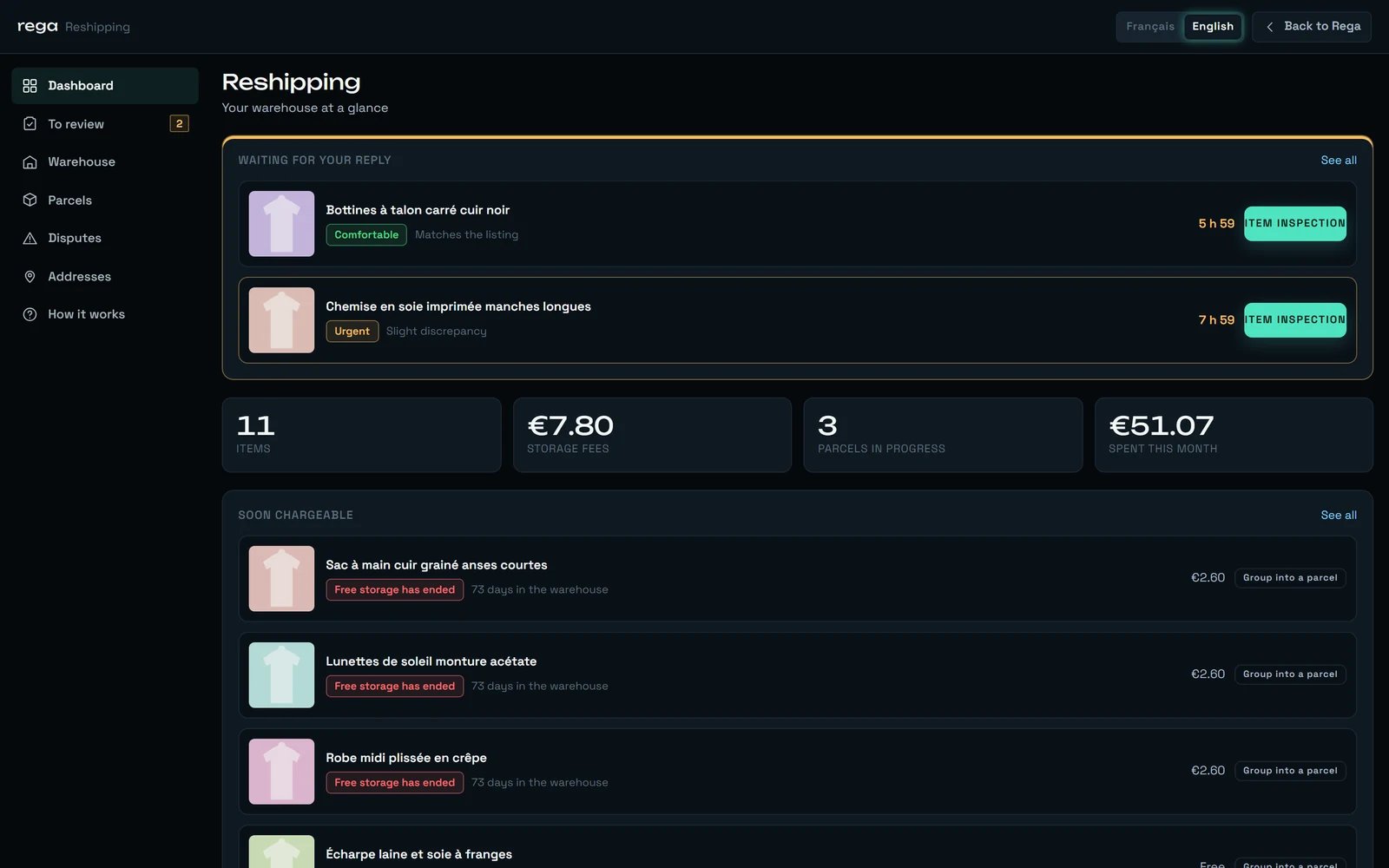
The pieces whose free period ends within fifteen days — and those already past it, marked “Free storage has ended”. Each line carries a “Group into a parcel” button. Empty, it says “No fee so far”
The Warehouse screen’s grouping suggestions
One of the four reasons a suggestion is offered is exactly this: “These items are about to leave free storage.” — with “About {montant} saved” next to it
The dashboard: the “Storage fees” tile among the four, and the “Soon chargeable” block with its “Group into a parcel” buttons.
Sorting by “Storage fees, highest first” is exactly the same order as “Oldest first” — not approximately, exactly. Both read the same date: the day the piece entered stock, or, for one whose inspection is not settled yet, the day it reached us. Pick whichever name matches the question you are asking: age, or cost. With one thing in mind — a piece still waiting on its inspection has no clock at all, so it can head the list and owe nothing.
Storage is the one line of a bill that is entirely in your hands. Four habits keep it at zero, and none of them asks for vigilance.
1
Answer inspections quickly, and know what that starts
Your reply is what sets the clock going. Answering fast does not cost you free days — the days before your reply were never yours to spend — but it does mean you know when the sixty days began.
2
Read the “Soon chargeable” block, not your inbox
It sits on the dashboard. It holds the pieces whose free period ends within fifteen days — and the ones already past it, which show a red “Free storage has ended” instead of a countdown. Each line already carries the button that fixes it: “Group into a parcel”.
3
Take the grouping suggestions offered for this reason
The Warehouse screen proposes groupings for four reasons — they are about to leave free storage, a parcel is already open, they fit in a single box, they are going to the same place — and the first of the four is precisely “These items are about to leave free storage.” Next to it, what the grouping saves you on the consolidation fee alone: “About {montant} saved”.
4
Ship in batches, on a rhythm you choose
Sixty free days is roughly two months of buying. A workspace that ships once a month never sees a storage line at all — and pays the €10.00 consolidation fee once a month, instead of once per find.
You are warned three times before the free period ends — 15 days, 7 days and 1 day ahead of it — by an e-mail titled “Soon chargeable”, whose subject reads Your free storage ends in {jours} day(s).It says: {n} item(s) in your warehouse leave free storage in {jours} day(s). and then “After that, fees accrue per day and per item, and are settled when you ship. Grouping your items now avoids them.” Its button is “See my warehouse”.
The message
When it goes out
What it asks of you
Your free storage ends in {jours} day(s)
15, 7 and 1 day before the end of the free period
Group the item into a parcel and ship it while it is still free
Action needed: “{titre}” is about to leave the warehouse
15, 7 and 1 day before the abandonment threshold
Put it in a parcel and ask for a quote
“{titre}” has left your warehouse
When a person has decided the abandonment
Nothing. It states a fact
Four rules govern those reminders, and all four exist to stop the service becoming noise.
One e-mail per item, not per client. Thirty pieces crossing the 15-day mark on the same day means thirty messages. And each one speaks of a single item: the count inside the sentence always reads 1.
One reminder at a time, the most urgent one due. You will never receive the 15-day and the 7-day notice on the same day. And a milestone already sent is never sent again for the same piece.
A reminder can arrive shortly after the day turns, rather than at the stroke of it. If you are playing a deadline to the day, read the countdown on the item rather than waiting for the letter.
The notices come in two runs, and the stretch between them is silent. Three fall before the free period ends; three more follow the same rhythm — 15 days, 7 days and 1 day — ahead of the abandonment threshold on day 180. In between, while the meter runs, nothing writes to you: the fees are visible on the item, in the warehouse block and on every quote, and a message there would propose no gesture you could not already see.
The bell has a Reshipping tab of its own, carrying seven switches, all on when you arrive — and those are the seven things that ring: inspection to approve, item approved, quote ready to choose, reshipping payment received, parcel shipped or delivered, dispute (opened, deadline, outcome), end of free storage and write-off. Everything else reaches you by letter only, and deliberately so: those are facts you need to learn when you are not in front of the screen. Every person in your workspace receives the letters, each in their own language — and reshipping is the one place in the product where the default, for someone who has never chosen, is English.
No reminder carries an amount. Not the storage warning, not the abandonment notice, not the receipt for a paid parcel. The only figure any e-mail of this service ever contains is the sum obtained when a dispute is won. If you want to know what a piece is costing you, the number lives on the screen, never in your inbox.And there is no e-mail preference here: no unsubscribe link, no per-message switch. The in-app bell has switches by type; the letters do not.
An item held 180 days passes the abandonment threshold. Passing it does not destroy anything: it makes the piece a candidate, and a person then has to decide, and to write down a reason.
1
You are warned in the run-up, three times
Three notices fall before day 180 — 15 days, 7 days and 1 day ahead of it — one milestone at a time, and never twice for the same piece. Nothing has left your warehouse at this point.
2
The message is “Last reminder before abandonment”
“{titre}” has been with us for a long time and is nearing the storage limit. Past that limit, it leaves the stock for good. Then the way out, in the message itself: “To keep it, simply ship it: put it in a parcel and request a quote.” The button is “Ship this item” and it opens that exact piece.
3
The threshold is passed, and it is recorded once
The item is marked as a candidate — once, never repeatedly. Still nothing has left your warehouse: a candidate is a piece somebody now has to look at.
4
A person decides, with a written reason
Abandonment is never a timer. It is a human gesture, and the reason is required — it is written down, and it is what we re-read if you later ask where your goods went. Nothing in the service removes an item from stock on its own.
5
You get “Item abandoned”
“{titre}” passed the storage limit and has been removed from stock. This is final. And, plainly, about the money: “Storage fees accrued up to that date remain payable. Your other items are not affected.”
The abandonment warning gives you no date. It says the limit is near; it does not say how many days are left, and it does not name the day. The deadline you can actually read is on the Warehouse screen, in the storage block, under “Abandonment approaching”: each line shows “in {n} day(s)” or “Deadline passed”, with the help text “Past that deadline the item can no longer be shipped. Create a parcel before then.”
Two more facts about the end of the road:
An item already inside a parcel cannot be abandoned. It has to be taken out of the parcel first — which means a piece you have grouped is, by that fact alone, out of reach of this whole section.
Abandonment is terminal. The state cannot be reopened: the piece has been destroyed or given away, and reopening it would mean nothing physically.
Here is a real bill, with a storage line in it, from end to end. Three items grouped into one parcel. One of them has been with us 75 days, the other two fewer than 60. You ticked three packing options and asked for insurance on a declared value of €207.00. We typed in a Colissimo price of €34.50. No discount. Everything else is at its standard setting.
№
Line
How it is worked out
Amount
1
Shipping
Typed in by us, once the parcel was weighed and measured
Our provider’s cut, worked out so that the sub-total reaches us intact
€2.12
Total to pay
€62.33
Only one of the three items paid storage, and only for fifteen days. The two younger pieces were still inside their free period, so they contributed nothing — and because a line worth zero is not shown, a parcel of items that are all still free carries no storage line at all.Note also what the €10.00 consolidation fee is doing here: it is flat, so those three items shipped separately would have carried it three times, €30.00. That is why waiting and grouping is never the expensive choice, and why an item’s storage is often cheaper than the postage it saves. Consolidation and quotes reads the rest of this bill line by line.
The free clock does not start when your parcel lands
It starts when the inspection is settled — by your reply, or by the deadline passing. Everything before that is on us. Which means a piece that sat in the inspection queue for a week has not used a single one of its free days.
Being inside a parcel does not pause the meter
A parcel being prepared is not a parcel that has left. The item is still on our shelf, and the days still count — right up to the moment a quote freezes the figure. A parcel you build and never pay for holds its items in the meter, not out of it.
Cancelling a parcel does not reset anything
The items go straight back to your warehouse, keeping the entry date they already had. Nothing is lost, and nothing is gained: cancelling and rebuilding a parcel is neither a way of clearing fees nor a way of doubling them.
A closed dispute restarts nothing
A closed dispute puts no counter back to zero. A piece that already had a storage clock keeps that one, and the days it spent under claim count like any others — the counter does not pause during a dispute. A closed dispute only starts a clock for a piece that had never entered stock: that one has no entry date, so the entry date and the free-until date are set at that moment — otherwise it would have stayed free for ever, which is not a rule anyone would have chosen deliberately. That, and only that, is where its sixty free days begin.
Changing the rate card changes what the shelf owes
The rate card applied is the one in force on the day your quote is worked out, and it covers the whole of an item’s stay, days already spent included: bring the free period down from 60 days to 30, and pieces that came in 45 days ago become chargeable that same day. What does not move is an amount already frozen on a quote. The free-storage date shown on an item’s sheet is the one written down the day it entered: it does not move on its own, but it is not a price guarantee. Ship rather than bank on a free window you think you have.
The ceiling arrives before the abandonment threshold
€50.00 is reached on day 178; the abandonment threshold is day 180. So there is a window of two days in which a piece is at its maximum cost and about to be flagged. Nothing about that is dangerous — but it does mean the number stops moving before the item’s stay does, and that a counter which has not changed for a week is not a counter that has broken.
Sorting by fees is sorting by age
Exactly, not roughly — both sorts read the same date, so they cannot produce two different lists. What that date is not, always, is a meter: a piece whose inspection is not settled yet sorts as the oldest thing you own and owes nothing at all.
We can waive storage, and it shows on the quote
A storage amount can be set on a quote as a commercial gesture. When that happens you see it where everything else is: on the quote, as a line, at the amount actually charged. There is no hidden second price list.
A dash is not a zero
“—” means we do not know. “€0.00”, or “Free”, means it genuinely costs nothing. The service never uses one for the other, on this screen or on any other.
We would rather write it here than let you find out halfway through.
The dated abandonment line never shows on a sheet
An item’s sheet has a sentence for it — “Without a shipment before {date}, this item will be treated as abandoned.” — and it does not appear today. The dated warning you can trust is the “Abandonment approaching” block on the Warehouse screen.
“How it works” shows no figures
That page has a slot for the free period, the reply window, quote validity and the abandonment threshold. All four lines are missing at the moment. The figures that are live are the ones on your items, in the warehouse block and on your quotes — and the ones on this page.
No reminder while the meter runs
The notices fall before the end of the free period, then again ahead of the abandonment threshold. In the long stretch between the two, nothing writes to you to say the meter is running. That is deliberate, and it is also why this page exists.
No amount in any message
No e-mail of this service carries a storage figure — not the warning, not the abandonment notice, not the receipt for a paid parcel. Amounts live on screens.
Storage cannot be settled on its own
The only place a storage amount is ever charged is inside a paid parcel’s quote. An abandoned item’s accrued fees are stated as payable in the e-mail, and there is no screen in the service where you could pay them.
No history on an item
An item’s sheet has a “Details” section meant to carry its timeline, and it reads “No tracking yet.” whatever the piece has been through — including the day its clock started. Your record of what happened is the e-mails.
Reminders cannot be turned off
There is no unsubscribe link and no per-message preference in the service. Every person in your workspace receives every letter. Only the in-app bell has switches by type.
Every amount and every threshold here is the setting in force today, and each one is adjustable — including for a single workspace, by agreement. Adjusting one re-counts what is already on the shelf; only a figure already frozen on a quote is out of its reach. None of them was measured on a population of parcels; they are the terms we chose, not an average we observed. Where the product has a figure it cannot compute, it prints a dash rather than a guess, and this page does the same.