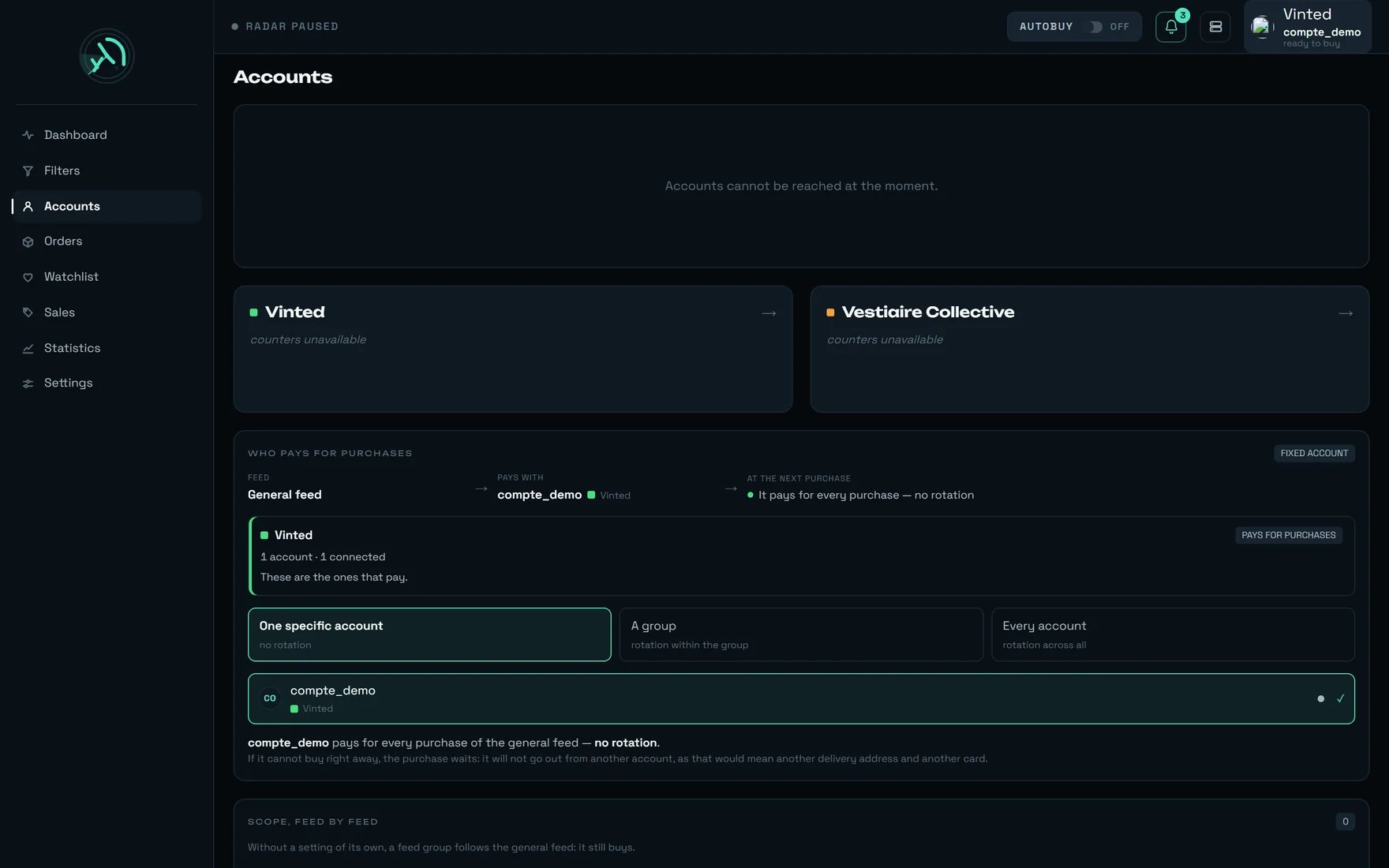
The Accounts screen: the two doors, and below them the WHO PAYS FOR PURCHASES panel.
counters unavailable and the panel Accounts cannot be reached at the moment. sits above them. Nothing is lost, nothing is erased, nothing is written — the “who pays” setting stays readable just below and keeps applying. This is exactly what you should see in that case: never an invented 0 in place of a figure we do not have.What you see
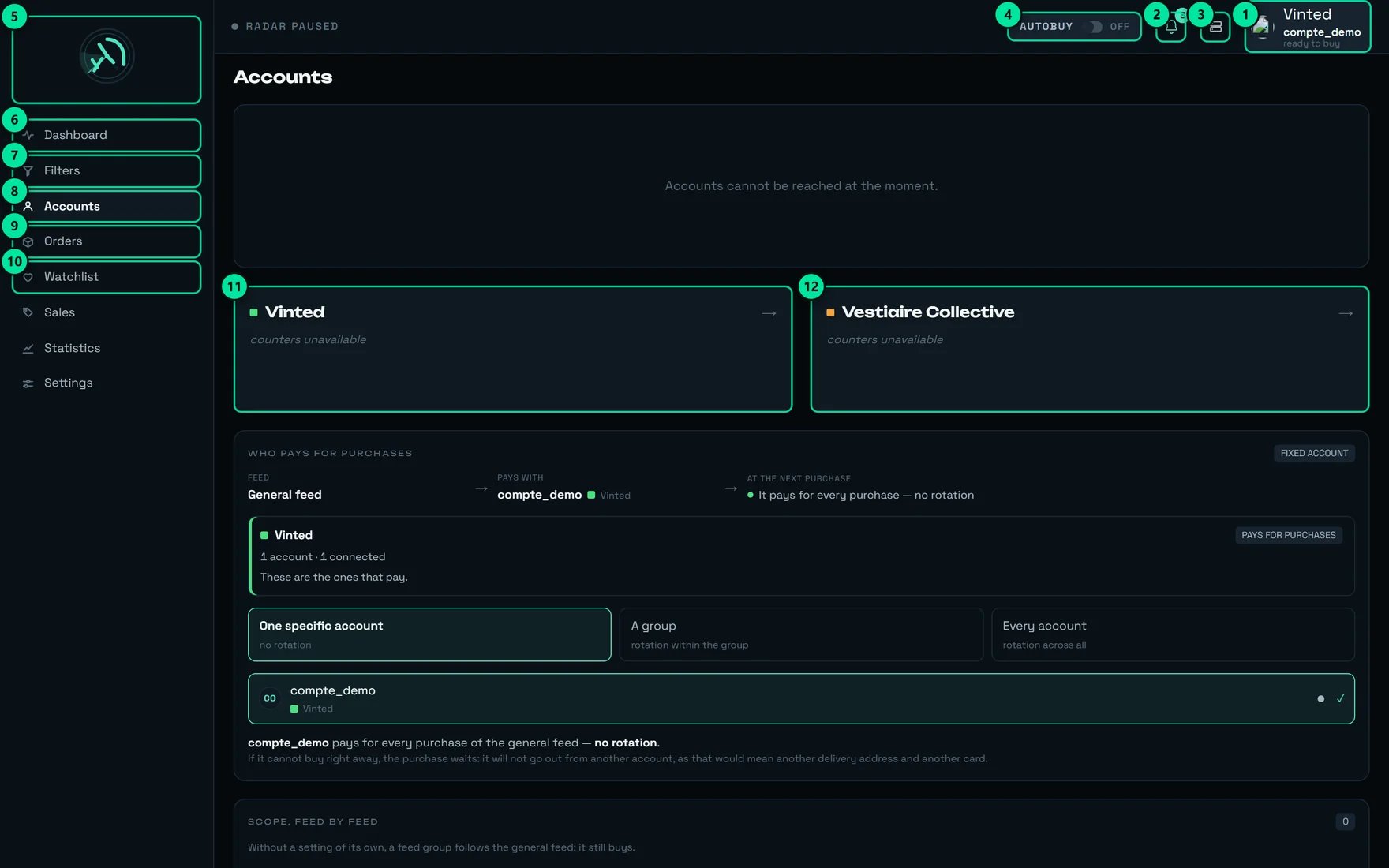
The same controls, numbered.
The three levels of the screen
”WHO PAYS FOR PURCHASES”
The panel reads as a sentence, in three cells:Feed → Pays with → At the next purchase.
On our test account it says: General feed → compte_demo (Vinted) → It pays for every purchase — no rotation, with the FIXED ACCOUNT pill at the top right. When a rotation is in place, the pill becomes ROTATION and the third cell says It pays, then we switch account in 2 purchases or It pays, then we move to the next account. While reading, it says Reading… — never a random account.
The three (or four) modes
Which mode to choose
Open the Accounts screen without going through a door
All marketplaces.Click the mode
Name the account or the group
Nothing has changed yet — choose the account that will pay. (or choose the group that will pay.) with a CANCEL button.Check ORDER OF PLAY
Connected / Disconnected, the ROTATION or NO ROTATION pill, Next: on the one that will pay, and an EXCLUDE button on each line. Excluded accounts stay visible under NOT IN THIS ROUND, with their cause.Only “next” is certain: what follows shifts if an account becomes unavailable at the moment of purchase. The displayed order is an intention, not a promise.The two marketplace cards
PAYS FOR PURCHASESThese are the ones that pay.This card is always shown, even with zero accounts. It then says: No account here — and they are the only ones that can pay today. Connect one from the account list.PAYS FOR PURCHASESThe same badge, and it means the same thing: a Vestiaire account is a payer. On a Vestiaire payer’s line the panel adds what belongs to that marketplace alone: Selectable — at Vestiaire the bank asks you to confirm every purchase: REGA prepares and pays, you confirm.This card too is always shown, even with zero Vestiaire accounts: a card at zero is information, an absent card is a mystery.SWITCH ACCOUNT EVERY … PURCHASES
Left empty, the field follows the general setting and carries the GLOBAL SETTING pill. Filled in, it wins for this scope. Escape restores the previous value, Enter confirms. A value below 1 falls back to the applied value — not a silent refusal, a visible return.
What can refuse a setting
When nobody can pay
The panel does not merely announceNo purchase will go out: it names the cause and the gesture. Seven distinct admissions exist.
No account is connected.
No account is connected.
Connect an account from the account list, then come back to choose who pays.None of your accounts buys on this feed's marketplace (…).
None of your accounts buys on this feed's marketplace (…).
Connect an account for that marketplace from the account list. The cause is no longer “your accounts are Vestiaire accounts”: it is “none of your accounts belongs to the marketplace of this feed” — and the gesture follows it, since telling you to connect a Vinted account would be wrong on a Vestiaire feed.The chosen group holds no account able to pay.
The chosen group holds no account able to pay.
Add an account to it in the left-hand column, or choose another group.Every account in this round is excluded.
Every account in this round is excluded.
Put one back in the round, below — an excluded account stays visible, struck through.No account in this round is connected.
No account in this round is connected.
Reconnect an account from the account list.“…” cannot pay at the moment.
“…” cannot pay at the moment.
Reconnect this account, or name another one below.No account can pay with this setting.
No account can pay with this setting.
Change the setting below, or reconnect an account.SCOPE, FEED BY FEED
One line per feed group, expandable, only one open at a time. Without a setting of its own, a feed group carries the INHERITS pill and the note Without a setting of its own, a feed group follows the general feed: it still buys. At zero: No feed group. Every feed pays with the general feed's scope.
The badge on the Filters screen lands directly here and expands the targeted line — you do not have to hunt for it.
The left-hand column: accounts and groups
Once a door is open, the list takes the left and the account page the right.SMS code expected · Connecting… · Connected · Last connection failed · No password · Disconnected. Hovering shows the masked address, never the whole one. No password is the ordinary state of one of your accounts once its connection has expired — not a fault: see “When the connection has expired”, further down.
A group header carries its colour, its name, its count, and the ACTIVE SCOPE pill, whose tooltip lists the feeds actually paid for (Buying scope of: …). Its second line says 2 connected, or, if none is: No account connected — this group will buy nothing, followed by · last used: …. The ⋯ menu offers Edit the group (Name, colour, rotation and accounts) and Delete the group, whose tooltip reassures: The accounts are not deleted.
A group gathers accounts in an ORDER. Deleting a group deletes no account. — and for Vinted it adds: It pays nothing until a buying scope designates it — that is set at the top of this screen, under “who pays for the purchases”. A group without the ACTIVE SCOPE badge is decorative. On the Vestiaire side the same window says instead: It only holds Vestiaire accounts. — a group’s marketplace is fixed when it is created, and a mixed group is refused by the server, not merely by the screen.The Group window, in detail
The Group window, in detail
Accent · Soft · Neutral · Subtle — four intensities, never colours), a Rotation between the accounts of this group toggle, a Change account after N purchases — default value field, and the ACCOUNTS OF THE GROUP — ROTATION ORDER list with its arrows and the BUYING pill.The toggle explains itself: rotation on, When a buying scope designates this group, purchases move from one account to the next, in the order below.; rotation off, … purchases always start from the first available account — without rotating.Two notes worth reading: A disconnected account is skipped without shifting the others and Excluding an account for a single feed is done in the buying scope: removing it here would remove it for every feed.⚠️ The Change account after N purchases field in this window is global, not specific to the group: 1 = next account on every purchase. A scope that sets its own overrides this one. It is saved separately from the SAVE button, and the screen re-reads what the server kept: Value not kept — we keep 2.What the left-hand column can refuse
What the left-hand column can refuse
Deletion refused. Otherwise Group deleted — … · the accounts are kept.· A group with no connected member says so in its own window: None of these accounts is connected: as it stands, this group will buy nothing.· Search with no result: No account matches. Empty list: No account. Add one to get started.Adding a Vinted account
TheAdd an account window opens from + ACCOUNT, at the bottom of the list — or from the Add an account button of the starting frame, when you have no account yet. It has two paths, chosen with two chips at the top: Password and Vinted token. It opens on Password. Switching chip also clears any refusal still on show, so a sentence left by the path you have just left cannot read as a verdict on the one you have just chosen. If this is your first minutes in the product, The first ten minutes walks the whole sequence; this section is the reference for each screen of it.
By password, then the SMS code
Fill in E-MAIL ADDRESS and PASSWORD, then ADD AND CONNECT
[email protected]), not a username. SHOW / HIDE reveals the password while you type, and Enter in the password field does the same as the button. The note at the bottom says what comes next: Vinted will then send a code by SMS, to be entered on the page that opens right after. There is no market to choose on this path: a United Kingdom account is entered in the same window, with nothing to change.Read the window while it waits — it names each step
CONNECTING… and a line under the title says where the connection stands, in the same words as the account page: Saving the account…, then Preparing the connection… · Connecting to Vinted… · Vinted security check… · Finalising…. The window waits up to 90 seconds and does not close on its own. Accepted: the toast … — credentials accepted, enter the code received by SMS, the window closes and the account page opens. Beyond 90 seconds: … — the connection is taking longer than expected, the rest is on its page.Enter the SMS code on the account page
CONNECTION panel shows the four-step strip — Preparation · Check · SMS code · Connected — with a ✓ on the steps already done, and the line Vinted has sent a code by SMS. Under it, where to look: Code sent to …. with the number as Vinted masks it, or The code arrives on the phone linked to the account. Type the digits in CODE RECEIVED BY SMS (digits only, Enter submits) and press SUBMIT, which reads SENDING… while it goes. Then Code sent — …, and the strip reaches Connected.Next to the field, New code possible in … counts down the delay Vinted imposes, then gives way to RESTART — NEW CODE. The code is expected for about six minutes. After that, the page reads A confirmation code is expected for this account. and the connection has to be started again — from the RESUME THE CONNECTION block described further down.Name it straight away
Name this account → This name replaces the address everywhere in rega — lists, groups, messages. It stays with you: the Vinted account is not modified. A button offers Use the Vinted username “…”.By token — or, better, by the full cookie export
TheVinted token chip is the path for the day the password is refused. Its subtitle says why it cannot be: If signing in with a password is refused, paste the token of a Vinted account already signed in to your browser. No sign-in is attempted, so nothing can be refused.
When the connection has expired
Because your password is not kept, an expired connection needs you — and the screen was built for that, not as an error.- In the list, the line reads
No password. That is the ordinary state of one of your accounts once its connection has expired — not a fault, and not theDisconnectedyou might expect: it says exactly why rega could not reconnect it alone. - On the page, the state next to the name says
Disconnected, theCONNECTIONpanel saysAccount disconnected., and the rest of the page is bare:Connect this account to see its profile, its address, its payment methods and its pickup points. The connection needs a code sent by SMS. - The
RESUME THE CONNECTIONblock sits in that panel: theVinted passwordfield, theRECONNECTbutton (CONNECTING…while it goes) and the noteYour Vinted password is not kept: it is used to open the connection, then forgotten. Vinted will then send a code by SMS.Enterin the field does the same as the button; an empty field answersEnter the password of the Vinted account. Then Vinted sends a code, and the SMS step is the one described above. - The
CONNECTbutton in the header first tries to reopen the saved connection without you —Reconnecting without retyping…— and when that is enough, the panel readsConnected.When it is not, it readsYour sign-in has expired. Enter your Vinted password again to reconnect this account.and the block above is the way forward. The toasts:Connection started — …orConnection already under way — …. Check the connection, shown instead ofCONNECTwhen the account is connected, checks the saved connection:Reconnected — …orNothing to resume — … was not connected.- The
⋯menu (Other actions):Name this account·Reload this account·Resume the saved connection·Sign out(answersDisconnected — …) ·Remove this account from rega(Account removed — …; on an account set up by REGA:This account was set up for you — write to us to remove it).
What the window and the page can answer
Every sentence below is served in your language, except the two flagged as French only. The product-wide list lives in When something refuses. The password path, in the window:RESTART — NEW CODE is not a promise of a new SMS. It starts the connection again from the page and answers Connection restarted — …. Whether Vinted sends a second message while the first code is still expected is not something we have measured: wait for the countdown, read the page, and once the six minutes are over the page asks for your password again.
Several discs laid flat, and only one of them ringed. A list of accounts holds together the same way: they are all yours, and one of them is designated.
An account page
As long as the account is not connected, the page is deliberately bare:Connect this account to see its profile, its address, its payment methods and its pickup points. The connection needs a code sent by SMS.
The “Ready to buy” strip — the five points
It is the most useful summary on the screen, and it is immediate: it makes do with what the page already shows.Ready to buy, Ready to buy — one setting could still be improved and 2 things to sort out before buying. The subtitle settles it, and that is the line to read: A purchase started from the radar will go through to payment. or A purchase would stop before payment.
Where each of the five points falls during a purchase
The panels, one by one
- Address
- Card
- Dry run
- Delivery and phone
- Favourites
Replace my address — never “edit”, because Vinted offers no way to edit or delete an address: Saved on your Vinted account, it will be used for all your orders. Vinted does not allow it to be edited: this one replaces the previous.The window works in two steps: Check first — Have Vinted check the address first — checking writes nothing. — then REPLACE. Any edit cancels the check you had obtained.The refusals, word for word: Check the address first — checking writes nothing · Incomplete address — street, postcode and city · Address refused by Vinted · Replacement refused.Without an address: No address saved on this account. A purchase cannot go through without one.VINTED PROFILE and ACCOUNT TRUST complete the page: username, name, location, member since, items for sale, followers on one side; a score out of 100 with RATING PUBLISHED BY VINTED and WHAT MAKES UP THE SCORE on the other. The score is an in-house indicator: Vinted publishes none.WHERE YOU COLLECT YOUR PARCELS
This is the panel that saves time on every purchase — and the one everybody gets wrong.
The summary announces 2 carriers ready out of 3 (or No carrier ready for the moment), then puts a figure on the cost: A pickup point will be chosen during the purchase, the closest to your address. It works, but it costs 1.3 s on every purchase. And it names the real decider: It is the seller who chooses the carrier, not you: as long as MONDIAL is not ready, those purchases will take 1.3 s longer. When everything is covered: — and they are all ready: no purchase will pay the pickup point step.
The life of a pickup point
PREPARE THIS CARRIER — the only window in the product that spends
It is optional. Without preparation, the purchase still goes through — it is simply ~1.3 s slower on items shipped by that carrier.
The map and the ranking
The map shows the points found around your address, with the legendThe cross ✛ is your delivery address. Points without an exact position do not disappear: they stay in the list below. If the address could not be located, nothing is approximated: We could not locate this account's address. No pick-up point is offered: showing none is better than offering points in another town.
Below the map, YOUR PICKUP POINTS, IN ORDER: a ranking you move up, move down, remove, with PREFER THIS POINT on a point’s panel. And if this point is closed? unfolds the chain of fallbacks, each with its reason (used if the previous one does not suit).
REVIEW THE NEARBY POINTS returns Pickup points refreshed — 12 found or Pickup points already up to date: it takes a fresh look around your address, and it opens no order with a seller. A list refreshed within the last few hours is left as it is — clicking again will change nothing for several hours.
The three ceilings — and which one applies
None of them is set on this screen, but all of them decide the fate of a purchase going out from one of your accounts.Settings
Purchase ceiling, Automatic pick-up point, Which point, the two-step cancel confirmation.Filters
Orders
Your Vestiaire accounts
The Vestiaire Collective door
There is noVestiaire entry in the menu, and none is coming: the marketplace lives inside the screens you already use — its detections in the feed, its filters in the filter list, its items in the watchlist and in the sales. Accounts is the one place where the two are kept apart, and the reason is written into the product: a group of accounts exists to take turns, and taking turns between Vinted and Vestiaire makes no sense — not the same listings, not the same basket, not the same payment.
The Vestiaire door opens a list and account pages with six rows: CONNECTION · PROFILE · MY VESTIAIRE ACCOUNT · ADDRESS BOOK · PAYMENT METHODS · DELIVERY, plus the pickup points.
Accounts in the menu — on a phone, under More — then the Vestiaire Collective door. To come back out, ← All marketplaces, at the top of the list. The open marketplace lives in the page and not in the address: no link opens the Vestiaire side directly, and nothing is read for a marketplace until you push its door.Connecting an account: three fields, and no code
Push the door, then + ACCOUNT
Connect a Vestiaire Collective account, and its button.Fill in the Add a Vestiaire account window
ACCOUNT NAME (optional) (Main buying, Backup…), E-MAIL ADDRESS, and PASSWORD with its HIDE / SHOW toggle. Then ADD AND CONNECT, which becomes CONNECTING….Read the verdict in the window itself
Address required. · Password required. · Adding refused, and the field at fault is pointed at. On success, Account added and connected — …, the list is read again, and the new account’s page opens.What the list and the page say
The health strip — the five points
The page opens on a strip that has no equivalent on the Vinted side, computed by our servers and never recomputed in the browser:This account can buy or This account will not buy, with Everything is in place: address, card, delivery method., Everything is in place. One point needs watching., or One thing is missing: …. Before anything has been read it says Account not checked yet and Run a check to find out what is missing.; the button is Check again.
Ready · To watch · Missing, sometimes followed by Inferred from what we knew — not checked again. This account can buy is an AND over the five points, decided by the server: a strip missing a point never passes for complete.
Five things this page does differently
Removing an account asks nothing
Removing an account asks nothing
Remove this account from rega, in the More actions menu, removes it straight away — no confirmation window, no second click. If what you want is to stop it buying without losing it, use Set this account aside (It stays on record but will not be used for any purchase) and, later, Reactivate this account. The SET ASIDE pill then sits on the page.rega never needs your card number
rega never needs your card number
A card is saved with Vestiaire at the first purchase: rega presents it at payment, then Vestiaire keeps it and shows it here. What rega keeps is the security code alone, encrypted, because Vestiaire asks for it at every payment. Without a card at all, the panel is blunt: Until a card is on record, this account detects items but cannot buy anything.The pick-up point map needs a full basket
The pick-up point map needs a full basket
Vestiaire only shows its pick-up points during an order: this map stays empty until an item is in the basket. To draw it, rega puts one item from your Vestiaire feed into the basket, reads the points offered, then empties the basket — on its own, when the panel opens. Nothing is bought.Ranking a point is not choosing it
Ranking a point is not choosing it
DELIVERED HERE. Only the second decides where the parcels arrive. And if you change the delivery address, the points ranked for the old one go stale — Vestiaire would accept them as they stand, and the parcel would go to the wrong town.Three panels are missing on purpose
Three panels are missing on purpose
Your Vestiaire accounts
Buying on Vestiaire
The states of the screen
Our advice
2 · For a drop, do not stay onOne specific account. That mode will never go looking for another account, even a busy one: the purchase waits, because changing account would change the delivery address and the card. A group or Every account absorbs bursts. Keep One specific account for what it is really for: an order that must arrive at one precise address.
3 · Trust ACTIVE SCOPE, not the group’s “rotation” toggle. A group can have its rotation armed and pay for nothing at all. The only reliable signal is the ACTIVE SCOPE badge, whose tooltip lists the feeds actually paid for. A group without that badge is decorative.
4 · Walk through your account pages before a big day, and aim for Ready to buy everywhere. The five points on the strip are exactly what a purchase checks. A 2 things to sort out before buying left as is means an account that will fail mid-race, on an item the radar had found for you.
5 · Make your card the default ON VINTED rather than imposing it here. A SELECTED card that differs from Vinted’s default card slows down every purchase. The panel flags it, but it cannot fix it for you — the change is made on Vinted, in one gesture, once and for all.
6 · Put a delivery number on every buying account, once and for all. Some carriers require it, and without it the purchase is refused cleanly — not a penny lost, but the item has gone to somebody else. Since rega can only save it on a purchase already open, the simplest route is to set it directly on Vinted, once per account.
7 · Budget carrier preparation as an investment, and aim for coverage. Of the order of 8 € per carrier and per buying account, across the three carriers targeted out of the box. What you need is not a perfect carrier: it is the share of your purchases that is covered, since the seller is the one who chooses.
8 · Rank your pickup points BEFORE an account’s first purchase. The ranking steers the point Vinted will keep; it never overwrites a point already kept. Set too late, it only takes effect at the next purchase through that carrier — which may be several days away.
9 · Maintain nothing. A kept point holds for days on end without a single gesture, and a dry run changes nothing about that. Re-running trials “to keep it warm” only opens pointless orders with real sellers.
10 · Name your accounts as you add them. On a purchase line, in a group, in a message, that name is what tells you which address the parcel is heading to. A name like Main buyer or Backup beats a thousand masked addresses.
11 · Do not delete a banned account — exclude it. A banned account can still browse Vinted; it can no longer buy, and a ban can be lifted. EXCLUDE in ORDER OF PLAY is enough: the account stays in place, ready to take its turn again.
12 · After a refused addition, click Remove this account. The account is saved before the password is tested: closing the window leaves a dead line in your list, and the clean gesture is no longer one click away. On the Vestiaire side there is nothing to clean up — a refused addition writes nothing at all.
13 · Watch the renewal date on every Vestiaire account. Connection to be renewed before … is the only warning you get: nothing renews itself on that marketplace, and the day it passes, buying stops dead. Reconnect a few days early rather than on the day, and prefer an account that reads yes — password on record, so it can come back without you.
14 · Never leave a Vestiaire account retrying refused credentials. rega sets it aside itself, and says why: retrying every ten minutes is the surest way to get the account locked. Correct the password, reconnect once, and check that the health strip turns to This account can buy.
15 · On the token path, paste the whole cookie table rather than the bare token. The field accepts both, and the screen only describes the second. A bare token expires after about two hours and nothing renews it; the full export carries the renewal token, and the account then stays connected on its own — no SMS code, no password to type again.
What surprises people
“INHERITS” does not mean “buys nothing”
“INHERITS” does not mean “buys nothing”
This feed has no scope of its own: its purchases go out with the general feed's. The two notions were deliberately kept apart — merging them would suggest a purchase that will never go out.A Vestiaire account pays — but only for Vestiaire feeds
A Vestiaire account pays — but only for Vestiaire feeds
PAYS FOR PURCHASES badge. What it cannot do is pay for another marketplace’s listings: This is a Vestiaire Collective account: it cannot pay for this feed's listings. The refusal is about the gap between the account’s marketplace and the feed’s, not about Vestiaire.Every Vestiaire purchase ends with your bank
Every Vestiaire purchase ends with your bank
“Last used” disappears when the page reloads
“Last used” disappears when the page reloads
An avatar shown as initials is normal
An avatar shown as initials is normal
A card's expiry date is never shown
A card's expiry date is never shown
REVIEW THE NEARBY POINTS may change nothing
REVIEW THE NEARBY POINTS may change nothing
Pickup points already up to date, and that is not a fault — come back later rather than clicking again. And on an account where the reading is not possible, it is refused and says so.A carrier can be missing from the map while still being offered by the seller
A carrier can be missing from the map while still being offered by the seller
“Preferred according to Vinted” does not exist
“Preferred according to Vinted” does not exist
The account preselected on opening is not necessarily the first in the list
The account preselected on opening is not necessarily the first in the list
The screen beats fast, then calms down
The screen beats fast, then calms down
Adding an account to a group puts it at the END of the rotation
Adding an account to a group puts it at the END of the rotation
(at the end of the rotation). To move it up, go through Edit the group and the Move up in the rotation order arrows.Renaming an account does not touch Vinted
Renaming an account does not touch Vinted
Without a name, the account is shown with its Vinted username, and failing that with its address.A group can hold a member rega no longer knows
A group can hold a member rega no longer knows
The search field only appears at the 5th account
The search field only appears at the 5th account
On the phone
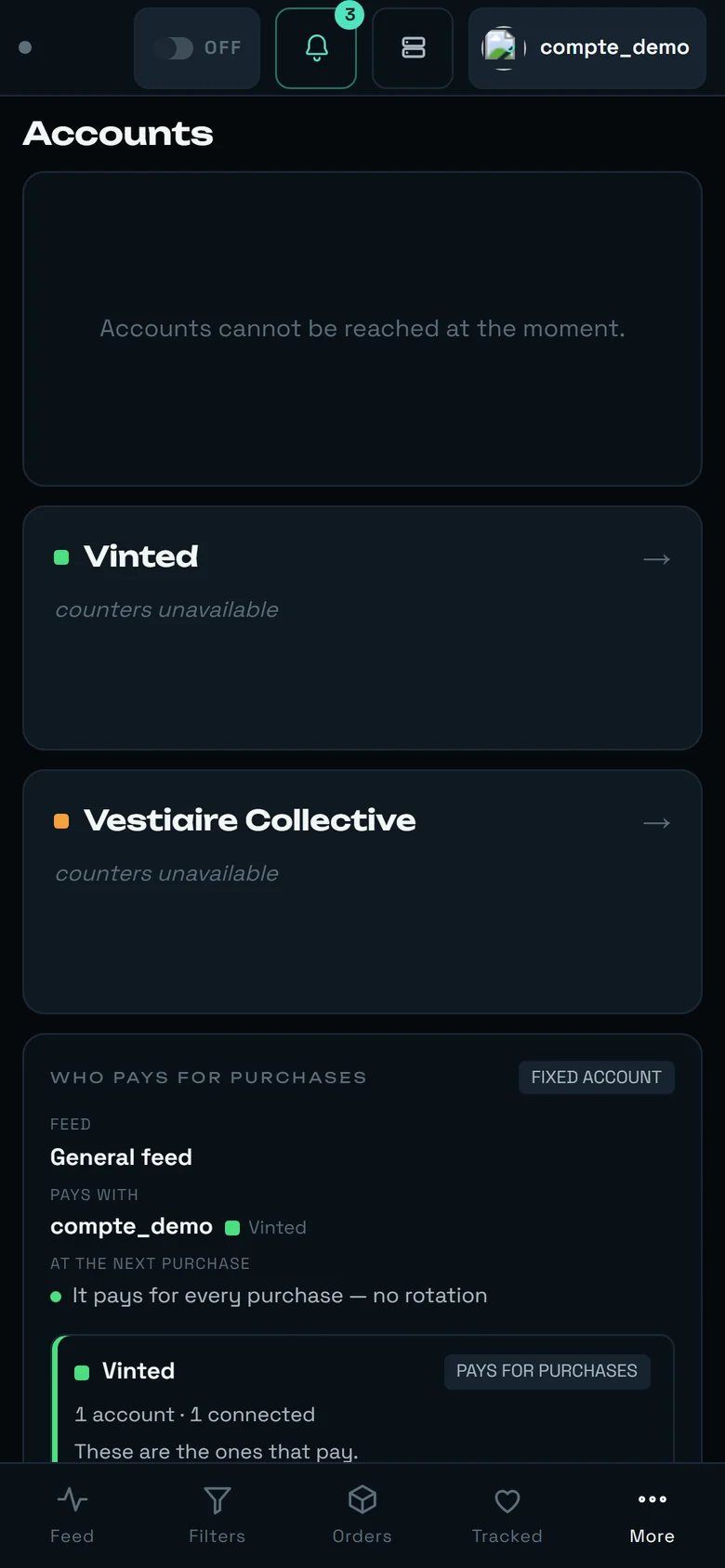
The Accounts screen on a phone: the doors stack, and the “who pays” sentence reads line by line.
- One column at a time. Below 900 px, the list and the account page no longer sit side by side: the
Back to the listarrow, at the top of the page, is the only way back. - The scope sentence goes vertical:
FEED, thenPAYS WITH, thenAT THE NEXT PURCHASE, one under the other. It reads just as well, it simply takes three lines. - Below 600 px, fields and buttons go full width, one setting per line.
- Everything that acts is at least 44 px tall — including the arrows of the pickup point ranking.
- The bottom bar replaces the left-hand navigation:
Feed·Filters·Orders·Tracked·More.Accountssits underMore. - The
Vestiaire Collectivedoor behaves the same way: its list and its account pages do not sit side by side either, andBack to the listis the way out of a Vestiaire page. - The pickup point map stays usable, but ranking is markedly more comfortable on a large screen: that is the gesture to do at the desk.
The limits, said plainly
- The Vestiaire card of
WHO PAYS FOR PURCHASEScontradicts itself. It carries thePAYS FOR PURCHASESbadge — which is right — and, just below it, an older line saying the payment is not wired yet — which is not. A Vestiaire account pays; we write it here because the screen has not been cleaned up yet. - A Vestiaire purchase always ends with your bank. The card’s issuer challenges every time, measured four times out of four. rega goes all the way to the payment; the confirmation is yours to give, and no setting removes that step.
- Removing a Vestiaire account asks for no confirmation. One click in
More actionsand it is gone.Set this account asideis the reversible gesture. - The empty Vestiaire frame explains nothing. Where the Vinted one tells you what the account will be for, the Vestiaire one carries only
Connect a Vestiaire Collective accountand its button. - There is no card form, and there will not be one. A card is added on Vinted, where your bank validates it.
- A Vinted address can neither be edited nor deleted — Vinted does not offer it.
Replace my addressis the only possible model. - The
ACCOUNT TRUSTscore is an in-house indicator. Vinted publishes no trust score; this one is computed from public feedback, verifications and the standing of the account. Its labels are not translated yet. - No direct link to a marketplace or to an account page. The screen holds the open marketplace in the page, not in the address: you cannot bookmark “that account’s page”.
- On the Vestiaire page, every point of the health strip shows
Fix →— the short label proper to each point is not served yet. - The
Add an accountwindow claims to keep your credentials. Its opening sentence on thePasswordpath saysrega keeps them to reconnect on its own when the session ends; for an account you connect yourself, it does not. The account page has the right sentence, and an expired connection asks for your password again. - The token path’s help line only describes the bare token. It sends you to copy the value that starts with
ey…, which lives about two hours; the field also takes the full cookie export, which is the thing to paste, and the screen does not say so. - Two refusals of the password path are served in French only. An account already connected on another workspace, and an account that could not be attached to yours, are announced in French whatever your language — the token path carries both in English.